Seasonal Fishing: The Complete Fish Movement Guide
Ask ten anglers where the fish are, and you will get ten answers. Ask again in three months, and most of those answers change. That is seasonal fishing: fish are rarely in the same place twice, and the angler who understands the movement wins more trips than the one with better gear.
This guide walks through the seasonal fish movement patterns of the most common North American gamefish, explains what triggers each shift, and gives you a simple system for finding fish in any month.
Fish Migration Patterns: The Three Triggers
Fish do not move by accident. Three forces drive almost every seasonal migration pattern, and they often work together.
Water temperature is the master switch. Fish are cold-blooded, so their body temperature — and their activity level — tracks the water around them. Metabolism roughly halves in winter cold, which is why fish feed less and move slower. In spring, warming water pulls fish out of deep winter holding spots toward the shallows. In summer, hot water pushes them back down. Every species has a comfort band, and much of the year is spent moving to stay inside it.
Forage movement is the second trigger. Gamefish follow food. When shad, alewives, or other baitfish shift depth or migrate into the shallows, the predators follow within days. Watch the bait, and you have already found the bass. These fish migration patterns repeat every year, which is what makes them so reliable to fish.
Spawning instinct is the third. Photoperiod and temperature together flip a hardwired switch that sends fish into tributaries, onto gravel reefs, or into weed-choked bays — often miles from where they spent the winter. The spring migration is really a spawning migration, and it happens earlier in the South and later up north.
Spring: The Shallow-Water Migration
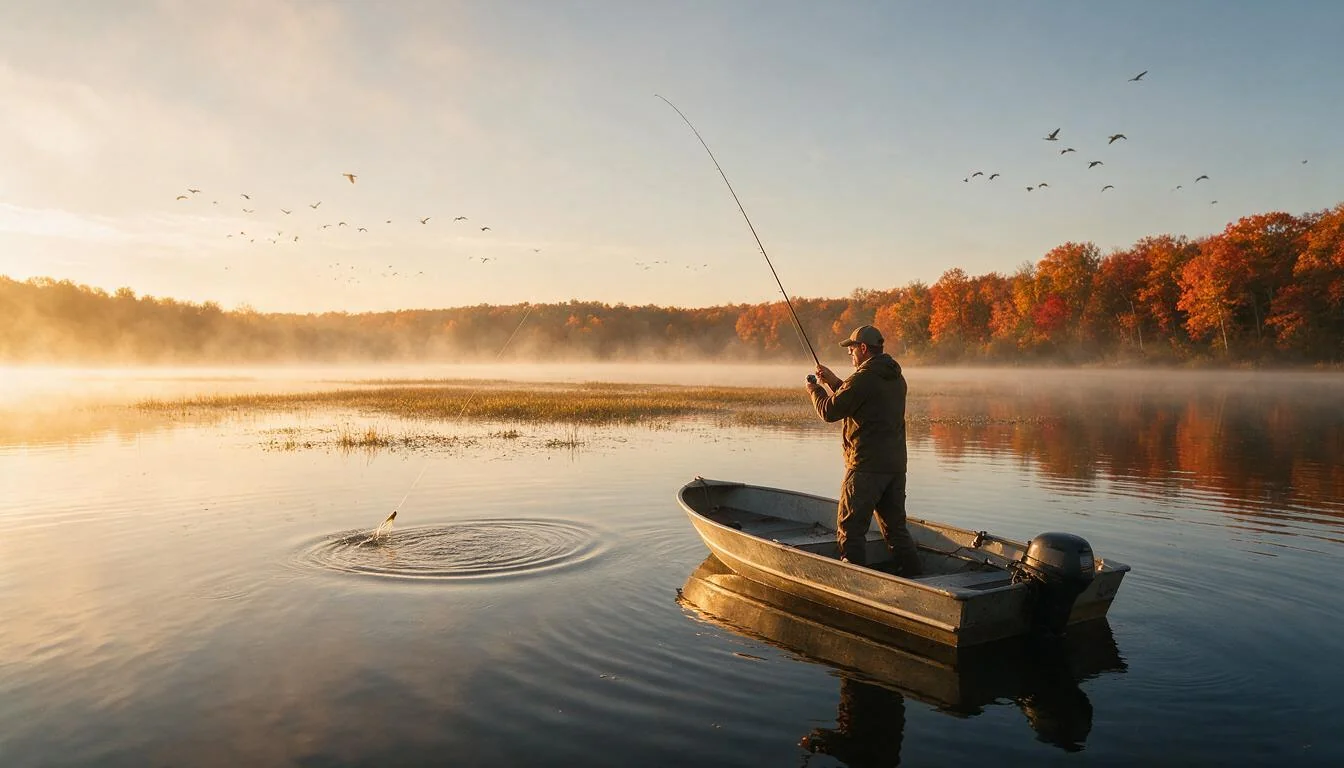
The most dramatic fish movement of the year happens in spring, when ice goes out and water temperatures climb through the 40s and 50s. Fish that spent months in deep winter basins suddenly appear in 2 to 6 feet of water.
This is the classic "fish the flats" season — our spring fishing guide breaks down the pre-spawn, spawn, and post-spawn windows in detail.
The timing is driven by species, not the calendar. Largemouth bass stage near spawning flats when water hits the mid-40s, then move in to build nests once it passes about 60°F, peaking at 62-65°F. Crappie colony-nest in 1 to 6 feet at 55-65°F — early February in the South, late May into June in the North.
Walleye run up tributary riffles and over gravel reefs in April at 40-55°F. Northern pike spawn almost immediately after ice-out at 40-52°F in shallow weedy bays. Yellow perch string their gelatinous egg ribbons in 44-52°F water along shore.
The pattern repeats everywhere: shallow water warms first, so shallow water feeds first. If you want the first aggressive bite of the year, fish the warmest, shallowest cover you can reach in late afternoon.
Summer: Deep Water, Low Light & the Thermocline
By June, the game inverts. Surface water in lakes and reservoirs climbs past 70°F, and fish that loved the flats in May retreat to comfort.
Deep lakes stratify into layers, with a thermocline separating warm, oxygen-rich surface water from cooler depths. Below the thermocline, oxygen can run out; above it, water gets uncomfortably warm. Fish stack in the narrow band in between — usually 10 to 25 feet down in most northern lakes, deeper in the South.
That is where the "fish the deep holes" rule of summer comes from. Walleye spend the day at 15 to 35 feet on structure, then invade shallow flats at night. Pike slide out to weedlines at 8 to 20 feet. Crappie suspend at 15 to 30 feet near deep brush.
Largemouth bass still roam, but they do their best work at dawn and dusk on topwater, then drop to shaded structure through the middle of the day.
The exceptions are the night feeders. Channel catfish, walleye, and big bass all prowl shallow water after dark, when the surface cools a few degrees. A summer fishing pattern built around first light, last light, and darkness consistently beats a full day on the water.
Fall: The Feeding Frenzy & the Shad Migration
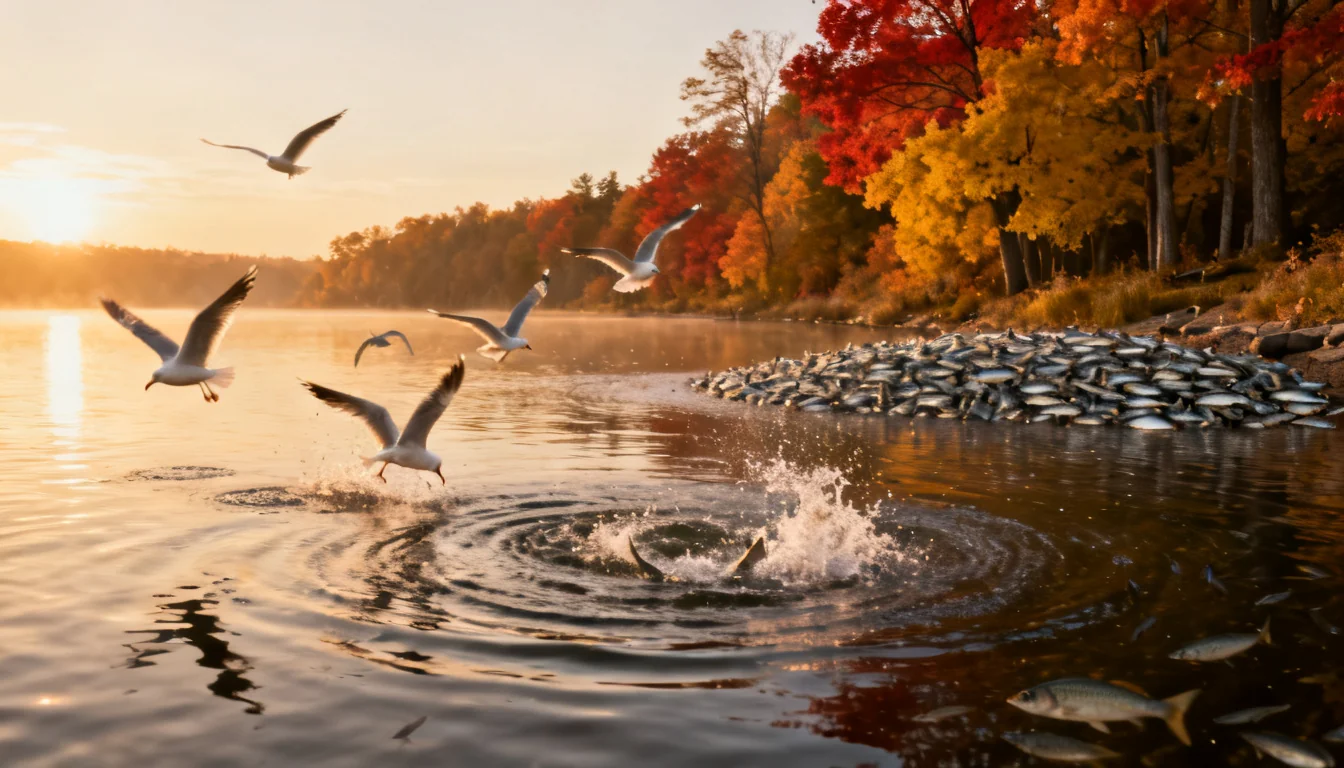
Fall is the reward season. As lakes "turn over" — the 39°F water of maximum density mixes the whole column, collapsing the thermocline — fish suddenly have the entire lake available. Baitfish like shad school up and push into the shallows, and every predator from bass to walleye to pike goes on a feeding binge to fatten up for winter.
This is the season of the surface bite and the shallow bite. Watch for busting shad, diving birds, and shoreline bait balls in the morning; the big fish will be underneath or just behind them.
Northern pike, walleye, and largemouth all make their best big-fish showing of the year in fall — often the same shallow flats and weed edges they used in spring, but now loaded with bait instead of nests. The fall fishing guide covers the timing of this window in detail.
Some movement also starts for next year. Brown trout run up streams to spawn from October through December when water drops into the mid-40s, often feeding at night on the way. Rainbow trout stage their own spring runs, but fall is when big browns become reachable.
Winter: Slow, Deep and Close to the Bottom
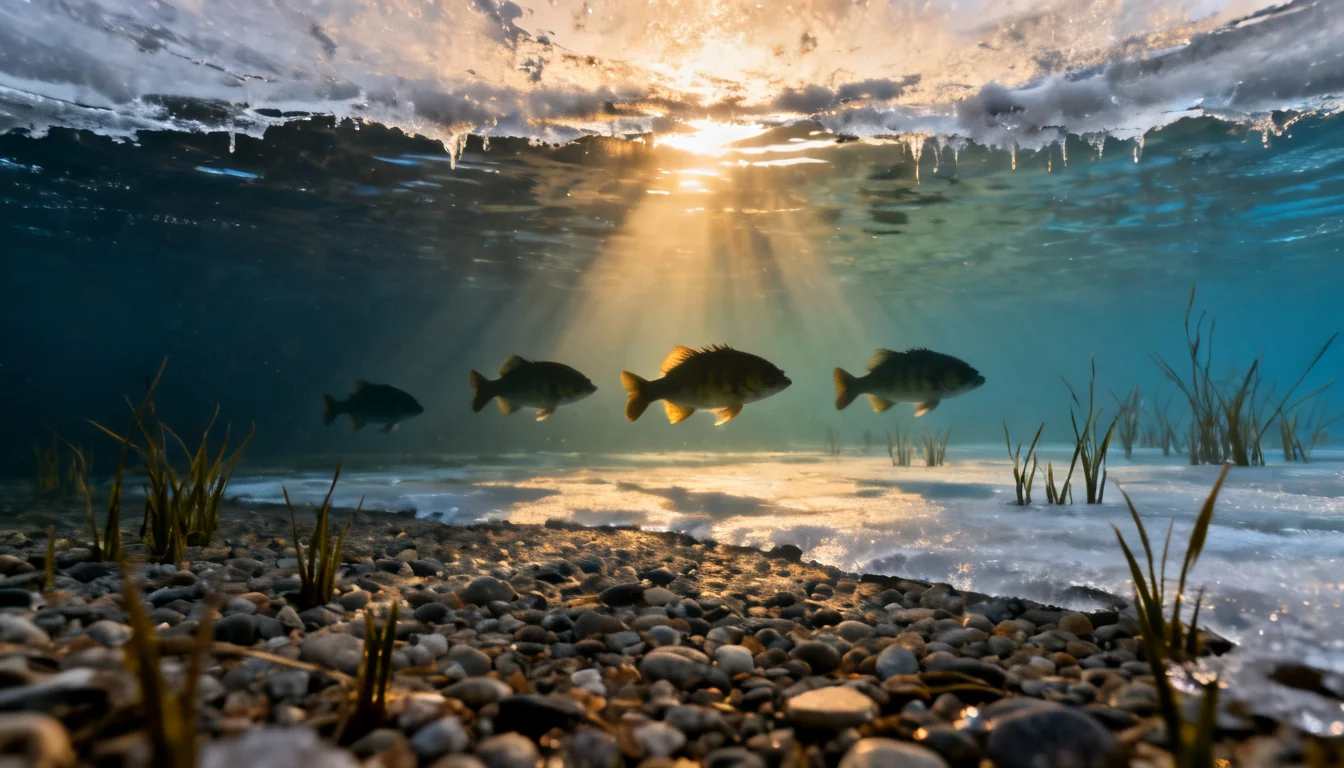
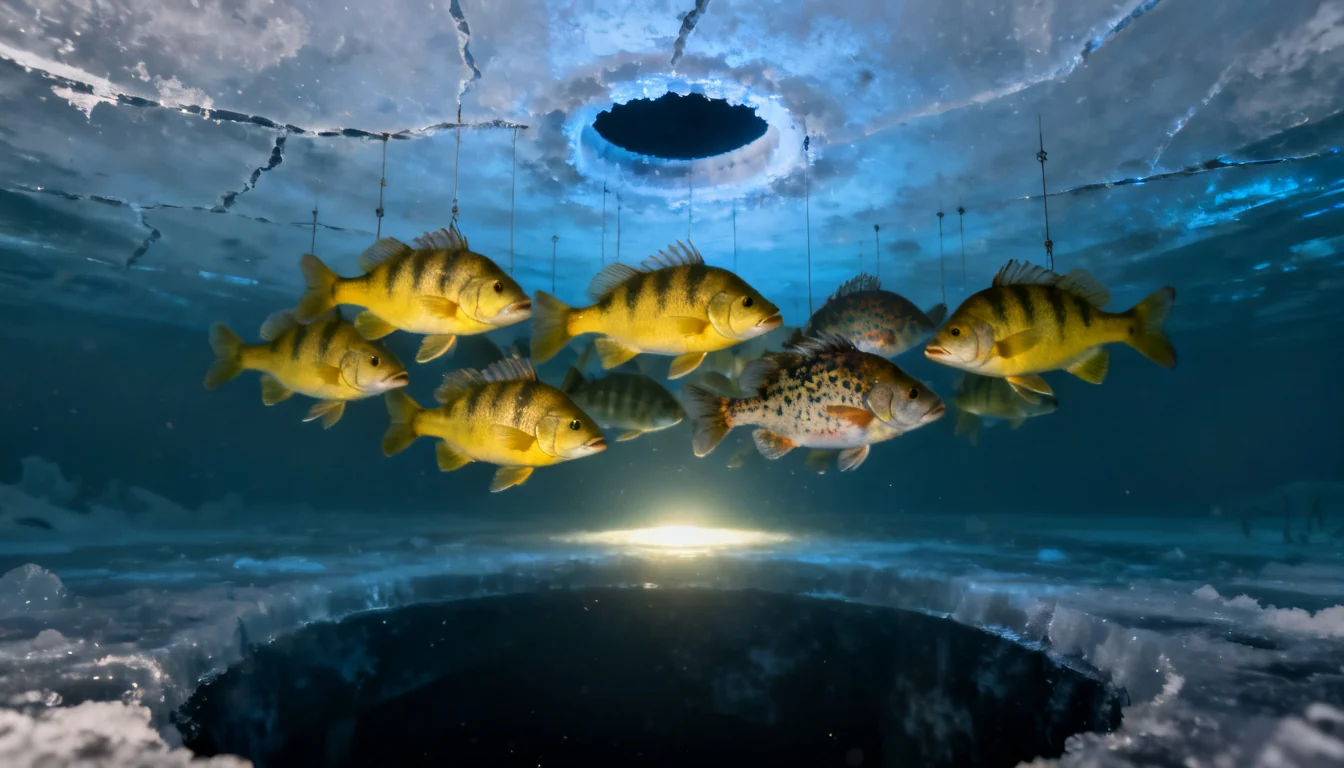
When the water plunges into the 30s, the movement does not stop — it just slows way down. Metabolism drops, feeding windows shrink, and fish pull into the deepest, most stable water they can find. Under the ice, perch and crappie suspend tight to deep basins, while pike still patrol weed flats and walleye hold on the deepest points.
The winter rule is "fish the sunny side." On open water, the warmest few degrees of the day — and the warmest banks, especially those with dark bottoms that absorb sun — hold the most active fish. Tailwaters below dams stay fishable all winter because deep-release water comes from warmer reservoir depths and the current keeps ice from forming.
The winter fishing guide explains ice safety, depth selection, and why small, slow presentations out-fish everything else.
Wondering where do fish go in winter? Usually 15 to 35 feet down, tight to bottom or cover, and almost always where the water is most stable. Find the deep basin, find the fish.
Seasonal Fishing Patterns by Species
| Species | Spring | Summer | Fall | Winter |
|---|---|---|---|---|
| Largemouth bass | Pre-spawn staging, then nests in 1-6 ft at 60-65°F | Deep structure by day, topwater at dawn/dusk | Shallow feeding binge following shad | Slow, deep, low activity |
| Crappie | Colony nests in 1-6 ft at 55-65°F | Suspended 15-30 ft near deep brush | Mid-depth, following shad schools | Deep, tight to structure |
| Walleye | Spawn run into riffles/reefs at 40-55°F | 15-35 ft by day, shallow flats at night | Feeding frenzy; best big-fish window | Deepest points, slow presentation |
| Northern pike | Spawn at ice-out (40-52°F), weedy bays 2-6 ft | Weedlines at 8-20 ft | Shallow again — best trophy window | Under ice on weedy flats |
| Yellow perch | Shallow 3-10 ft, spawning | Deep 15-35 ft near bottom | Shallower, following baitfish | Deep basins — #1 ice target |
| Bluegill | Nesting colonies at 65-75°F | Weed edges and shade | Shallow, still feeding | Deep, very slow |
| Rainbow/brown trout | Rainbow spawn runs (spring); rivers high | Cold pools, deep holes, shade | Brown trout spawn runs (Oct-Dec) | Tailwaters, slow deep pools |
The walleye fishing guide is a good example of how these patterns play out on a single species: low-light feeders that follow temperature and prey through the entire year.
Putting It Together: Seasonal Fishing in Practice
Strip the details away and the seasonal fishing patterns come down to three rules. First, follow the forage — locate the baitfish and the gamefish are within casting distance. Second, follow the temperature band — find the depth where the water matches the species' comfort zone, then fish the structure along that depth.
Third, expect movement at transitions: ice-out, the first hard frost, fall turnover, and the first cold snap all trigger a predictable shift.
There is an old angler's rhyme from East Asia that says: fish the flats in spring, the deep holes in summer, the shaded edges in fall, and the sunny banks in winter. Translated to North American water, it is a surprisingly accurate map.
Spring flats hold spawning bass and crappie, summer thermoclines hold walleye, fall shade lines hold feeding schools, and winter sun-warmed banks hold whatever is still active. Use it as a starting point, then let the three rules above refine it.
Water type changes the details. Learning to fish a lake is mostly learning where the depth bands and structure sit; rivers add current and spawn runs on top of the same seasonal clock. But the clock itself never changes: temperature, forage, and the urge to spawn move fish every season, in every body of water.
FAQ
Where do fish go in winter?
Wintering fish concentrate in the deepest, most stable water available — often the main basin of a lake or the hole below a dam. Start your search on the deepest point you can find, then use your sonar: fish will be holding tight to bottom or suspended a few feet off structure.
Where the depth holds steady and the bottom holds cover is where they stack up. In open southern waters, tailwaters and deep holes that keep a constant temperature hold the most active fish.
Do fish migrate in lakes?
Yes, but differently than ocean fish. Lake fish rarely travel long distances; instead they migrate vertically and along shore — from deep basins to spawning flats in spring, back down through the thermocline in summer, and shallow again in fall. Some species like walleye do make short runs up tributaries to spawn.
What is the best season for fishing?
Spring and fall are the two classic windows. Spring offers the most aggressive bite of the year as fish move shallow to feed and spawn. Fall combines a feeding frenzy with cooler, more comfortable conditions — and it is the best season for trophy bass, walleye, and pike.
Do fish move more at night?
Many species do. Walleye leave deep daytime haunts to feed on shallow flats after dark, channel catfish prowl shorelines, and big bass raid shallow cover under the cover of darkness. In summer, the best action is often first light, last light, and the hours between.
Where do fish go after a cold front?
A cold front pushes fish deeper and makes them lethargic for a day or two. Fish that were feeding aggressively in shallow water will drop to the nearest deep edge or heavy cover. The bite usually recovers as the barometer stabilizes — fish the deeper side of the same structure you fished before the front.
The Bottom Line
Seasonal fish movement is not random — it follows temperature, forage, and spawning instinct, and it repeats every year. Learn where each species sits in each season, watch the baitfish, and be on the water when the big transitions happen.
Spring flats, summer thermoclines, fall feeding frenzies, and winter basins: that is the whole calendar, and now you know where to be on it.