Blue Crab Season Across America: Timing, Limits and Local Rules
When is blue crab season? Ask ten crabbers and you'll get a few different answers, because there is no national opening day. Each coastal state sets its own dates, its own limits, and its own gear rules, then adjusts them as the stock shifts.
The biology underneath is the same everywhere. Crabs feed hard in warm water, shed their shells as temperatures climb, and bury themselves when it drops near 50°F.
Read a calendar and a water thermometer and you can crab anywhere from Texas to New Jersey. If you are new to it, start with our guide to how to catch blue crabs, then come back for the seasonal detail.
Who Sets the Season, and Why the Map Looks Patchy
Because a blue crab season is a state decision, the national map looks patchy. Louisiana and Texas allow recreational crabbing year-round, while Maryland runs a defined season from April 1 through December 15 in the Chesapeake Bay and its tidal rivers.
Texas has one quirk worth knowing. Crab traps must come out of coastal waters for ten straight days beginning the third Friday in February, which in 2026 meant February 20 through March 1.
Virginia splits its blue crab regulations by gear rather than by month. Hard crab potting is closed from December 1 through March 16, trotlines may fish April 15 through October 15, and hand lines, dip nets, and cast nets stay legal in tidal water all year.
States farther north compress the calendar further. Colder winters mean fewer months of shallow-water action, and several of them shut their bays down entirely in the dead of winter.
Water Temperature Is the Real Trigger
Air temperature gets the attention, but water temperature sets the schedule. Once shallow water climbs past roughly 50°F in spring, crabs wake up, leave the deep channels, and start feeding along creeks and marsh edges.
Between 50 and 55°F they are slow and half-hearted. Push into the 60s and 70s and everything accelerates: bigger appetites, faster growth, more shedding. Our blue crab species guide covers the growth cycle behind that pattern and how to tell a male from a female.
Fall is the quiet bonus. Cooling water triggers a feeding binge before winter, and plenty of crabbers swear the crabs they pull in late September and October are the heaviest of the year.
A cheap thermometer clipped to a dock piling tells you more about the coming month than any forecast does. In practice, that puts prime time from late spring through early fall almost everywhere, with April strong in the Gulf and mediocre in New Jersey.
Peeler Crabs and the Soft-Shell Window
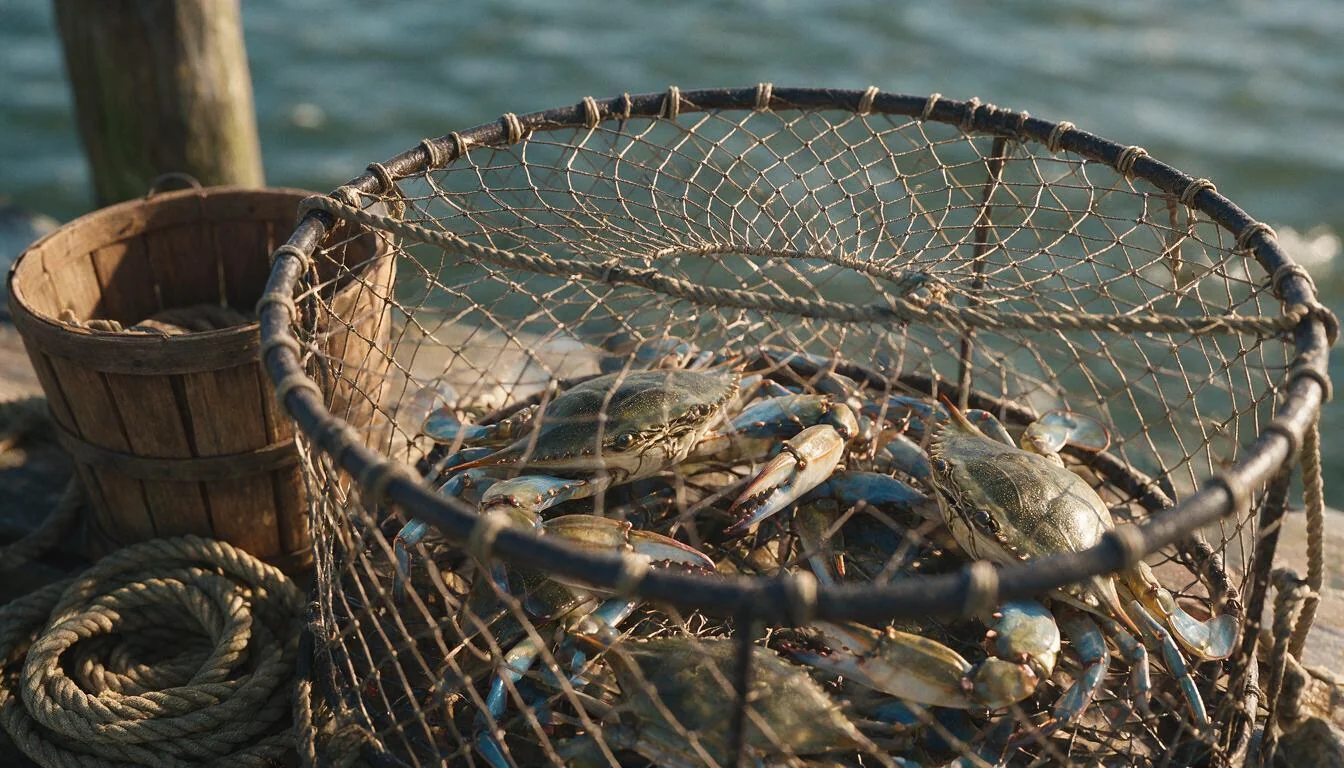
A peeler crab is a crab that is about to molt. Crab shedding is how the animal grows, and it keeps going as long as the water stays warm — with one exception.
Mature females stop molting after their final molt and never shed again, so almost everything in the cycle below is juveniles and males. Young crabs shed every few days; by the time a crab approaches legal size, it sheds every three to seven weeks.
You can read the timing from the swimming legs. A white line means a shed is seven to ten days out. Pink means two to five days. A red line means one to two days, and a rank crab with a solid deep-red line may pop within hours.
That narrow window is what soft-shell season is built on. In the Chesapeake and the mid-Atlantic, the first heavy run of peelers usually arrives on the full or new moon in May, and May and June are the peak months. Gulf crabbers see shedding from roughly April into October, slowing as the water cools.
Serious crabbers fish peeler pots, baited with a large male to draw in females that are close to shedding. The catch goes into shedding tanks and gets checked every few hours, because a crab left in the water too long hardens up and loses its value.
Tides, Moon Phases and the Dawn Bite
The best tide for crabbing in a bay or estuary is usually the last two hours of the incoming tide. Rising water pushes crabs out of the channels and onto the flats where they feed, which puts your bait right in their path.
Slack water sparks arguments. Some crabbers love the calm at the top of the high, when crabs can forage without fighting current. Others find the bite dies and wait for the water to start moving again. Ripping current and a dead midday low in August are the two worst cases.
Moon phase matters because it drives current. New and full moons deliver the strongest tides of the month, and many crabbers plan serious trips for the two or three days on either side of them.
Dawn and dusk are the most reliable hours of the day, and summer nights with a light over the water can be outstanding. A workable plan is simple: check the tide table for your spot, arrive two hours before high water, and fish until the ebb builds.
Crab Size Limits, Possession Limits and Licenses
This is where states diverge the most, and where the numbers change from year to year. Maryland may be the strictest state in the country for recreational crabbers. Male hard crabs must measure 5 inches tip to tip through July 14, then 5¼ inches from July 15 through December 15.
Maryland also bans keeping female hard crabs or female peeler crabs recreationally, along with any egg-bearing sponge crab. Limits run 2 dozen male hard crabs for an unlicensed crabber working from shore or two registered pots, and 1 bushel for a licensed crabber, or 6 dozen if you store them in something other than a bushel basket.
Virginia allows 1 bushel of hard crabs and 2 dozen peeler crabs per person per day, with a vessel limit of 1 bushel no matter how many people are aboard. A bushel there is a volume measure, roughly 40 pounds of crabs. Males and immature females must measure 5 inches; mature females carry no size limit.
Gulf states are looser. Louisiana sets no minimum size for recreationally caught blue crabs and allows 12 dozen per person per day, but egg-bearing females are off limits. Texas has no bag or possession limit and a 5-inch minimum, with up to 5% of a day's catch allowed undersized for bait, kept in a separate container.
Licensing is just as local. Maryland requires a license for trotlines and multiple pots, Virginia sells a separate license for each commercial-style gear type, and Texas wants a saltwater endorsement on top of your fishing license. Cheap, but never optional.
If you already work the same shorelines for other shellfish, our oyster harvesting guide covers the bivalve half of the day.
Winter: Where the Crabs Actually Go
Cold water does not kill blue crabs. It moves them. Once shallow water drops below about 50°F, adults leave the creeks and the marsh and slide into deeper, warmer water, where they bury themselves in the mud and wait.
That is why winter crabbing is a different sport. From a boat you can still find crabs in deep channels and river mouths, but expect to fish deeper, soak baits longer, and work harder for fewer crabs. Shore crabbers in most states are done for months.
Winter is also when next year's rules get made. Maryland and the Virginia Institute of Marine Science run the Blue Crab Winter Dredge Survey, and the results feed the catch limits set the following summer.
Louisiana and Texas have no closed blue crab season, so southern crabbers can go year-round, though December into February is slow and the crabs scatter.
Don't Trust Last Year's Dates
In 2026, Maryland announced new recreational boat limits in a public notice effective July 1, tied to the winter dredge survey, and said they would hold through June 2027. That is how blue crab season management works now: annual, data-driven, and published by notice instead of carved in stone.
Virginia revises its rules on the same rhythm, and both states treat the bay, the coastal bays, and the Potomac differently. Texas publishes its trap closure each year by proclamation. Rules that were legal in April can be illegal by August.
So the last step before any trip is ten minutes on your state marine agency's website, or a call to the local office. Read the current public notices rather than a blog post from three summers ago. Officers do check coolers, and the fines for undersized crabs or an over-limit catch are not cheap.
FAQ
What months are best for crabbing in the Chesapeake?
Late May through October. The water is warm enough for heavy feeding and shedding, and the crabs are big enough to keep legally. April and November can still produce good days, but the catch rate drops and the size rule tightens in mid-July.
Do I need a license to catch blue crabs?
In most states, at least for some gear. Maryland and Virginia let you work from shore or with a couple of pots without one, while trotlines and larger pot sets require a license. Texas wants a valid fishing license with a saltwater endorsement.
Why can't I keep female crabs in Maryland?
Maryland's recreational rules protect the spawning stock. Female crabs carry the eggs that rebuild the population, so the state allows only male hard crabs and soft crabs for recreational crabbers. Virginia takes a different approach and allows mature females with no size limit.
How long does a peeler crab take to shed?
Most peelers take two to five days from a pink line to a soft crab, and a rank crab can pop within hours. That is why shedding tanks get checked every few hours, day and night, and why water in the high 70s to low 80s°F shortens the window while cold water stretches it out.
Is crabbing better on a full moon or a new moon?
Both create the month's strongest tides, and moving water is what concentrates feeding crabs. Plenty of crabbers target the two or three days around either one. A quarter moon brings weaker tides, which usually means slower action in bays and estuaries.
Do Gulf states close crabbing at any point?
Texas sits at the opposite end: no closed season, but crab traps must leave coastal waters for ten days starting the third Friday in February, and local closures — river mouths, nursery areas — are announced separately, so check the current notice before you set gear. Louisiana keeps recreational crabbing open year-round with nothing to track.
The Bottom Line
Crabbing is simple once the water warms: moving water, shallow flats, a rising tide. Seasons, size limits, and possession limits vary by state and are revised yearly, and agencies publish the notices for a reason.
- Treat 50°F as the switch that turns shallow-water crabbing on and off.
- Plan trips around moving water near high tide, especially within a few days of a full or new moon.
- Confirm the current rules with your state agency, then compare notes with the local tackle shop or dock.
- The rest of a shellfish day follows the same logic, so our clam digging guide makes a good next read.