Muskellunge: The Complete Guide to the Fish of 10,000 Casts
There's a reason anglers call the muskellunge "the fish of 10,000 casts." This apex predator of northern waters is elusive, enormous, and notoriously hard to fool. But for the anglers who chase them, nothing else compares: a muskie strike is a topwater explosion, a drag-screaming run, and a story you'll tell for years.
This guide covers muskie identification, habitat, season, gear, and the techniques that actually produce — plus how to handle and release these fish, which is the most important skill of all.
What Is a Muskellunge?
The muskellunge (Esox masquinongy) is the largest member of the pike family — a close relative of the northern pike, but bigger, less widespread, and far more challenging.
Key facts:
- Scientific name: Esox masquinongy
- Common names: muskie, musky, lunge
- Size: commonly 30–48 inches; fish over 50 inches and 30+ pounds are trophies; the record exceeds 60 pounds
- Lifespan: 20+ years (females grow largest and live longest)
- Habitat: large lakes and rivers with cool, clean water and weed/structure cover
- Diet: fish — suckers, ciscoes, walleye, perch, bass, and even smaller muskies
Muskellunge vs. Northern Pike vs. Tiger Muskie
| Feature | Muskellunge | Northern Pike | Tiger Muskie |
|---|---|---|---|
| Body | Elongated, but heavier than pike | Long, slim, torpedo-shaped | Muskie body with pike markings |
| Markings | Dark bars/stripes on light background | Light spots on dark background | Tiger stripes (vertical bars) |
| Cheek | Scaled on upper half only | Fully scaled cheek | Mixed |
| Tail | Pointed lobes | Rounded lobes | Pointed lobes |
| Origin | Native | Native | Hybrid (muskie × pike), stocked |
Quick tip: look at the tail lobes and the cheek scales. Pointed tail lobes plus a half-scaled cheek means muskie; rounded tail lobes and a fully scaled cheek means pike.
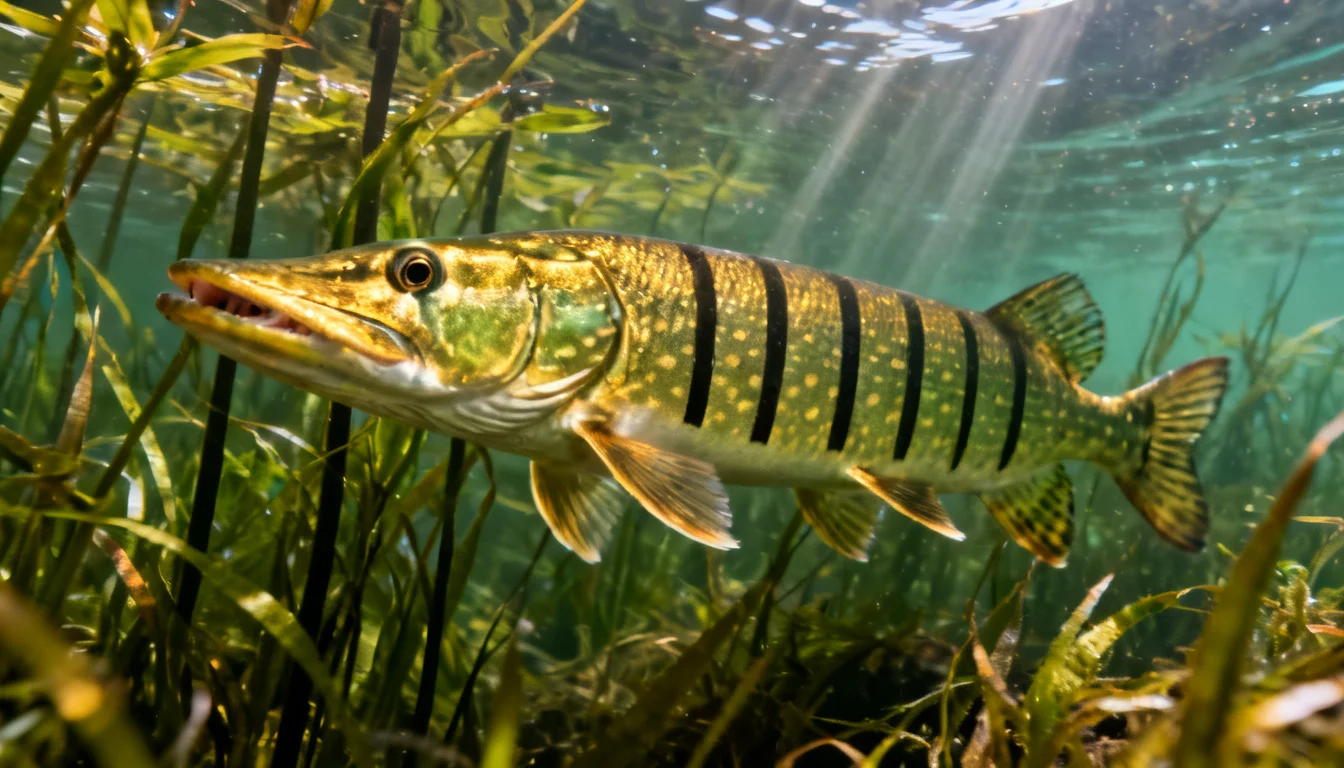
Muskellunge Identification
- Body: long, cylindrical, powerful — built for ambush
- Markings: varies by strain — clear vertical bars (barred muskie) or dark markings on a light body (spotted/clear muskie)
- Fins: dorsal and anal fins set far back near the tail
- Mouth: large with many sharp teeth; duckbill-shaped snout
- Tail: forked with pointed lobes
Where Muskellunge Live
Muskies are native to the Great Lakes basin, the Ohio Valley, and northern rivers, and they've been widely stocked beyond their native range:

- Wisconsin and Minnesota — the heart of muskie country
- Michigan, New York, Ohio, Pennsylvania — strong fisheries (including the St. Lawrence River, a legend for giants)
- Canada — Ontario, Quebec, Manitoba
- Stocked waters across the Midwest, South, and East
Habitat preferences:
- Large lakes with weed beds, rock structure, and deep water nearby
- Big rivers with current seams, eddies, and backwaters
- Cool, clean water — muskies are sensitive to poor water quality
- Fish relate to cover: weed edges, points, submerged timber, and drop-offs
Muskellunge Season
| Season | What's Happening |
|---|---|
| Spring (after spawn) | Fish are shallow and recovering from spawning; slow presentations |
| Summer | Weed-oriented fishing; early morning and late evening are best; deep water during heat |
| Fall | The best muskie season — fish feed heavily before winter and grow aggressive |
| Winter | Deep water; some fisheries target them through the ice |
The fall window (September–November) is the classic muskie time. Cool water, heavy feeding, and big fish make it the best chance at a trophy.
How to Catch Muskellunge
Gear: Heavy and Reliable
Muskie fishing demands tackle that can handle a 40-inch fish with a bad attitude:
- Rod: 7.5–9 foot heavy casting rod (or 8–9 foot for figure-8 work)
- Reel: high-capacity baitcaster with a smooth, strong drag
- Line: 65–100 lb braid (heavy, abrasion-resistant)
- Leader: 80–130 lb fluorocarbon or wire leader — muskies have razor teeth and will cut light line
- Tools: large net, long needle-nose pliers or bolt cutters, jaw spreaders, hook cutters
- Release kit: wet hands, unhooking mat, and a plan
Top Lures
Muskies eat big meals, so big lures work:
- Bucktails — the classic muskie lure; spinner blades and hair
- Large crankbaits — deep divers for structure
- Glide baits and jerkbaits — erratic action triggers strikes
- Swimbaits — big soft plastics that mimic suckers
- Topwater — large poppers and walkers for explosive strikes
- Suckers (live bait) — a big live sucker is a top producer, especially in fall
The Figure-8 (The Muskie Essential)
The single most important muskie technique: end every cast with a figure-8 at the boat. Muskies often follow a lure to the boat and strike only when it turns — the figure-8 triggers that final commitment. Do it on every cast, every time.
Reading the Water
- Weed edges — the classic muskie ambush zone
- Points and humps — structure that concentrates bait
- Current seams in rivers
- Deep water adjacent to shallow cover — muskies move between feeding and resting areas
Handling and Release (Critical)
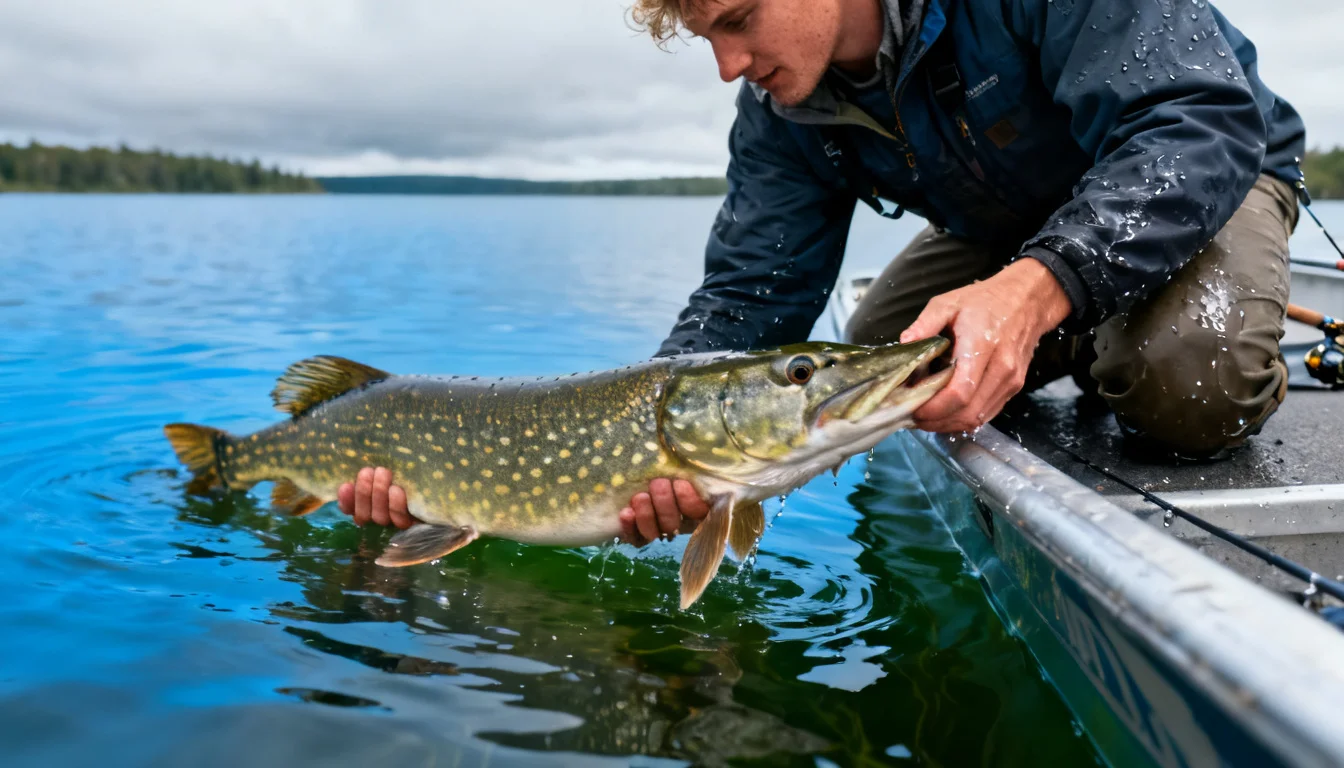
Muskies are fragile for their size — a bad release kills a 15-year-old fish. The essentials:
1. Keep the fish in the water as much as possible
2. Use a big net and keep the fish upright
3. Wet your hands — never handle with dry hands or gloves
4. Use jaw spreaders and long pliers to remove hooks safely
5. Support the belly — never hold a muskie vertically by the jaw (it damages internal organs)
6. Minimize air time — a quick photo, then back in the water
7. Revive properly — hold the fish upright in the water until it swims away strongly
8. Cut hooks if needed — bolt cutters save fish when hooks are deep
Many muskie fisheries require these practices, and some states require a permit or special handling gear.
Muskellunge Regulations
- License: required — see our fishing license guide
- Size limits: often a high minimum (40–50 inches in many waters) to protect breeding fish
- Season: some states close the season during spawning
- Gear rules: some waters require heavy leaders and specific handling gear
- Possession: many fisheries are catch-and-release only
Common Muskie Mistakes
1. Skipping the figure-8 — the biggest mistake in muskie fishing
2. Light line or no leader — muskies cut through light line instantly
3. Poor release handling — vertical holds and long air exposure kill fish
4. Giving up too soon — "10,000 casts" is not a joke; fish the best water thoroughly
5. Fishing without a net — you cannot land a muskie by hand
6. Not watching followers — a muskie following your lure means one more cast in the right place
FAQ
How hard is it to catch a muskie?
Very hard — they're called the fish of 10,000 casts for a reason. Skilled anglers might boat a few fish per season on good water. Success comes from fishing the best structure thoroughly, especially in fall.
What's the difference between a muskie and a northern pike?
Muskies have pointed tail lobes and scales only on the upper half of the cheek; pike have rounded tail lobes and fully scaled cheeks. Muskies also grow larger and prefer different habitat.
When is the best time to catch muskie?
Fall (September–November) is the best season, when muskies feed heavily before winter. Early morning and evening are the top daily windows in summer.
What lures work best for muskie?
Bucktails, large crankbaits, glide baits, and big swimbaits are the mainstays. Live suckers are excellent in fall. The most important technique is ending every cast with a figure-8.
Why do I have to release muskie carefully?
Muskies are slow-growing, long-lived fish that are vulnerable to mishandling. Vertical holds and long air exposure cause internal damage and mortality. Proper handling keeps the fishery alive — many waters are catch-and-release only.
Do I need special gear for muskie fishing?
Yes — heavy rods, high-capacity reels, 65–100 lb braid, and 80–130 lb leaders are standard. You'll also need a large net, jaw spreaders, hook cutters, and a release plan.
Final Checklist
1. Gear up heavy — rod, braid, and a thick leader
2. Fish the fall — the best window for big fish
3. Work the cover — weed edges, points, and structure
4. Figure-8 every cast — the technique that catches muskies
5. Handle with care — in the water, upright, quick release
6. Check the rules — size limits, seasons, and required gear
If you're chasing pike first, our how to catch northern pike guide is the natural starting point. And tie on your heavy leaders with the knots in our fishing knots guide.