Fishing Hooks Guide: Types, Sizes & Sharpening
Assembling your first tackle box? Start with our beginner fishing gear checklist. Then the hook itself — a small piece of wire, but the piece of tackle that actually catches the fish. With dozens of hook types and a size system that confuses everyone at first, fishing hooks deserve a plain-English guide — consider this your fishing hooks guide for the freshwater basics.
The essentials: match hook type to your bait and presentation, match hook size to your target fish, and keep them sharp. This guide covers the hooks you’ll actually use in freshwater — no tackle-shop overwhelm.
Hook Anatomy: Know the Parts
Every hook has the same parts, and the terms matter when you read hook packaging:
- Eye — where you tie the line (the hole)
- Shank — the straight part between eye and bend
- Bend — the curve
- Point — the sharp tip
- Barb — the backward-facing spike that keeps fish hooked
- Gap — the distance between point and shank (the “bite” room)
- Offset — how far the point sits sideways from the shank’s plane
Types of Fishing Hooks You’ll Actually Use
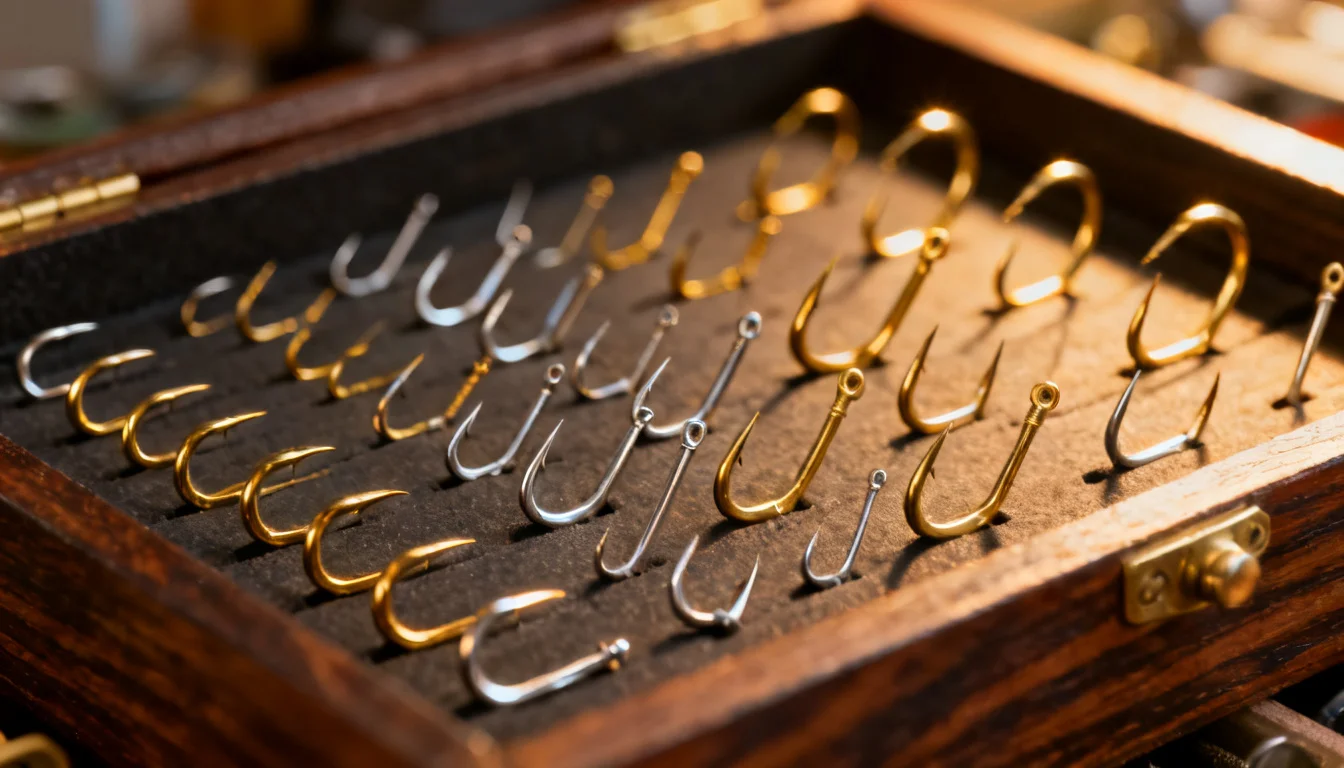
These are the hooks this fishing hooks guide recommends starting with:
J-Hooks (The Classic)
J-hooks are the benchmark every other hook is compared against — the classic circle hook vs J-hook debate starts here.
The standard single hook — the shape gives the family its name. Sharp point, open gap, reliable hooksets.
- Best for: live bait, cut bait, and most general fishing
- Variations: Aberdeen (thin wire, long shank — easy to remove, great for panfish), Octopus (short shank, wide gap — excellent for live bait and bass)
Circle Hooks (The Self-Setting Hook)
The point curves inward toward the shank. When a fish swallows it and swims away, the hook rotates and sets itself in the corner of the mouth.
- Best for: live bait fishing, catfish, and catch-and-release — hooks are almost always lip-hooked, gut-hooks are rare (see our channel catfish guide for the rig)
- Key rule: do NOT jerk to set a circle hook — let the fish take line and reel into it
Treble Hooks (Three Points)
Three hooks fused on one shank. Massive hookup ratio, more damage, harder to remove.
- Best for: artificial lures — crankbaits, topwater, spinners
- Note: not for live bait; always check treble hooks on lures — they rust and dull fast
Worm Hooks (Offset/Extra-Long Shank)
A long-shank offset hook designed for soft plastics — the offset lets the hook point ride up through the plastic for weedless rigging.
- Best for: soft plastic worms, creature baits, Texas rigs
- Look for: a wide gap so the plastic has room, and a sharp point for clean penetration
Drop Shot Hooks
A thin-wire, light hook tied perpendicular to the line above the weight, with the bait drifting just off the bottom — an advanced finesse setup you can learn later.
- Best for: finesse bass fishing, clear water, light bites
- Key feature: the hook sits with the point up — set gently
Hook Sizes: The Confusing Part
Hook sizes are counterintuitive: the smaller the number, the bigger the hook — until you hit 1, then it flips.
| Size | Typical Use |
|---|---|
| #16–#12 | Tiny — fly fishing and micro bait (rarely needed by beginners) |
| #10–#8 | Small — crappie, trout, small baits |
| #6–#4 | Medium-small — panfish, walleye, small bass |
| #2–#1 | Medium — bass, walleye, general freshwater |
| 1/0–2/0 | Large — bass, catfish, live bait |
| 3/0–5/0 | Larger — big bass, catfish, pike, musky |
| 6/0+ | Huge — musky, big catfish, saltwater |
Rule of thumb: match hook size to the fish’s mouth and the bait’s size. A hook too big won’t fit in a panfish’s mouth; a hook too small won’t hold a bass’s lip.
Hook Type by Fish: Quick Reference
| Fish | Hook Type | Size |
|---|---|---|
| Panfish (bluegill, crappie) | Aberdeen or small J-hook | #8–#6 |
| Trout | Small J-hook, fine wire | #10–#6 |
| Bass (worms/soft plastics) | Worm hook | 2/0–4/0 |
| Bass (lures) | Treble (on lures) | varies |
| Walleye | J-hook or Octopus | #4–#2 |
| Catfish | Circle hook | 2/0–5/0 |
| Pike, musky | Large J or treble (with leader) | 3/0–6/0 |
Barbed vs Barbless
- Barbed hooks hold fish better but are harder to remove — the standard choice for most fishing
- Barbless hooks are easier to remove, gentler on fish (great for catch-and-release), and popular for fly fishing
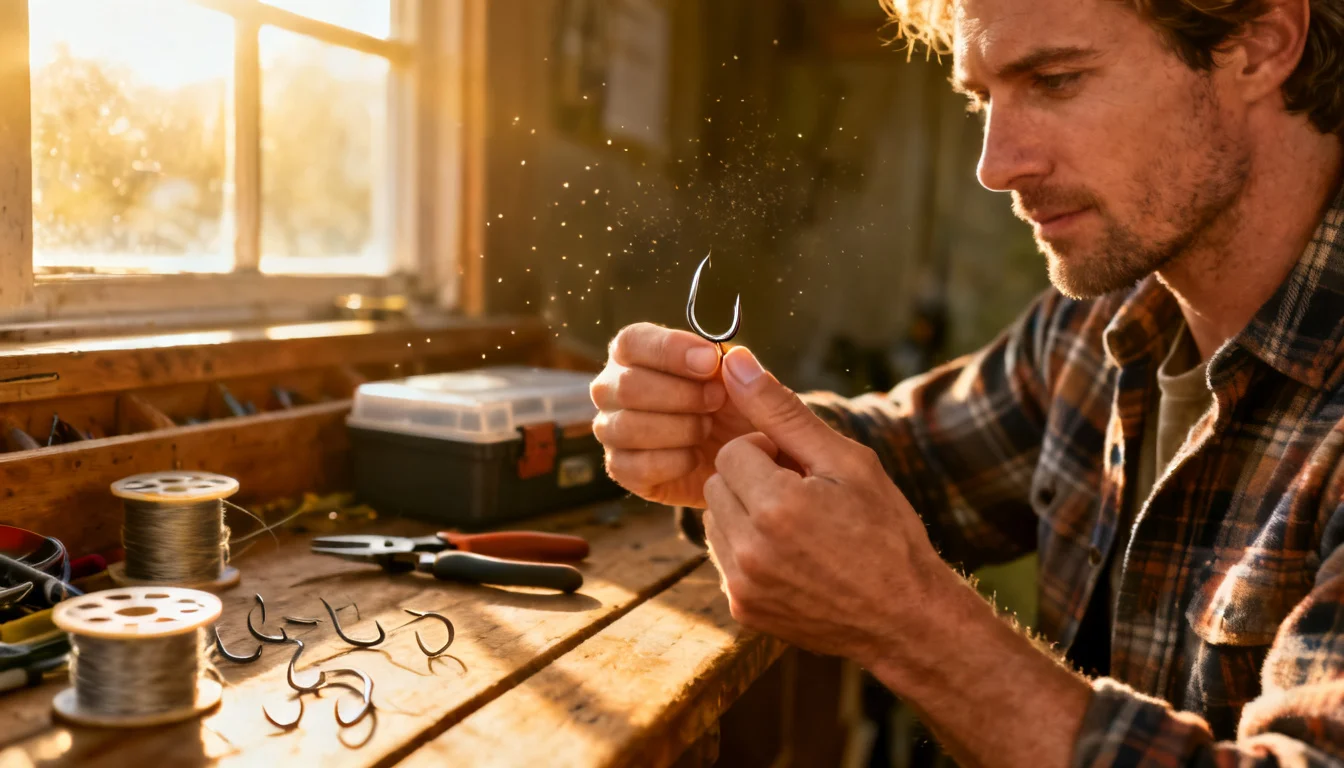
- Try this: you can pinch down the barb on any hook with pliers if you want barbless for a day
Hook Care: The 30-Second Habit
A dull hook is a missed fish. Check your hook point with your thumbnail — it should catch, not slide. When hooks dull:
1. Sharpen with a small hook file (a few strokes at the point’s angle)
2. Replace rusty or bent hooks — they’re cheap, and the fight isn’t
3. Check lure trebles before every trip — trebles rust and dull faster than single hooks
Common Hook Mistakes
Even with a solid fishing hooks guide, most anglers make these mistakes:
1. Using hooks too big for the fish — a #4 hook in a bluegill’s mouth misses everything
2. Not checking sharpness — dull hooks are the #1 cause of “I had it, then it got off”
3. Jerking circle hooks — pulling a circle hook out of a fish’s mouth defeats the self-setting design
4. Fishing offset hooks on soft baits wrong — the point needs to ride up through the plastic, not buried flat
5. Ignoring hook quality — cheap hooks bend and dull fast; spend a few cents more
FAQ
What’s the best hook for beginners?
A medium J-hook in sizes #6–#10 — it handles panfish, trout, and small bass, and J-hooks are the easiest to tie and set.
How do fishing hook sizes work?
The bigger the number, the smaller the hook (e.g., #10 is tiny, #6 is medium-small). Once you pass #1, sizes go 1/0, 2/0, 3/0 — the bigger the number, the bigger the hook. So #10 < #4 < #1 < 2/0 < 5/0.
What hook for bass fishing?
Worm hooks 2/0–4/0 for soft plastics, wide-gap hooks for Texas rigs, and treble hooks for crankbaits and topwater — see our largemouth bass guide for hook-to-rig matchups. Match size to your bait — the hook should barely be bigger than the bait’s head.
Are circle hooks better than J-hooks?
For live bait and catfish — yes. Circle hooks self-set in the corner of the mouth and virtually eliminate gut-hooking, which makes them ideal for catch-and-release. For artificial lures and active fishing, J-hooks are the standard.
Why do hooks come with different shapes?
Each shape solves a problem: long shanks are easier to remove (panfish), wide gaps hold bulky soft plastics, inward-curved points self-set (circle), and three points increase hookup odds (treble). Pick the shape that fits your bait and fish.
Should I use barbed or barbless hooks?
Barbed for most fishing — they hold better and are the norm. Go barbless (or pinch the barb down) for catch-and-release and fly fishing where quick, gentle releases matter.
Final Checklist
1. Start with: J-hooks, sizes #6–#4
2. Live bait & catfish: circle hooks (don’t jerk — let them take it)
3. Soft plastics: offset worm hooks 2/0–4/0
4. Lures: check the trebles — keep them sharp
5. Every trip: thumbnail test — a hook should catch, not slide
Tie your hooks on with confidence using our fishing knots guide, and pair your hooks with the right rod in our rod selection guide.