Fall Pond Prep: Winterizing a Pond So Fish Survive to Spring
Winterizing a pond is a three-part job, and none of it is about keeping fish warm. Fish in water two feet deep or more do not need warmth. They need depth, clean water, and a way for gas to move through the ice.
Get those three right in the fall and most ponds come through with every fish alive. Skip them and you will not know until the ice goes out in March, when the dead ones surface.
Here is how to winterize a pond in a way that holds up through a real northern winter, and what changes if your water is small.
Fish Survival in Winter: Oxygen, Not Cold, Is What Kills
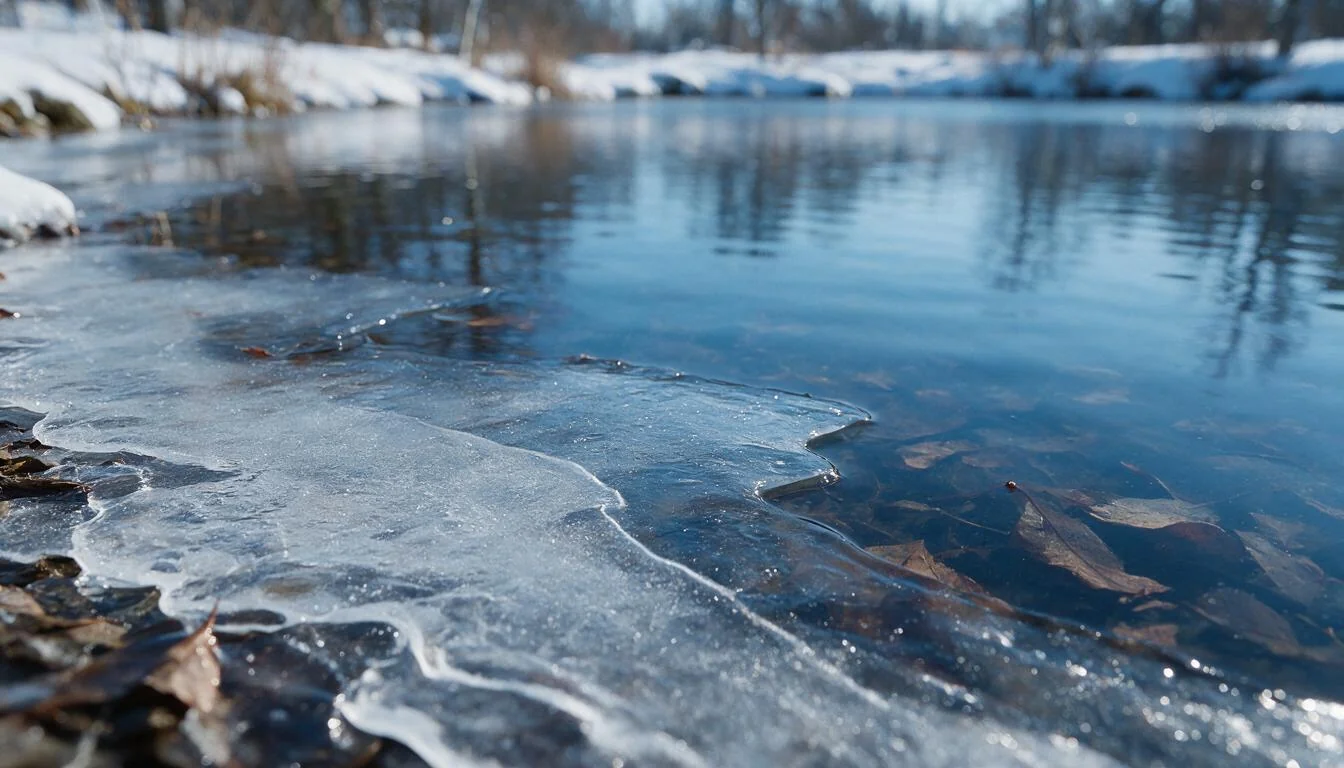
Cut a hole in a frozen pond in January and you will measure roughly 32°F just under the ice and about 39°F near the bottom. Fresh water is densest at 39°F, so the heaviest water sinks and stays down there while colder water floats above it. That bottom layer is the winter refuge.
Fish drop into it and slow down. Metabolism falls to a fraction of summer rates, movement nearly stops, and they stop eating. From that point survival comes down to oxygen. Once ice and snow seal the surface, oxygen from the air can no longer dissolve into the water, and snow blocks the light that plants and algae need for photosynthesis.
Ohio State University Extension puts plant and algae photosynthesis at 70-90% of a pond's dissolved oxygen. Under ice that engine stalls while bacteria keep breaking down leaves and dead plants. Oxygen falls. Fish become stressed below about 5 parts per million, and most species cannot handle 2 ppm for long. That is a winterkill.
Nobody watches it happen. Dead fish settle on the bottom until the thaw or until decay gases float them up. The first clue is usually a pond that will not bite in April. Bass, bluegill, channel catfish, and goldfish handle this in a pond with volume and clean water. Cold-sensitive species do not, no matter what you do in fall.
Where fish hold shifts with the season and with oxygen levels, which the fish habitat guide breaks down for the rest of the year.
Feed on Water Temperature, Not the Calendar
Feeding is the part of pond winter care that causes the most damage, usually out of kindness. Fish are cold-blooded, so digestion tracks water temperature. In the 50-60°F window, switch to a wheat-germ or low-protein food and feed once a day, only what the fish clean up in a few minutes.
At 50°F, stop. Fish are close to dormant, their gut slows to almost nothing, and food that sits there can rot. Below 40°F nothing should go in at all, and they live on the fat they built up over the summer.
Air temperature lies in both directions. A 65°F afternoon in early November does not warm a pond sitting at 47°F, and a cold front chills the air days before it chills the water. Hang a thermometer 12-18 inches deep and read that instead of the forecast.
- Stop feeding once the water holds below 50°F for several consecutive days
- Do not feed fish up for winter; uneaten pellets decay and pull oxygen down under the ice
- Warm-water forage fish such as tilapia begin dying near 50°F, so treat them as one-season stock
Fall feeding is not about weight gain. It is about not adding waste that has to be paid for in February.
Pond Freezing Depth: How Deep Is Deep Enough?
Pond freezing depth is the number most owners guess at, and the honest answer is that a pond rarely freezes to the bottom. Ice insulates, and the ground under a pond pushes a little heat upward all winter. The catch is volume: a shallow pond has very little water left to work with once the top inches turn solid.
For a backyard water garden, two feet is the practical minimum for goldfish, and koi ponds should run three feet or deeper. Those figures are where most extension guidance and pond builders land, and they assume fish can sit under the ice rather than in it.
They also assume zone 6 or warmer; in zone 5 and colder, treat three feet as the goldfish minimum and four feet for koi.
Fishing ponds and farm ponds need more. Ohio State University Extension, citing Austin et al. (1996), recommends at least 25% of a pond's surface area be 8 feet deep or more across most of Ohio, and 10-12 feet in the northern part of the state.
The reasoning is simple. Volume holds oxygen and resists temperature swings. Penn State Extension notes that a 1-acre pond 6 feet deep is a safer bet than the same acre at 3 feet.
Depth is the one thing you cannot fix in the fall, which is why it drives every other decision in winterizing a pond. If your water is shallow, spend the season cutting oxygen demand instead: fewer leaves, fewer rotting plants, fewer fish.
Fall Pond Maintenance: Clear the Watershed Before the Ice Sets
Fall pond maintenance is a fight against February. Everything that sinks in October becomes food for bacteria in January, and bacteria breathe the same oxygen your fish need.
- Net the surface before leaf drop starts, and empty skimmers weekly while leaves are coming down
- Cut marginal plants back and carry the tops away instead of leaving them on the bank
- Skip late-season herbicides; killing a pond full of plants at once creates a massive decay load
- Keep fertilizer, clippings, and runoff out of the pond, since nutrients feed next summer's growth
Hold off on big water changes in late fall. A partial change is useful while water is still above 60°F, but cold water is a poor time to stress fish that are already shutting down.
If the bottom is buried in muck, a fall drawdown before ice-up is the only practical window to pump or rake it out. Keep the fish in a holding tank, work fast, and refill from a clean source. The pond management basics guide covers the rest of the year-round water quality cycle.
Pond De-Icer and Winter Gear: What to Drain, What to Run
Pressurized filters, UV clarifiers, and any external pump that holds water should be drained and stored somewhere above freezing. Water left in a housing cracks the plastic, and a cracked filter in December turns into a spring replacement.
Waterfalls and streams get shut down for the same reason from the other direction. Ice dams build on the falls, back water up behind the ice, and can push a pond over its liner edge. Drain the plumbing and leave it off until spring.
Aeration is the best tool you have for fish survival in winter, but how you run it matters. Ohio State Extension warns against running a bottom diffuser at depth under ice, because circulation drags the 39°F refuge water up against the cold surface and can supercool the whole pond.
Hang the air stone 12-24 inches below the surface instead, and our winter fishing tips cover where fish hold once the ice is on.
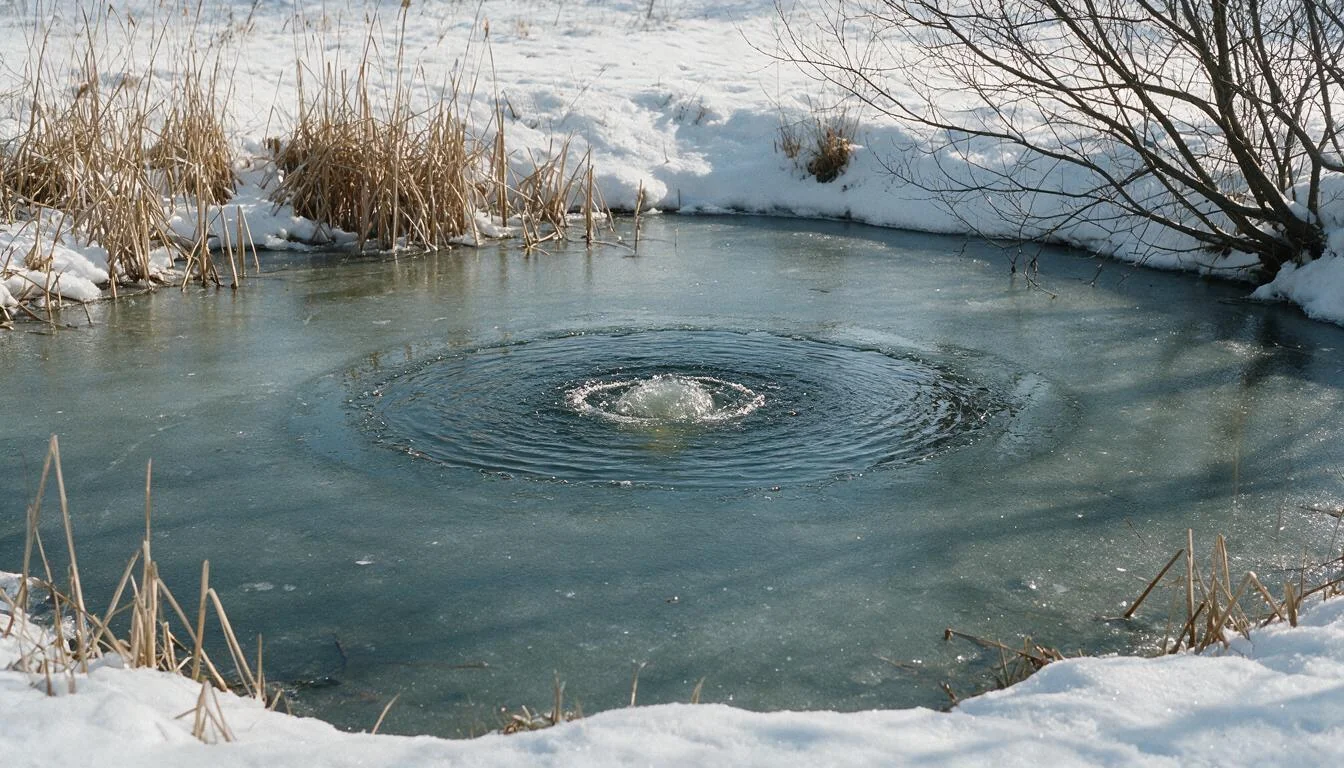
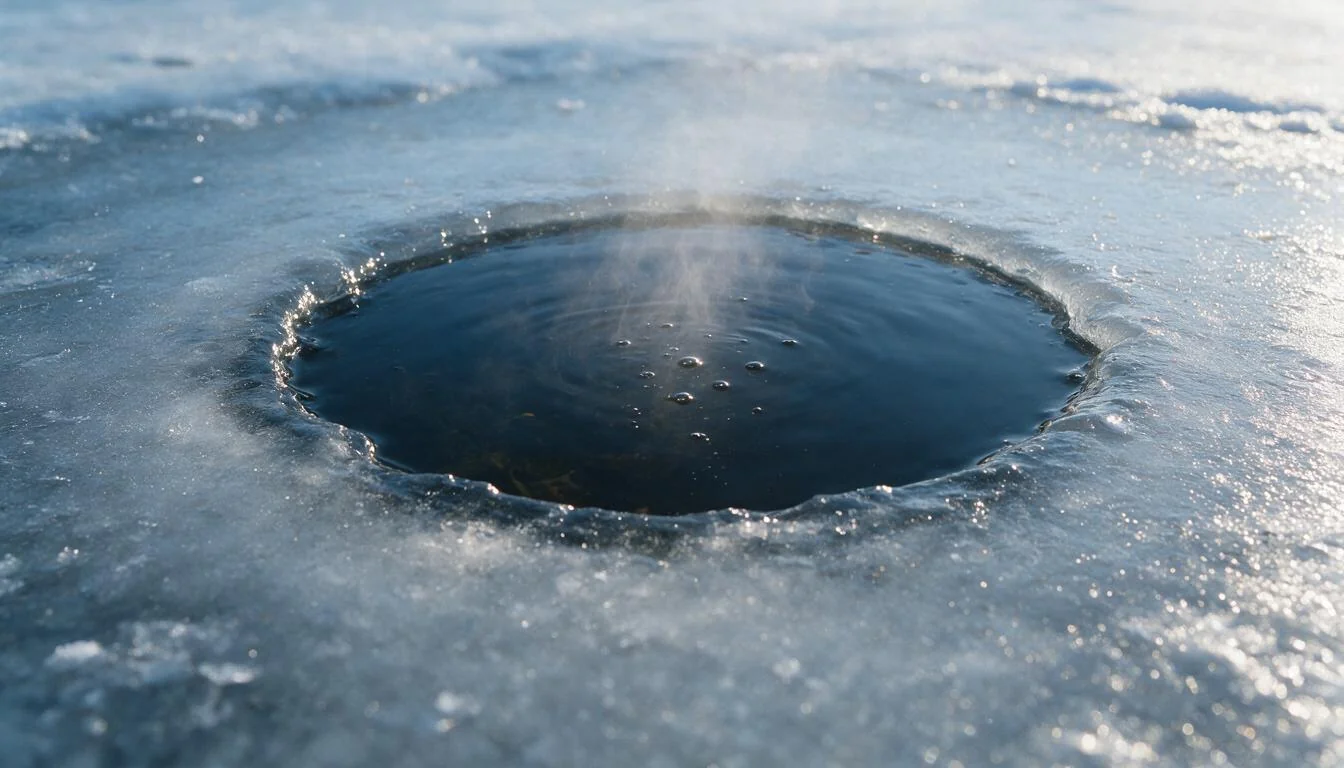
A floating pond de-icer keeps a vent open in the ice so carbon dioxide, ammonia, and methane can escape and a little oxygen can dissolve in. You want a couple of square feet of open water, not a heated pond. Most units just hold that hole open through the coldest nights.
Never smash ice with a hammer, spud bar, or boot. The shock wave travels through the water and stuns fish. If the hole seals over, let the de-icer work or pour warm water on the ice.
Ice Thickness: When Clearing Snow Is Worth the Risk
Snow on top of ice is the main driver of winterkill, which is why extension services keep recommending that you clear part of it. Do that only when the ice is strong enough to hold you.
The Minnesota DNR guideline is 4 inches of new, clear ice for one person on foot, and anything under 4 inches means stay off. White or snow ice is only about half as strong, so double those numbers. Maryland DNR uses the same 4-inch floor and warns that thickness varies from one spot to the next.
Check thickness in several places as you go, not once from the dock. Ice near shore, over springs, and around inlets is thinner than ice in the middle. Never go out alone, and keep ice picks on a cord around your neck.
If you do clear snow, open 10-by-10-foot windows covering roughly 25-50% of the surface. The Ohio Department of Natural Resources puts the rule of thumb at 30%. Pick one strategy, aeration or snow clearing, rather than both, since aerated ice is not reliable enough to walk on. When in doubt, leave the snow and let it melt on its own.
Small Ponds and Stock Tanks Need a Different Plan
A 300-gallon water garden, a half barrel, or a stock tank behaves nothing like a farm pond. The volume is small, so the water swings with the air, and a shallow container in a Minnesota or Wisconsin winter can freeze solid from top to bottom. Fish in those systems need help.
The dependable options are moving fish indoors, where a 50-gallon tank in a heated garage will hold a few goldfish comfortably, or insulating the container and running a small de-icer while keeping a vent open. A greenhouse or a foam-wrapped, covered tub works in milder zones.
What does not work is assuming a bubbler will save fish in a shallow tub. In deep water, aeration is insurance. In six inches of water, it just mixes the cold down. If the fish cannot be moved and the pond is barely a foot deep, accept that some winters will take them.
Stocking density matters in every pond, and it matters most in a small one going into winter. Fewer fish need less oxygen, and a pond that is crowded in August is at real risk by February.
FAQ
Will my fish survive if the pond freezes over completely?
Almost certainly, as long as the ice is on the surface and not down to the bottom. A pond two feet deep or more keeps liquid water underneath, and the fish sit in it in a near-dormant state. The threat is not the ice sheet. It is oxygen running out beneath it.
How do I keep a hole open in the ice without power?
A floating de-icer or a small air stone hung near the surface are the two dependable methods. Some owners float a dark, sun-absorbing object to melt a small opening, or pour a bucket of warm water over a sealed hole. Do not hammer the ice open.
Is it normal for pond fish to sit on the bottom all winter?
Yes. Fish crowd into the warmest, deepest water for most of the winter, then drift shallower as oxygen declines near the bottom. A stack of fish in one corner is normal winter behavior, not illness. Leave them alone and avoid walking on the ice directly above.
When can I start feeding again in spring?
Wait until the water holds above 50°F for several days, and many keepers wait for 55°F. Start with small amounts of a low-protein food and watch whether they actually eat it. Feeding early into cold water is the same mistake as feeding late into fall. Come spring, start with a wheat-germ food once the water holds above 55°F, feed only what disappears in five minutes, and stop again if a cold front drops the water below 50°F — spring swings are faster than the fall ones.
Do I need to do water changes in winter?
No, and disturbing a winter pond does more harm than good. Water changes in freezing weather are hard on fish that are nearly dormant. Top off only if the level drops well below the liner edge, and add the water slowly.
Can warm-water fish like tilapia overwinter in a northern pond?
No. Tilapia begin dying below about 50°F, so they cannot survive a winter in most of the United States without heated water. Treat them as summer forage: stock them in spring and expect them to be gone by ice-up.
The Bottom Line
Winterizing a pond comes down to volume, oxygen, and a clean watershed. Clear the leaves in the fall, stop feeding at 50°F, keep a vent open in the ice, and leave the deep water alone.
If the ice gets thick enough to fish through, the ice fishing basics guide covers the safety side.