Pond Aeration Explained: Moving Oxygen Through the Whole Water Column
Walk most farm ponds in July and the fish look fine. By August, one still, muggy night can flip the same water into a kill zone.
Pond aeration is the tool that buys margin. It moves water so oxygen gets spread through the column instead of sitting in layers that starve by dawn. Get it right and a pond carries fish through the worst week of summer.
Every pond sits inside a bigger routine. The water-quality fundamentals in our pond management basics guide come first, hardware second.
How Dissolved Oxygen Works in a Pond
Dissolved oxygen is oxygen gas held in the water itself, and fish pull it across their gills every second. Two sources feed it: algae and rooted plants producing it through photosynthesis, and the atmosphere bleeding it in at the surface when wind roughens the water.
Photosynthesis needs light, so dissolved oxygen climbs through the afternoon and falls all night. Dawn is the bottom of the curve. Example readings from a heavily bloomed farm pond — the shape Maryland Extension describes — show how wide that swing gets:
| Time | Light bloom | Heavy bloom |
|---|---|---|
| 3:00 a.m. | 7.5 ppm | 6.5 ppm |
| 6:00 a.m. | 7.0 ppm | 2.5 ppm |
| Noon | 8.5 ppm | 15.0 ppm |
| 6:00 p.m. | 9.5 ppm | 20.0 ppm |
Read the heavy-bloom column and the trap is obvious. A pond that tests fine at supper can be under 3 ppm before sunrise. For pond work, ppm and mg/L are interchangeable.
University of Florida IFAS guidance puts 5 mg/L or more as the target for strong fish health. Most species get stressed between 2 and 4 mg/L, and mortality usually begins below 2 mg/L. Oklahoma State lands inside that band: prolonged readings under 3 ppm are stressful, and short exposure below 1 ppm is often lethal.
Reading Pond Oxygen Levels Before Fish Show Stress
Your pond tells you before the test kit does. Oklahoma State Extension lists fish at the surface gulping air at sunrise as the earliest reliable sign of low oxygen, along with fish refusing feed.
Larger fish die first in a depletion event. They need more oxygen per fish and carry less gill surface per pound of body, so the biggest bass in the pond are usually the first floaters.
Oklahoma State puts numbers on the danger zone: dissolved oxygen below 3 ppm for prolonged stretches is stressful, and short exposure below 1 ppm is often lethal. There is no single hard lethal limit, because it shifts with species, size, and water temperature.
Sampling timing matters as much as the reading. UF/IFAS recommends testing in late afternoon (5-6 p.m.) and again late evening (8-10 p.m.), then plotting the decline. If the line projects below 4 mg/L before 7 a.m., run emergency aeration.
Pond Aerator Types and What Each One Actually Mixes
Pond aeration hardware splits into four working categories, and picking the wrong one is the most common way owners waste money.
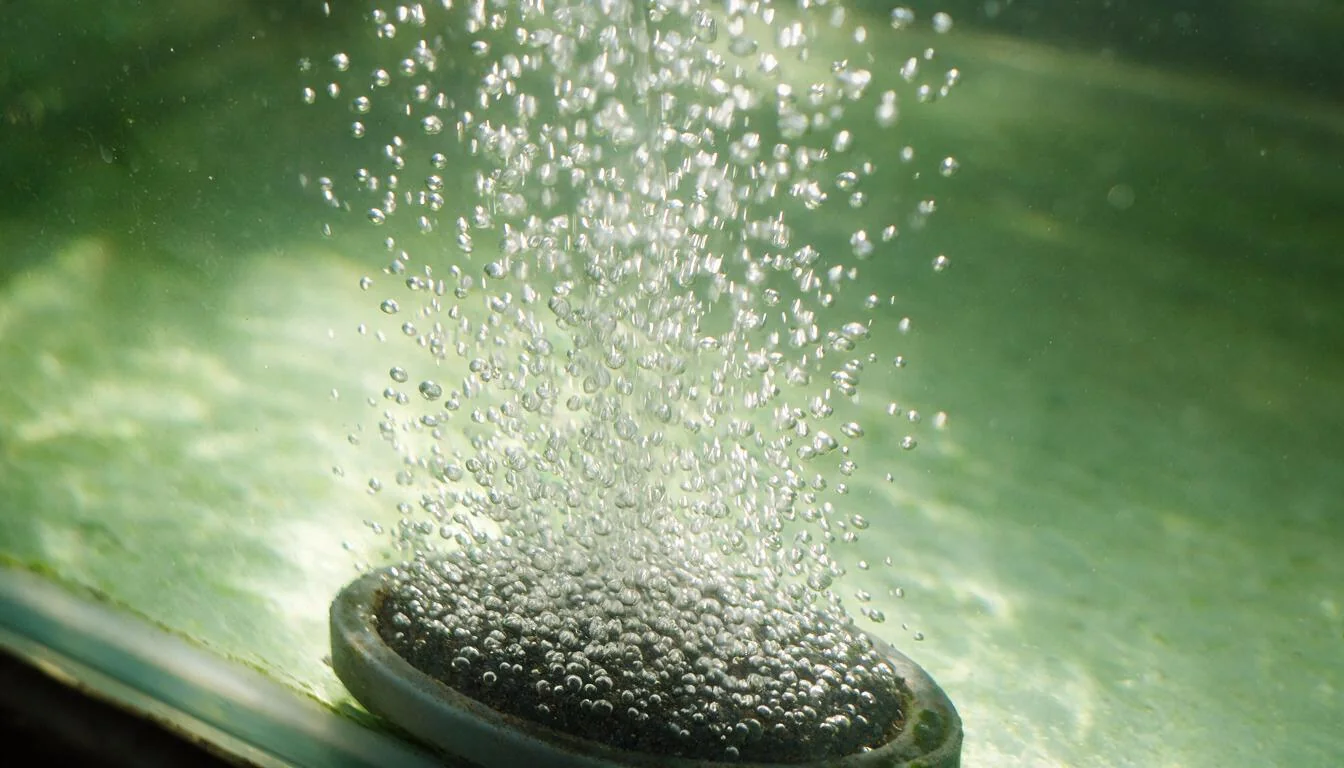
Bottom-diffused systems. A shore compressor pushes air through weighted tubing to diffuser plates on the pond floor. Rising bubbles lift bottom water upward, dragging the whole profile into the mix. Best choice in ponds deeper than about 6 to 8 feet.
Surface aerators. An impeller or propeller throws water into the air, where droplets pick up oxygen before falling back. Strong in shallow basins of 6 feet or less, where the splash can reach the bottom.
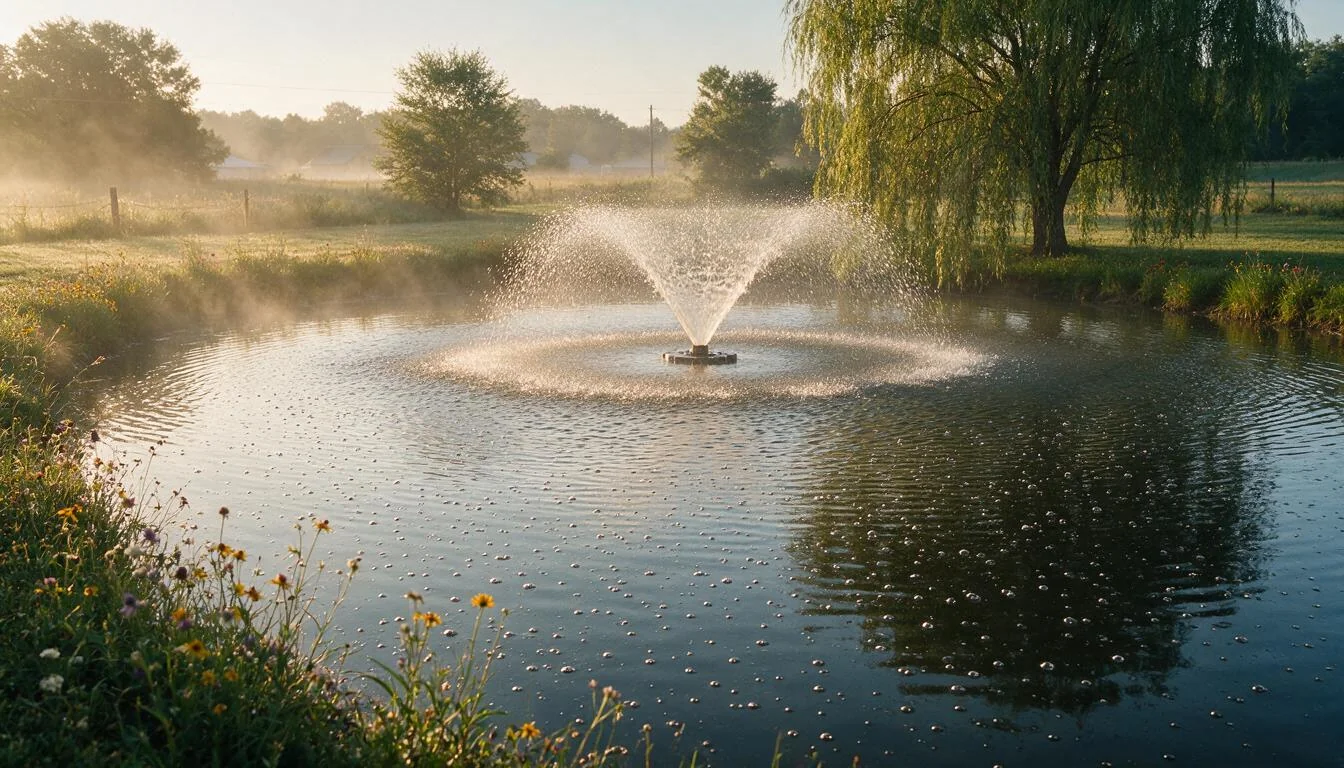
Fountains. Same idea with a decorative nozzle, and the design sets the limit. Most fountain pumps draw only from the top 6 feet, so the deep water never joins the mix.
Windmill and solar units. No grid power required, with output tied to wind or sun. Solar runs daylight hours only, and still air or heavy cloud cuts both back fast.
One installation detail from Maryland Extension: keep diffusers off the pond bottom. Sitting in sediment, a rising bubble column can stir muck and release nutrients that cloud water and feed algae.
Summer Fish Kill: Why Heat Is the Trigger
Mississippi State Extension is blunt about it: the most frequent cause of fish kills in farm ponds is low oxygen, and simple depletion usually lands between July and September. The mechanism is a double squeeze.
Warm water holds less dissolved oxygen than cold water. At the same time, warm fish burn more of it because their metabolism runs faster. Those two curves cross in late summer, which is why a summer fish kill so often follows a heat wave rather than a single event.
Weather stacks the odds higher. A stretch of cloudy, muggy, windless days cuts photosynthesis and stops the surface mixing that would normally replace oxygen. Organic matter rotting on the bottom keeps consuming whatever is left.
Shallow water is most vulnerable. Missouri Department of Conservation notes that ponds under 8 feet deep may not hold enough volume to carry fish through the year, and that summer depletions are common where aquatic plants cover much of the surface. Past 20% coverage is the point to start planning control.
There is one counterintuitive rule from MDC. If you treat heavy vegetation, treat only about a third of the area at a time, and only while water temperature is below 80°F. Killing every plant at once creates a mass of decaying matter that eats the oxygen you were trying to protect.
Fish you catch during a heat wave are already at their limit, so the handling rules in our keep fish alive while fishing guide matter most in July and August.
Pond Turnover and the Fall Cold Front
Summer builds a layered pond. Sunlight warms the upper zone, where algae pump out oxygen all day. Below it sits cold, dense water that gets little light, little photosynthesis, and almost no mixing, so it slowly loses oxygen all season.
The boundary between those layers is the thermocline. MDC defines it as the transitional layer where water temperature drops at least 0.5°F with each additional foot of depth.
A pond turnover happens when that layered structure collapses. Clemson Extension points at two triggers: a fall cold front that cools the surface, or a heavy rainfall and runoff flush. Mix the layers too fast and the oxygen-poor bottom water rises, dropping whole-pond oxygen in a single night.
Depth drives the risk. Clemson notes turnover is mostly a deeper-pond event, but it can hit water only 6 feet deep. Ponds that stratify hard every summer are the ones that crash hardest in October.
Prevention is boring. Keep the pond mixed all season with a diffused system and the bottom layer never builds the oxygen debt that makes a turnover lethal. If your pond has turned over once, assume it will again.
Sizing Aeration and Running It on a Schedule
Sizing starts with two numbers: surface acres and average depth. Multiply length by width in feet and divide by 43,560 for acres, then average depth readings taken across the basin.
Maryland Extension's figure for ponds with heavy stocking and feeding is a minimum of 1 to 2 horsepower per surface acre. The usual rule of thumb for diffused air is about 1 cubic foot per minute per surface acre, roughly doubling in stocked or muck-heavy ponds.
Depth decides which type fits. Bottom diffusers need water column to work with, and below about 4 feet the bubbles reach the surface too fast to transfer much oxygen. Surface units are the better answer there.
Build depth sets the ceiling on everything else. Purdue Extension recommends 8 to 12 feet of water over at least 75% of a pond's area, which limits plant growth and gives fish a deep refuge.
Kansas sets its target at 8 feet for spring-fed ponds, and 10 feet for runoff-fed ponds in the eastern half of the state. Water past 15 feet rarely returns its cost.
Stocking density drives oxygen demand as much as acreage does, so those decisions belong together. The numbers in our pond stocking guide tell you how many pounds of fish the water has to support.
Timing is where most owners leave money on the table. UF/IFAS recommends running an aerator from late evening (10 p.m. to midnight) until after daylight (7-8 a.m.). Running it through a sunny afternoon can strip oxygen out of water that is already supersaturated. Emergency aeration is warranted whenever dissolved oxygen drops below 4 mg/L.
If a pond has never been mixed, do not slam it on 24/7. Start with short daily runs and stretch them over one to two weeks so bottom water rises gradually instead of all at once.
FAQ
Can I aerate a pond with a fountain alone?
Only if the pond is shallow. Most fountain pumps pull water from roughly the top 6 feet, so in a 12-foot pond the bottom half never gets mixed or oxygenated. Fountains work well as a supplement above a bottom-diffused system, and they are fine as the only source of movement in a pond 5 or 6 feet deep.
How many hours a day should I run a pond aerator?
Start with the night shift. An overnight run from about 10 p.m. to 8 a.m. covers the hours when photosynthesis has stopped and oxygen is falling. During a heat wave or right after a bloom die-off, switch to continuous operation instead of trying to time it.
Does a pond need aeration in winter?
Sometimes. Water sealed under ice cannot exchange gas with the air, and decaying vegetation keeps drawing oxygen down beneath the ice. Snow cover blocks the light plants would use to replace it. Run winter aeration with diffusers in shallower water so the coldest layer stays where it is.
Does wind aerate a pond on its own?
Yes, and it is the main natural source in most ponds. Wind-driven wave action mixes the surface and diffuses atmospheric oxygen into the top layer. That is also why dense tree cover on the windward bank and solid mats of floating plants hurt, since they cut both the mixing and the gas exchange.
Can you add aeration to a pond that has never been aerated?
Yes, but ramp it up slowly. Bottom water that has been oxygen-poor for years can hold compounds that stress fish when they are suddenly lifted into the upper layer. Two weeks of gradually lengthening run times is much safer than continuous operation on day one.
Will aeration clear up green or muddy water?
Not on its own. Aeration moves water and oxygen, but the nutrients feeding the algae still have to go somewhere. What steady mixing does over time is keep the bottom oxygenated enough for aerobic bacteria to work through muck, which slowly shrinks the nutrient supply.
The Bottom Line
Pond aeration is not a cure for a badly built or overstocked pond, but it is the cheapest insurance against the one night that erases a year of growth.
- Aim for 5 mg/L or better, and treat 4 mg/L as your trigger to act.
- Size on acres and depth, then run the system overnight.
- Fix depth and fish load first, because fish habitat problems downstream of bad construction are expensive to aerate around.