Pond Stocking Guide: How to Stock a Pond for Years of Great Fishing
Pond stocking is the single most important decision a pond owner makes. Get the species and rates right, and you get years of bluegill action, bass in the 1–3 lb range, and catfish for the table. Get it wrong, and you fight stunted fish, murky water, or a pond that never fishes the way you hoped.
The good news is that stocking a pond is not complicated. State agencies and university extension programs have refined the recipe over decades, and the same core plan works from Texas to Wisconsin. This guide covers which fish belong together, how many to stock per acre, the correct order and timing, and the mistakes that wreck stocked ponds.
The Right Fish for a Stocked Pond
The classic North American pond combination pairs bluegill with largemouth bass at roughly ten bluegill for every bass. Bluegill reproduce fast and provide a steady food supply; bass control the bluegill population and give you the trophy fishing.
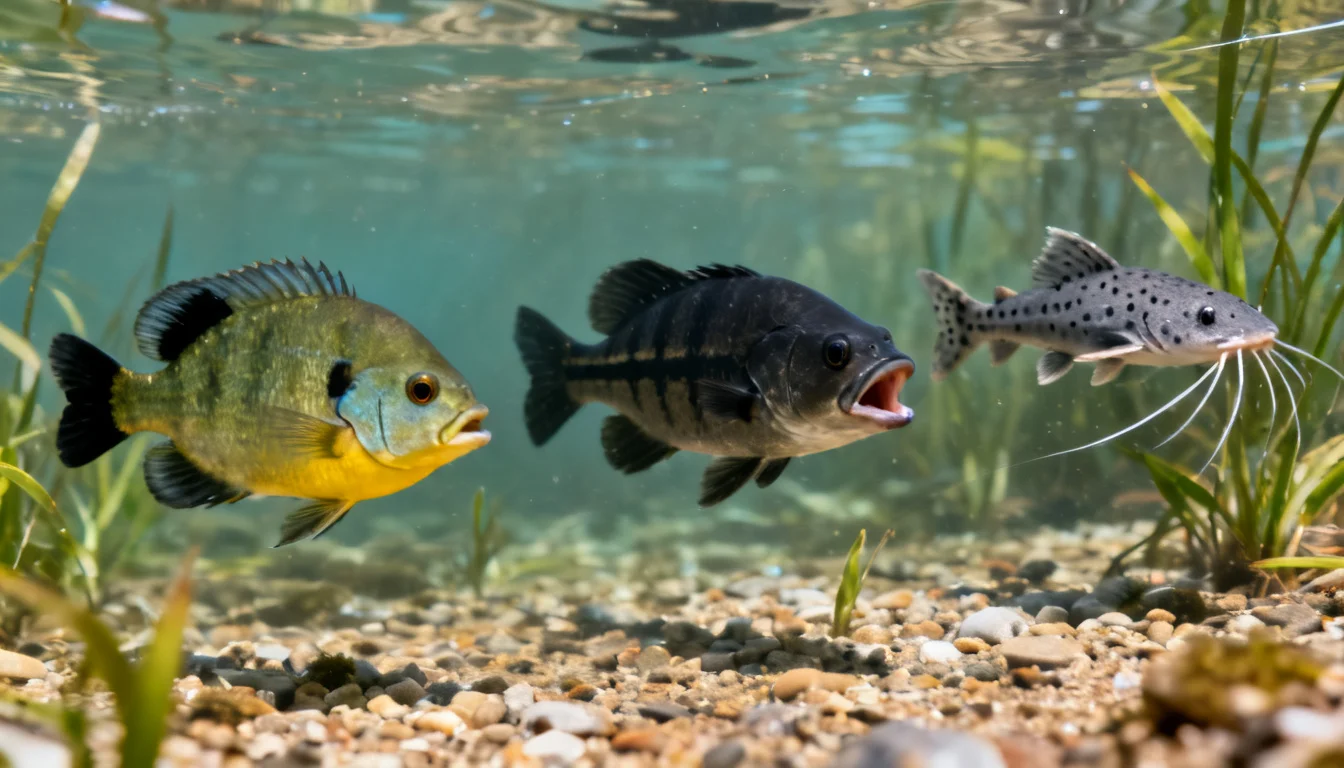
Neither species works well alone. Stock bass without enough bluegill and they starve or overpopulate; stock bluegill without bass and the pond fills with stunted fish.
Most pond owners add channel catfish as a third species. Catfish grow quickly on commercial feed, bite readily, and do not upset the predator-prey balance, because they rarely reproduce in ponds — they need cavities or flowing water to spawn, so a pond gives you a put-and-take fishery you can restock as needed.
Redear sunfish are a common fourth addition. Replace roughly a quarter to a third of the bluegill with redear and you add a species that grows larger than bluegill, feeds on snails, and does not compete much for the same food. Bluegill must still stay in the majority — redear alone cannot reproduce enough to feed a bass population.
The same stocked-pond basics apply whether you fish from the bank or a kayak; see our pond and reservoir fishing guide for how to work these fish once they are in the water.
Pond Stocking Rates: How Many Fish Per Acre
All pond stocking rates are quoted per surface acre. For a new pond of 1 acre or more, the standard unfertilized recipe looks like this:
| Species | Fish per acre | When to stock |
|---|---|---|
| Bluegill (or 350 bluegill + 150 redear) | 500 | Fall or winter |
| Fathead minnows (optional, extra forage) | 3 lb | Fall or winter |
| Channel catfish | 50 | Fall or winter |
| Largemouth bass | 50 | Next spring |
| Triploid grass carp (only if you have a weed problem) | 2–10 | Spring (as weeds begin growing) |
Ponds that are fertilized produce more food and can carry roughly double the stocking rate. A fertilized pond typically takes 1,000 bluegill per acre instead of 500, with bass still added the following spring.
The exact numbers vary a little by state — Indiana's DNR, for example, recommends 1,000 bluegill with 200 bass per acre (a 5:1 ratio) — but the 10:1 range is the most widely used across the South and Midwest. When in doubt, order your fish from a hatchery that stocks your state's recommended rates and can deliver certified disease-free fish.
Whatever rate you choose, never stock bass and bluegill at the same time. Bass fingerlings need prey small enough to eat immediately, and bluegill stocked in fall spawn the following spring — that first wave of fry is what the bass eat when they arrive.
How to Stock a Pond: Order and Timing
The sequence matters more than the species list. Stock the forage first, let it establish a spawn, then add the bass. Skipping a season to save time is the fastest way to a dead or imbalanced pond.
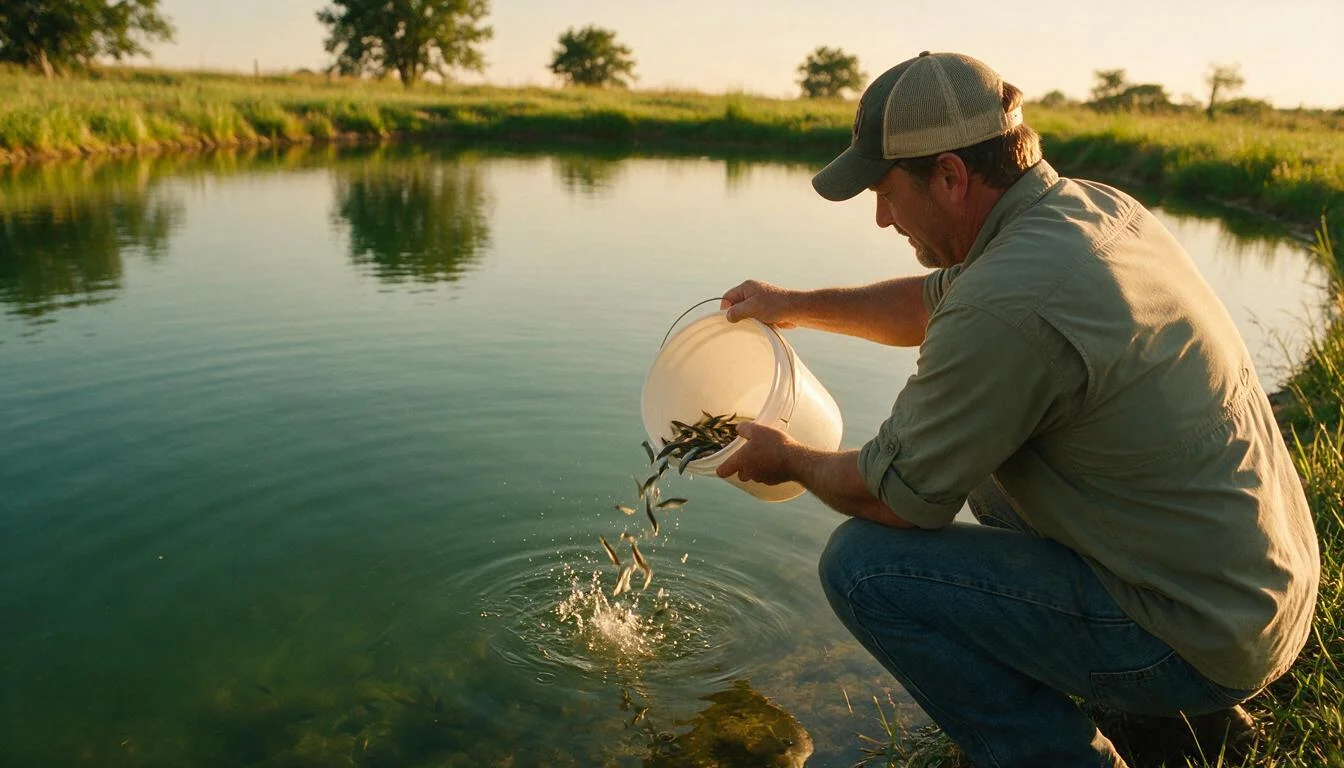
Step 1 — Fall or winter: stock the bream. Bluegill, redear, and fathead minnows go in first, once the pond is at least half full and still filling. Cool transport temperatures stress the fish less, and bream stocked in fall will spawn the next spring. New ponds get catfish fingerlings with the bream; when adding catfish to an established pond, use 8–10 in fish so the bass do not eat them.
Step 2 — The following spring: add the bass. Stock 50 largemouth bass fingerlings per acre in spring, when the bream are ready to spawn. The timing is deliberate: the bream fry are just hatching when the small bass arrive, giving them a food supply from day one.
Step 3 — Stock on a calm, cool day. Spring and fall are the standard windows. Avoid the heat of summer and hard winter freezes — temperature shock is the biggest killer of newly stocked fish.
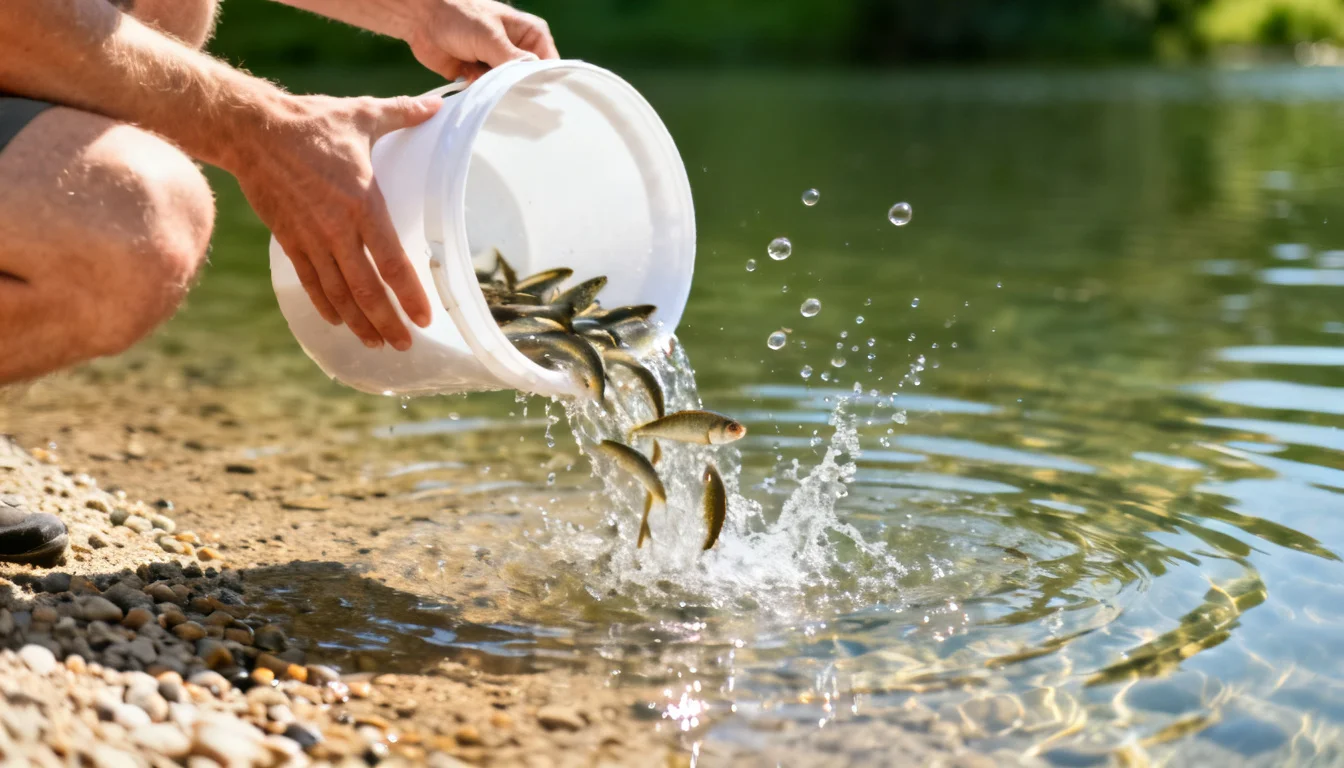
Step 4 — Acclimate before releasing. Float the sealed bags in the pond for 15–30 minutes so the water temperatures equalize, then gradually add pond water to the bag over another 10 minutes. Release the fish gently; do not dump the transport water into the pond, because it can carry disease.
Small Ponds: Hybrid Bluegill and Catfish-Only Options
Ponds under half an acre cannot support the classic bass-bluegill balance, because there is not enough room for both populations to regulate each other. For small ponds, the two proven options are:
- Hybrid bluegill and channel catfish. The hybrid — a cross between bluegill and green sunfish — grows fast, bites aggressively, and produces mostly males, so reproduction is limited and the pond stays manageable. Stock roughly 500–750 hybrids per acre with 50 channel catfish. Plan to restock every few years, since the hybrids cannot sustain themselves.
- Catfish-only. A pond stocked only with channel catfish (50–100 per acre) is simple to manage and easy to fish: feed them floating pellets, and they bite from the dock all summer. This is often the best choice for a tiny pond or a pond with poor water quality.
The Kentucky Department of Fish and Wildlife gives the same advice in one line: ponds under half an acre fish best with hybrid sunfish or catfish only.
Fish to Avoid Stocking in Ponds
Some fish ruin a pond faster than others, and the damage is hard to reverse without draining and starting over.
- Crappie. The most common stocking mistake. Crappie produce boom-and-bust year classes, hatch earlier than bass, and quickly overpopulate ponds, stunting themselves and starving the bass and bluegill. Missouri's DNR says crappie should not be stocked in ponds under 10 acres, and most southern agencies agree. If you absolutely want crappie, you must manage the pond for small, crowded bass to eat the young — which means giving up on big bass.
- Common carp and goldfish. They root up the bottom, keep the water muddy, and never stop reproducing. Grass carp are a different fish, and only sterile triploid grass carp are legal in most states.
- Tilapia. They eat vegetation and grow fast, but they die in winter in most of the country, leaving a mess of dead fish.
- Green sunfish. They overpopulate even faster than bluegill and rarely grow to a desirable size. They often arrive by accident when someone transfers fish from another pond — never move wild fish into your pond.
- Walleye, pike, and trout. They need cold, deep, well-oxygenated water that most ponds cannot provide.
Grass carp deserve special caution. Triploid grass carp are the standard biological tool for weed control, but they eat submerged weeds — hydrilla, coontail, elodea — not algae, not cattails. Stock them only if you actually have a weed problem, at 2 per acre for light growth, 5 for moderate, and up to 10 for heavy growth. Most states require a permit, and a few ban them entirely if your pond connects to other waterways, so check with your state DNR before ordering.
After Stocking: Keeping the Balance
Stocking is not the end of pond management; it is the beginning. Every few years, a stocked pond drifts out of balance, and the fix is harvest, not more fish.
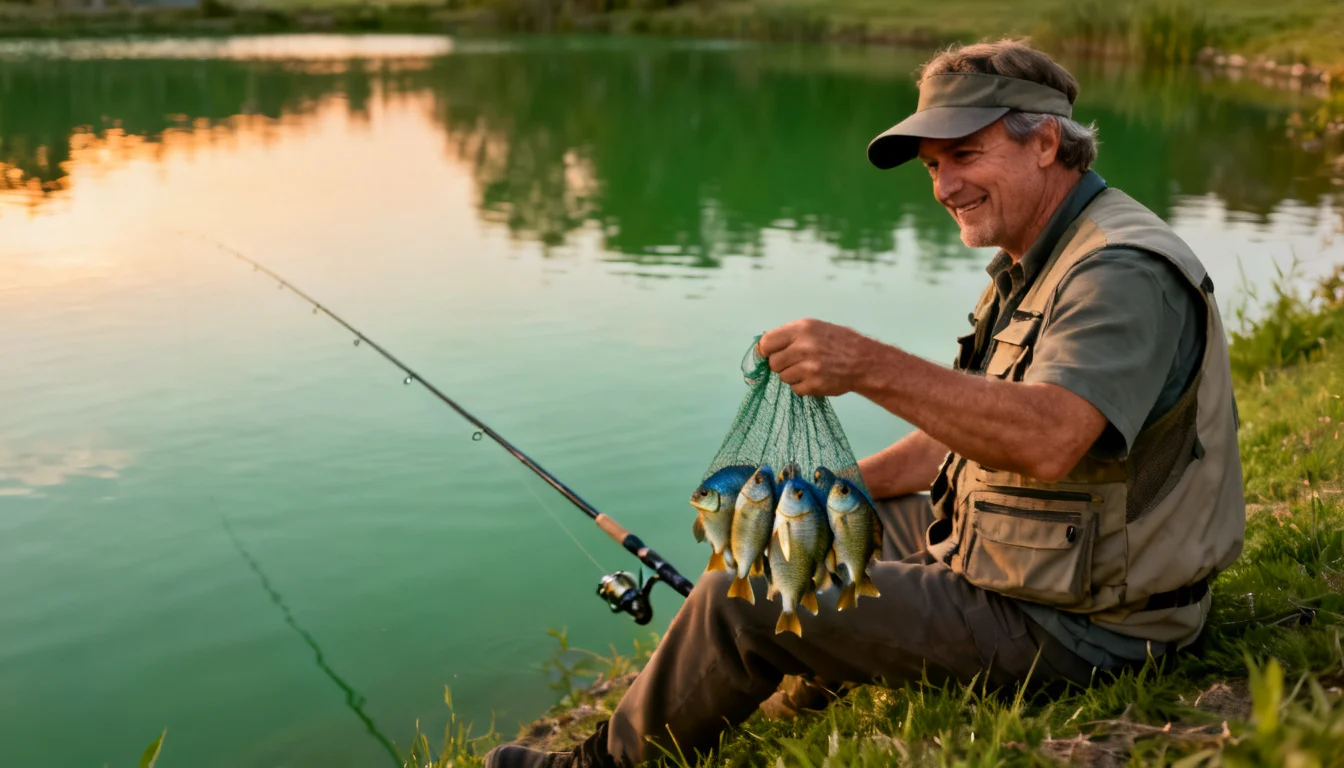
- Harvest bluegill harder than bass. A good rule from Kentucky's fisheries biologists: for every 1 lb of bass you take out, remove 4–5 lb of bluegill. A fertile 1-acre pond supports roughly 100 lb of bass and 200–300 lb of bluegill, and most of the bluegill growth should come out every year.
- Protect the bigger bass. Consider a voluntary 15 in minimum on largemouth bass. Bass that size are the predators keeping bluegill and crappie in check.
- Watch for stunting. If the bluegill are all 4–6 in and skinny, the pond is overpopulated — harvest more. If the bass are thin and numerous, the opposite is true: too many bass are competing for too little food.
- Fertilize only if the water is clear. A fertilization program can roughly double fish production, but it needs testing first. Lime a pond if the pH runs below 6.5 (about a ton of agricultural lime per acre raises pH by one point), then apply a high-phosphorus fertilizer in spring, stopping once a Secchi disk disappears at 18–24 in.
- Plan for oxygen. Most pond fish kills happen at dawn in summer, when an algae bloom dies off or a cloudy calm stretch drops oxygen. Keeping part of the pond 8–12 ft deep helps prevent winterkill and gives fish room during summer heat, but when an algae die-off drops oxygen, even deep water can run low — aeration is the real insurance.
Pond fish stocking is a long game: expect a full season before the bluegill are catchable, two or three years for the bass to hit 12 in, and steady improvement as the balance settles.
Common Stocking Mistakes
- Stocking bass and bluegill in the same season. The bass arrive with no food; the whole system stumbles.
- Overstocking catfish. Fifty per acre is a supplement; a hundred or more quickly become several hundred pounds of catfish that crowd the pond and muddy the water.
- Adding fish from another pond. Wild transfers bring green sunfish, parasites, and disease — buy from a certified hatchery instead.
- Skipping acclimation. Dumping bag water into a warm pond in July is a reliable way to kill half the order.
- Ignoring harvest. A stocked pond that nobody fishes becomes a stunted pond within a few years.
- Stocking grass carp "just in case." They can strip every rooted plant, and plants are the nursery for the whole food chain.
FAQ
How many fish should I put in a 1-acre pond?
For an unfertilized acre, stock 500 bluegill (or 350 bluegill and 150 redear), 50 channel catfish, and 50 largemouth bass the following spring. Add 3 lb of fathead minnows for extra forage if you want it. And resist the urge to double the order: every acre has a fixed food budget, and overstocking simply produces skinny, slow-growing fish.
When is the best time to stock a pond?
Stock bluegill, redear, and catfish in fall or winter while the pond is filling, then add bass the following spring when the bream spawn. Spring and fall are the safe windows; summer heat and winter freeze-ups stress fish during transport and release.
Why do ponds need both bass and bluegill?
They are a predator-prey team. Bluegill reproduce constantly and feed the bass; bass eat enough bluegill to keep the population from exploding. Stock either alone and the pond swings out of balance — all stunted bluegill or all skinny, overpopulated bass.
Can I stock crappie in my pond?
Not if you want a healthy bass and bluegill pond. Crappie overpopulate and stunt in ponds under about 10 acres, and once they take over, the usual fix is draining or chemically renovating the pond.
A few agencies will stock adult black crappie at 15 per acre into a deliberately bass-crowded pond — but that trade-off costs you the big bass.
Do I need a permit to stock fish in a pond?
Usually not for bass, bluegill, and catfish from a licensed hatchery, but triploid grass carp require a permit in many states, and some states require permits or health certificates for any stocking. It is illegal to stock public waters, and moving fish from another pond is illegal in most states. Check with your state DNR before ordering.
How long until stocked fish are ready to catch?
Bluegill are catchable within a year and good-sized in two. Bass take two to three years to reach 12 in, and channel catfish grow fast on feed — 8–10 in fingerlings become 2–3 lb fish in a couple of seasons on a feeding program.
The Bottom Line
Pond stocking works when you follow the recipe: bluegill first, bass next spring, catfish as a bonus, and crappie left out. Stock the right species at the right rates, and the pond largely manages itself — with a little help from your fishing rod.
A well-stocked pond is the best fishing you can own: bluegill for the kids, largemouth bass for the thrill, and channel catfish for the skillet.