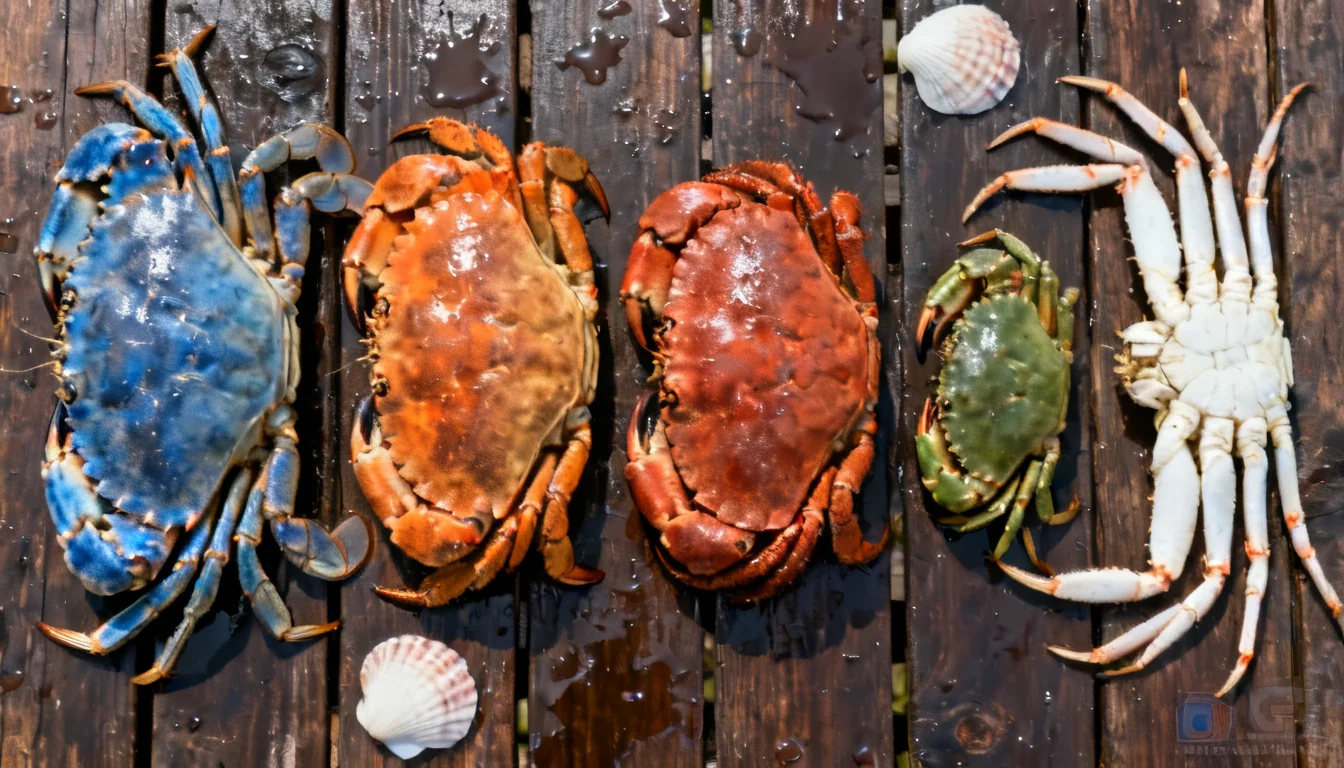
Common Crabs in US Waters: Identifying the Types of Crabs You’ll Catch
America has a lot of crabs, and most of them never reach a menu. If you want to know the types of crabs under your local pier — which are keepers, which are protected, and which ones are actually worth the work of picking — this is the page to bookmark.
They live in estuaries, on rocky jetties, in muddy bays, and deep in the Bering Sea. Some are among the best eating in the ocean; one is a costly invader; one isn’t even a crab. Here’s how to tell them apart.
Quick Comparison: Common US Crabs at a Glance
Use this table for fast crab identification, then jump into the write-ups below — it’s the short version of which are the most valuable edible crabs in US waters.
| Species | Where you’ll meet it | Typical size | Season | Worth eating? |
|---|---|---|---|---|
| Blue crab | Atlantic and Gulf estuaries | 4–7 in carapace | May–Oct | Excellent |
| Dungeness crab | Pacific coast, sand and bays | 6–8 in carapace | Varies by state | Excellent |
| Red rock crab | Pacific shallows, docks and breakwaters | 4–6 in carapace | Year-round | Very good |
| Jonah crab | Atlantic, Maine to Virginia | 4–6 in carapace | Year-round | Very good |
| Stone crab | Florida and Gulf rocky bottom | Up to 5.5 in carapace | Oct 15–May 1 | Exceptional (claws) |
| King crab | Bering Sea and Gulf of Alaska | Legs to 6 ft span | Oct–Jan, permit only | Exceptional |
| Snow and Tanner crab | North Pacific and NW Atlantic | 4–6 in carapace | Jan–Apr | Excellent |
| Green crab | Both coasts, estuaries and flats | 2–4 in carapace | Year-round | Edible, tiny yield |
| Mole crab | Sandy surf zones | 1–1.5 in | Summer | No — it’s bait |
| Horseshoe crab | Atlantic and Gulf beaches | 8–19 in with tail | Spring spawning | No, and often protected |
Sizes are adult ranges, not records, and every season and limit below is set by states that change them. Treat this as the map, not the rulebook.
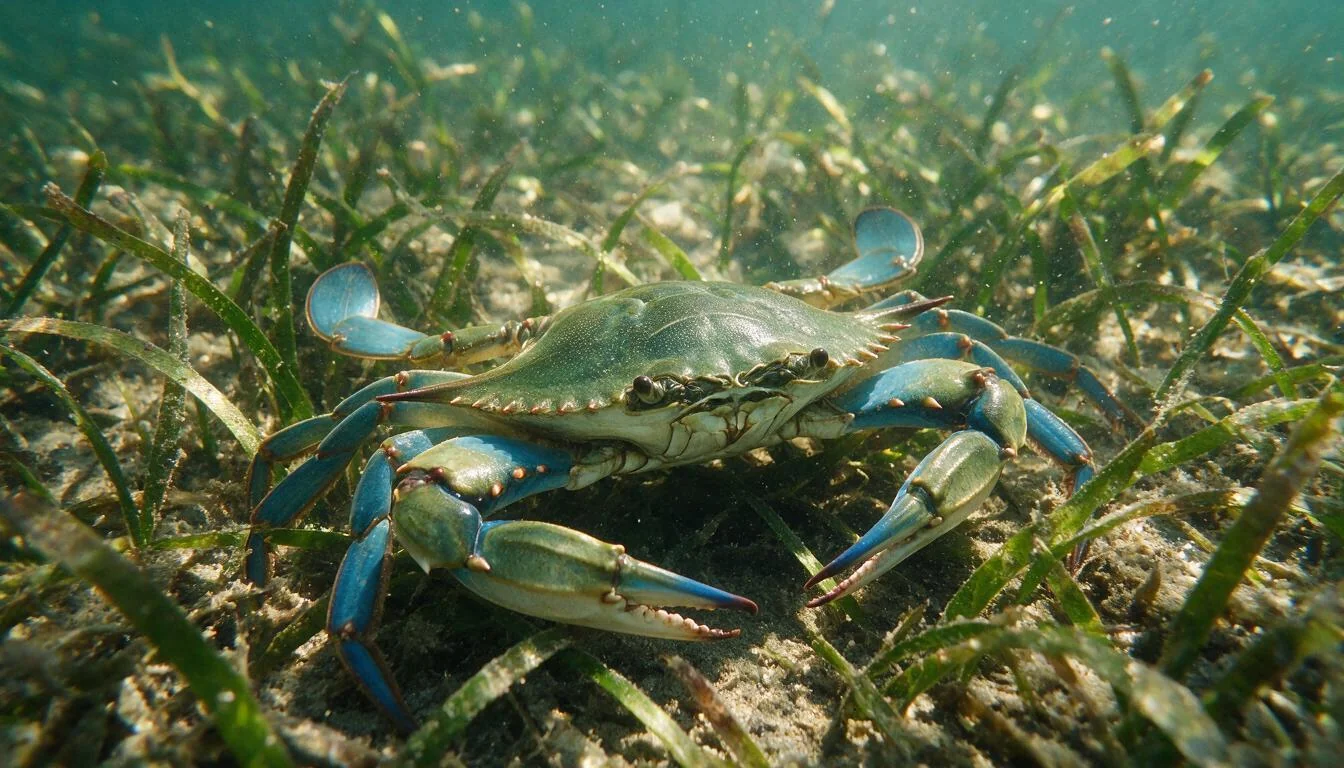
Blue Crab (Callinectes sapidus)
The Chesapeake icon, and the crab most Americans actually catch.
Identification
- Size: usually 4–7 inches across the carapace; big males can push 8 inches tip to tip.
- Color: olive-green to brown shell, blue-tinted claws, and bright blue on the swimming legs.
- Key features: two paddle-shaped rear legs built for swimming, a row of sharp spines down each side of the shell, and dark blue or purple claw tips.
- Male vs female: males carry a narrow, T-shaped flap on the underside; mature females have a broad, rounded, reddish flap.
Where It Lives and When
Blue crabs run the Atlantic from Nova Scotia to Argentina and right around the Gulf of Mexico, and they thrive in brackish water where rivers meet the sea. Look for them over mud, sand, and shell in estuaries, around eelgrass and marsh edges.
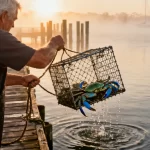
They’re most active May through October, peaking in July and August; in winter they bury in the mud and effectively vanish from the shallows. Aggressive scavengers and cannibals, they hit baited traps fast — and they’ll eat a smaller crab in your pot.
Edibility
Excellent. Sweet, tender meat, and soft-shell crabs — caught right after molting, before the new shell hardens — are fried whole as a seasonal delicacy. Picking takes patience, which is why a bushel on newspaper is a social event. Steam with Old Bay, or boil.
Sexing, habitat, and the fishery picture in full: blue crab species guide.
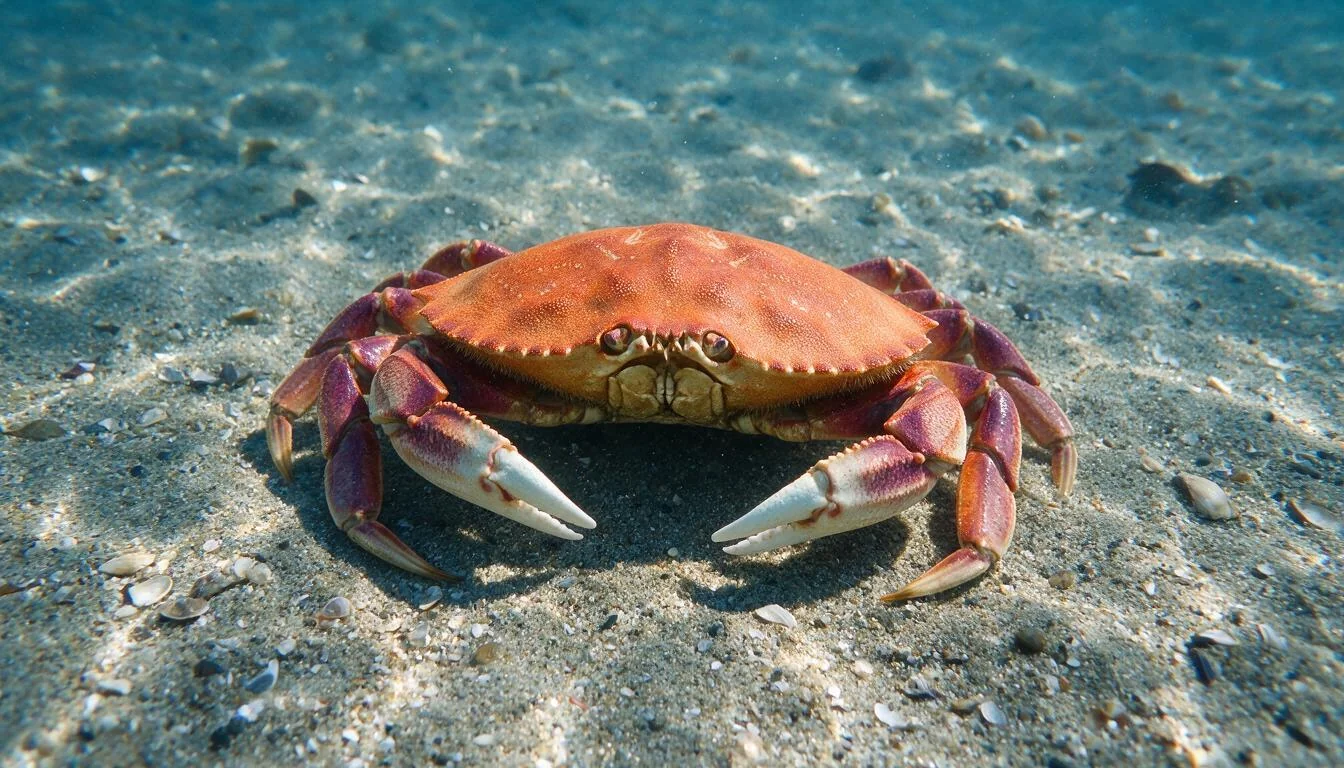
Dungeness Crab (Metacarcinus magister)
The West Coast heavyweight, with the best meat-to-shell ratio of any crab here.
Identification
- Size: commonly 6–8 inches across the carapace, up to about 10; large males exceed 2 pounds.
- Color: orange-brown to reddish, purple-tipped claws, white underside.
- Key features: a wide, fan-shaped carapace with a scalloped front edge lined with small teeth between the eyes.
Where It Lives and When
Dungeness range from Alaska to Baja California, on sandy and muddy bottom in bays, estuaries, and nearshore water — roughly 10 to 150 feet in the recreational range. Puget Sound, San Francisco Bay, Coos Bay, and Southeast Alaska are the classic grounds.
Season varies by state and gets adjusted by emergency order when crabs are still soft-shelled or when domoic acid turns up in testing. Washington’s recreational season is largely a summer fishery, opened area by area each year; Oregon and California lean toward fall, winter, and spring. Sport rules usually mean hard-shell males only, 6¼ inches minimum.
Edibility
Excellent. Sweet, firm, slightly nutty, with heavy meat in both body and claws. Boil, steam, or grill.
Rock, Red Rock and Jonah Crabs
The crabs you catch whether you meant to or not — and they’re worth keeping.
Identification
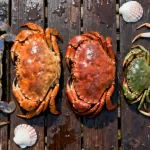
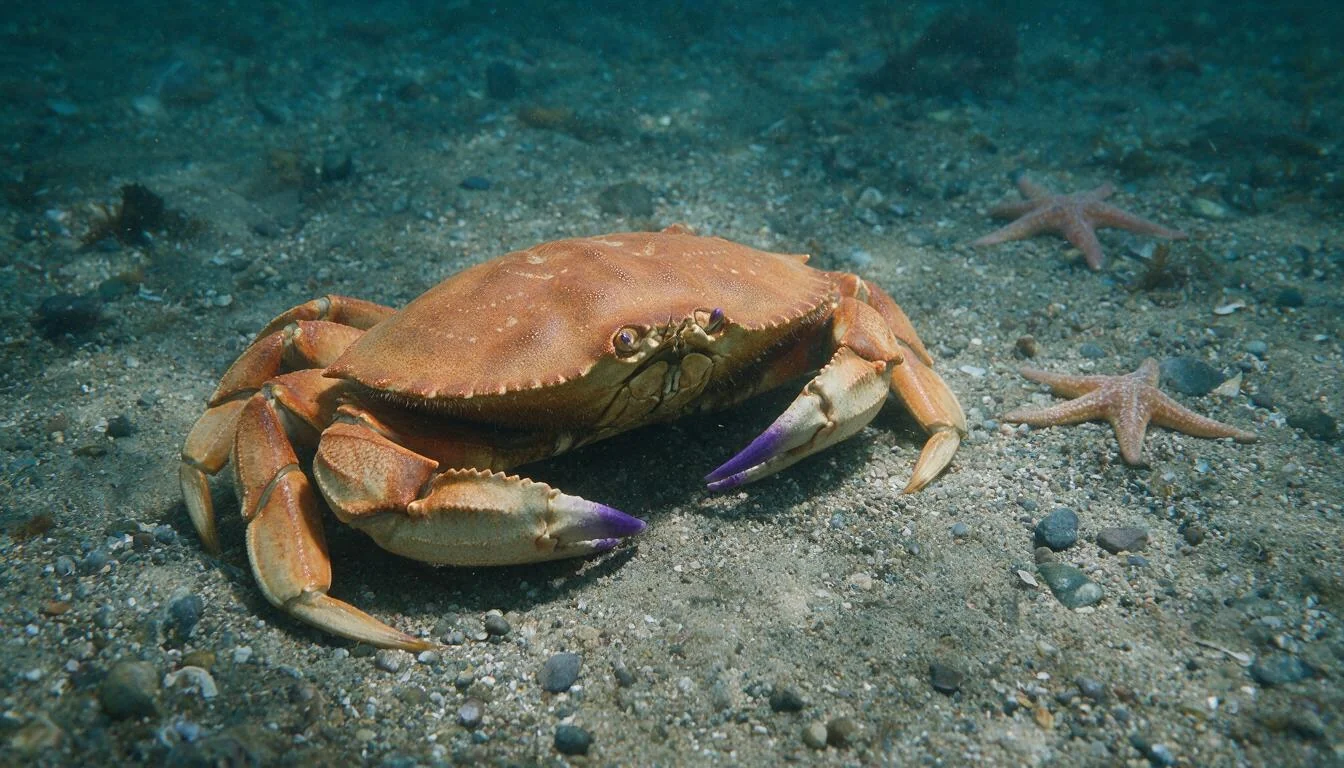
- Red rock crab (Pacific): 4–6 inches, brick red with black-tipped claws, wide toothed front edge.
- Rock crab (Atlantic): up to about 5 inches, yellow-brown with reddish speckling and dark claw tips.
- Jonah crab (Atlantic): 4–6 inches, heavy orange-brown, pebbly shell, black or purple claw tips.
Where They Live and When
Rock and Jonah crabs work rocky bottom, jetties, and shell hash from the low-tide line out past 100 feet. Red rock crab sit shallower than Dungeness and are common right off public docks, while Jonah crabs mix with lobsters in traps from New England to Virginia.
They’re available year-round in most areas, they don’t migrate much, and they’re far less fussy about tide and bait than blue crabs — a reliable backup when Dungeness season is closed. Washington allows six red rock crab a day, either sex, with a 5-inch minimum; Atlantic states set their own Jonah and rock crab rules.
Edibility
Very good. Sweet, slightly denser than blue crab, with a thicker shell that’s harder to open — which is exactly why so many get thrown back. Steam and pick the claws for crab cakes.
King Crab (Paralithodes camtschaticus and relatives)
The Alaska legend — and not a realistic recreational target.
Identification
- Size: carapace up to about 10 inches; leg span up to 6 feet.
- Color: red, blue, or brown, depending on species.
- Key features: extremely long, spiny legs and a heavily armored shell. Only legs and shoulder meat are worth keeping.
Where It Lives and When
King crabs live 100 to 600 feet down in the Bering Sea, Gulf of Alaska, and the North Pacific. The commercial season runs roughly October through January, and some years it doesn’t open at all — Bristol Bay has been shut in several recent seasons after stock collapses.
Recreational harvest is a small, permit-based personal-use fishery in a few Alaska areas with tight household limits. You will almost certainly buy your king crab rather than catch it.
Edibility
Exceptional. Sweet, tender leg meat, usually sold pre-cooked and frozen. Steam, boil, or grill with butter.
Snow and Tanner Crab (Chionoecetes opilio and C. bairdi)
The cold-water favorite behind most restaurant crab legs.
Identification
- Size: 4–6 inches across the carapace; leg span up to about 3 feet.
- Color: orange-brown to red, bright orange once cooked.
- Key features: very long, slender legs and small claws on a rough, spiny shell. Tanner crabs are the rounder-bodied cousin.
Where It Lives and When
Snow crabs live deep, 40 to 1,200 feet, on mud and sand in the Bering Sea, Gulf of Alaska, and the Northwest Atlantic. Tanner crabs sit shallower in parts of Alaska, which is why they show up in recreational pots there and snow crab almost never does.
The Bering Sea snow crab season runs about January to April. Deep Pacific trap gear also brings up horsehair crabs, a Japanese-market favorite that US recreational crabbers essentially never see.
Edibility
Excellent. Sweet, delicate, slightly fibrous leg meat. Steam or boil.
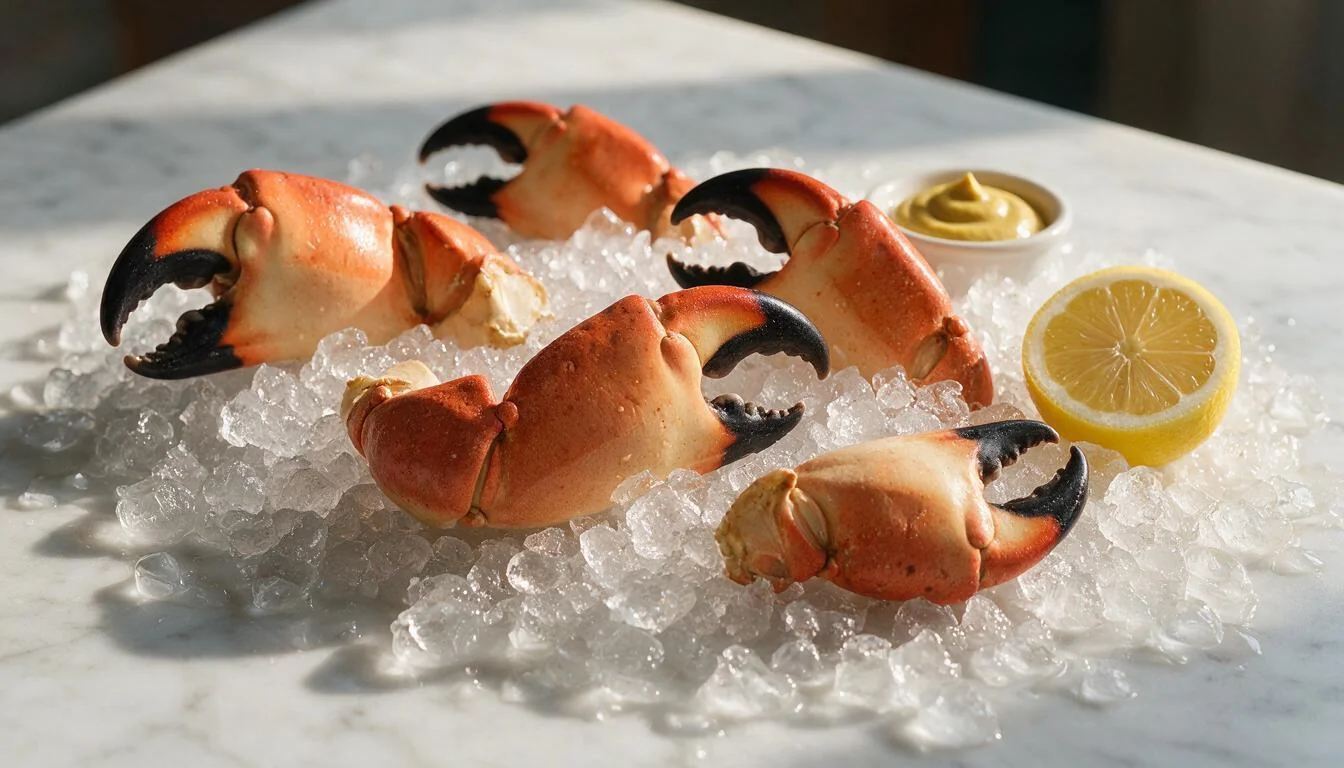
Stone Crab (Menippe mercenaria)
The Florida specialty that regrows your dinner.
Identification
- Size: carapace up to about 5.5 inches, claws reaching 6 inches.
- Color: tan to brown with gray spots and black-tipped claws.
- Key features: massive, asymmetrical crushing claws — one noticeably bigger — on a smooth, heavy shell.
Where It Lives and When
Stone crabs work rocky bottom, jetties, oyster bars, and mangrove shorelines from Florida through Georgia, South Carolina, and the Gulf, most abundantly on both Florida coasts.
The season runs October 15 through May 1. Claws must measure at least 2⅞ inches from the elbow to the tip of the lower immovable finger, the daily limit is one gallon of claws per person, traps must be pulled by hand, and taking claws from egg-bearing females is illegal.
Edibility
Exceptional. Firm, sweet claw meat, denser than blue crab and often served chilled with mustard sauce. Boil or steam the claws.
Green Crab (Carcinus maenas)
The invasive pest you’re allowed to eat.
Identification
- Size: 2–4 inches across the carapace.
- Color: usually mottled green, but red, orange, and yellow are common — color is not reliable here.
- Key features: a pentagon-shaped shell with five sharp spines on each side of the eyes, three rounded lobes between the eyes, and a flattened, hairy last pair of legs.
Where It Lives and When
Green crabs came from Europe and now occupy estuaries, marshes, and intertidal mud from Maine to Virginia and from Washington to California. They’re active year-round and most abundant in summer and fall. They eat juvenile clams, oysters, and mussels, and can clip eelgrass at the roots.
Edibility
Edible, barely worth it. The meat is sweet and “eat the invader” campaigns encourage harvest, but a 3-inch crab yields a thimble of meat. Use them for stock or bisque, or fry a freshly molted one soft-shell.
Mole Crab (Emerita spp.)
Not food. Outstanding bait.
Identification
- Size: 1–1.5 inches long.
- Color: gray, tan, or nearly white.
- Key features: oval, streamlined body, no claws, and snorkel-like antennae.
Where They Live and When
Mole crabs — sand fleas to beachgoers — occupy every sandy surf zone in the country. They burrow backward as the wave pulls out and filter plankton as it drains. Most active in summer and fall, and they’re the main food source for shorebirds and surf perch.
Edibility
Not eaten. Too small, and better on a hook. Mole crabs are deadly on surf perch, corbina, and pompano: dig a handful where the waves retreat, hook them through the shell, and fish the trough.
Horseshoe Crab (Limulus polyphemus)
The living fossil that isn’t a crab at all.
Identification
- Size: 8–19 inches long including the tail.
- Color: brown to dark olive.
- Key features: a horseshoe-shaped shell, a long spike tail, ten legs hidden underneath, and blue blood.
Where They Live and When
Horseshoe crabs are closer to spiders and scorpions than to the crab in your cooler. They’ve been here over 450 million years and are found from Maine to Florida to the Gulf, with Delaware Bay the most important spawning ground on earth. They come ashore on the highest tides around the full and new moons in May and June.
Edibility
Not recommended, and often illegal. There’s very little meat and it tastes of ammonia. Harvest is banned or tightly limited in several states, and their eggs feed migrating red knots while their blood is used to test medical equipment and vaccines. Handle one from the sides — never by the tail — and put it back.
Handling and Eating Safely
- No crab you’ll catch in US waters is poisonous. The real risks are spoilage and, on the West Coast, algae-derived toxins that concentrate in crab viscera during bloom events. Follow state health advisories and skip the guts when one is in effect.
- Cook live crabs. One that died beforehand is growing bacteria fast, and boiling doesn’t fix that.
- Avoid brightly colored reef crabs in tropical water — several warm-water xanthid crabs carry toxins — and never eat crab you can’t identify.
- Wear gloves on blue, Dungeness, and stone crabs. All three can draw blood.
- Buying instead of catching? Weight in the hand means meat in the shell, and anything already dead stays at the market.
FAQ
What types of crabs can you catch from shore?
Blue crab, red rock and rock crab, Jonah crab, green crab, and — in Florida — stone crab all turn up within reach of a dock, pier, or jetty. Dungeness and kings are deeper, so they usually mean a boat or a long soak.
Which crabs are the best to eat?
King and Dungeness win on meat yield, stone crab claws win on texture, and blue crab wins on sweetness. Rock, red rock, and Jonah crabs are close behind and much easier for a beginner to catch.
Do you need a license to catch crabs?
In most coastal states, yes — a recreational saltwater license, plus a registration for pots in some places. Size limits, seasons, and gear rules are set state by state.
Are green crabs safe to eat?
Yes, and eating them helps native shellfish. Yield is the problem: a legal-size green crab gives you almost nothing, so most people boil them for stock.
Can you eat horseshoe crabs?
They aren’t true crabs, their meat is poor, and several states restrict or ban harvest. Leave them where they are — their eggs feed migrating shorebirds.
Related reading
- How to Catch Crabs — traps, lines, and the techniques that fill a bucket.
- How to Catch Blue Crabs — the East and Gulf Coast method guide.
- American Lobster: The Complete Guide — the Northeast crustacean that shares your trap.
- How to Dig Clams — the other shellfish trip worth planning around the tide.
Crab rules change by state and sometimes by year. Confirm species limits, seasons, and gear requirements with your state fish and wildlife agency before you keep anything — and release the egg-bearing females.