How to Catch Crabs: Traps, Lines & Techniques for Beginners
Crabbing is the most forgiving way there is to put your own seafood on the table. You don’t need a boat, a $200 rod, or years of practice to learn how to catch crabs — a length of twine, a chicken neck, and a dip net will get you started from almost any public dock on the coast.
My first bushel came off a pier during a family vacation, with borrowed gear and a bucket I still own.
That said, the difference between a bucket of keepers and an empty afternoon comes down to four things: the right gear, bait they can smell, the tide window, and knowing which crabs you’re legally allowed to keep. All four are covered below.
What You’re Catching
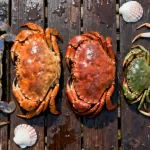
The crab under your local dock decides your gear. On the Atlantic and Gulf coasts the default target is the blue crab, an estuary specialist that crowds grass beds and mud bottoms in brackish water. West Coast crabbers usually chase Dungeness on sandy bottom, with red rock crab as the everyday backup.
Florida has stone crab claws, Alaska has Tanner and permit-only king crab, and both coasts produce rock and Jonah crabs that most people don’t know are edible.
If you can’t yet tell a keeper from a throwback — or you’re not sure whether that little red crab is worth cracking — start with our guide to the common crabs in US waters before you set anything. Misidentifying your catch is the fastest way to an expensive ticket.
The Gear That Actually Matters
You can spend a fortune on crabbing gear, and plenty of people do. Cheap crab traps, a hand line, and a dip net cover most of the crabbing in America.
Crab Pots and Traps
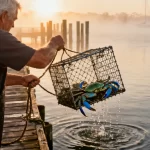
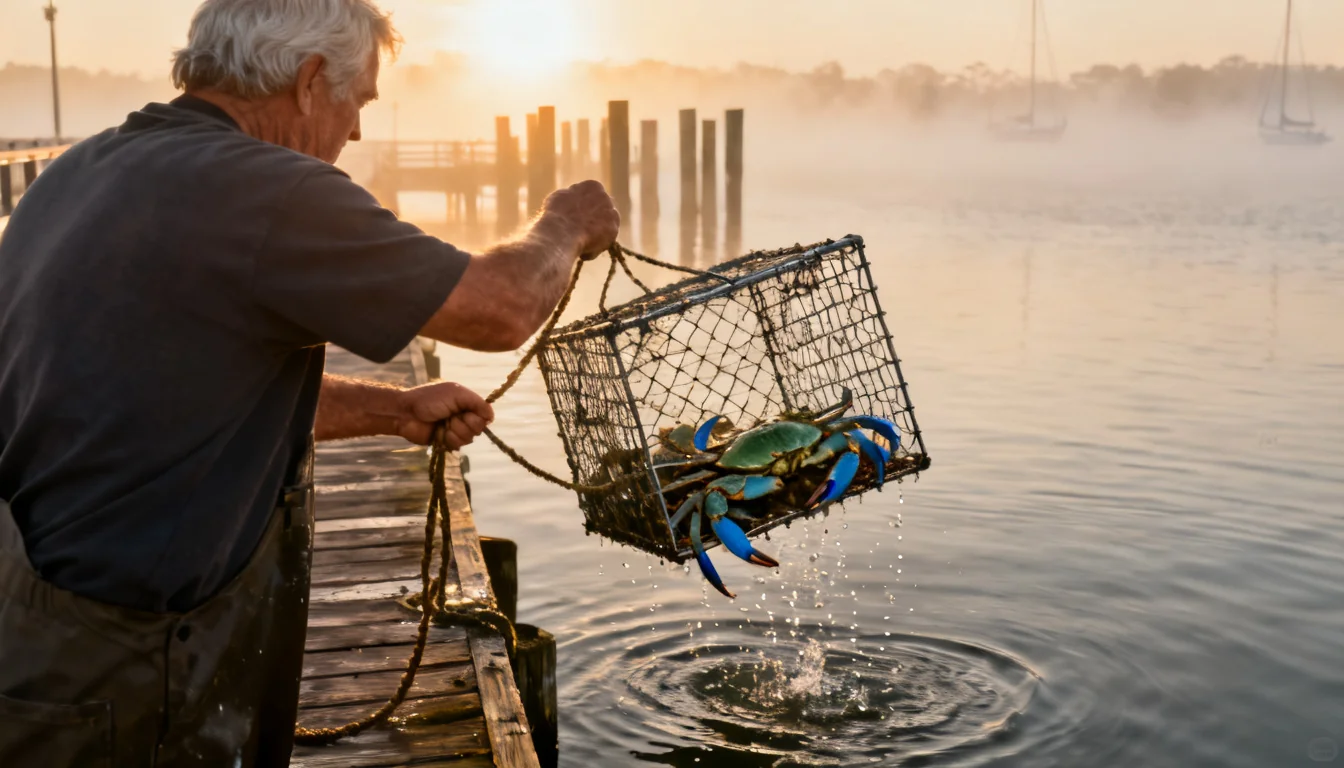
Crab pots are the volume producer. Bait goes in the center, crabs walk in through funnel-shaped throats, and they can’t find their way back out until you pull the pot.
- Box pots: rectangular wire frames with two or more entrances. Best for blue crabs and Dungeness.
- Pyramid or folding traps: they fold flat, they’re cheap, and they store in a car trunk. Perfect for pier crabbing.
- Ring nets: two hoops with bait in the middle, pulled up fast. The easiest gear for kids and total beginners.
Two specs matter more than brand or price. First, mesh: openings of 1½ inches or larger are required in many states, because undersized crabs need to be able to walk out. Second, cull rings — the round escape ports set into the side panels.
Maryland requires two, one at least 2 3/16 inches and one at least 2 5/16 inches. Virginia requires two unobstructed rings at least 2 3/8 inches across, and Florida requires mesh of 1½ inches or more plus 2 3/8 inch escape rings.
Removing a cull ring to keep more shorts is illegal in most states, and it’s the fastest way to wreck a crab stock.
A few more pot rules worth knowing: Maryland requires turtle reduction devices on pots in Chesapeake waters, and setting pots from private shoreline needs a free registration. Everywhere, mark your pot with a visible buoy and stay out of boat channels.
Hand Lines and Trotlines
A hand line is the simplest crab gear on earth: 30 to 50 feet of nylon line, a 2 to 4 ounce sinker, and bait tied to the end. You drop it, you feel the crab tug, and you bring it up slowly with a dip net waiting.
A trotline is the same idea scaled up — a long baited mainline you work from a boat — and it’s covered in the techniques section below.
Dip Nets, Gloves, and the Rest
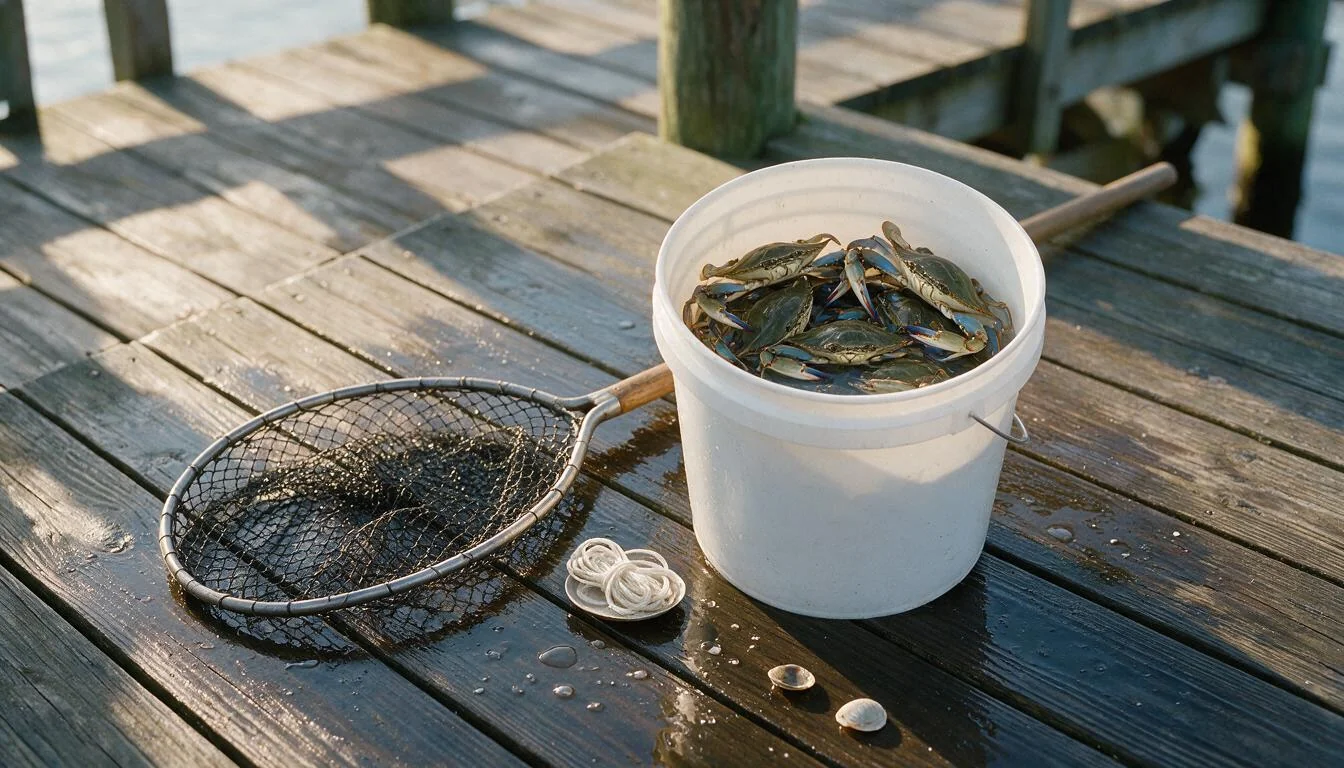
- Dip net: 12 to 18 inch frame, 8 to 12 foot handle. Fine mesh, or your crabs walk off the rim.
- Gloves: leather or puncture-resistant work gloves. Blue crabs draw blood on purpose.
- Footwear: closed-toe shoes with grip. Docks and jetty rocks are slick.
- Bucket or cooler: with a lid, and never more crabs than it can hold with room to spare.
The Best Bait for Crabs
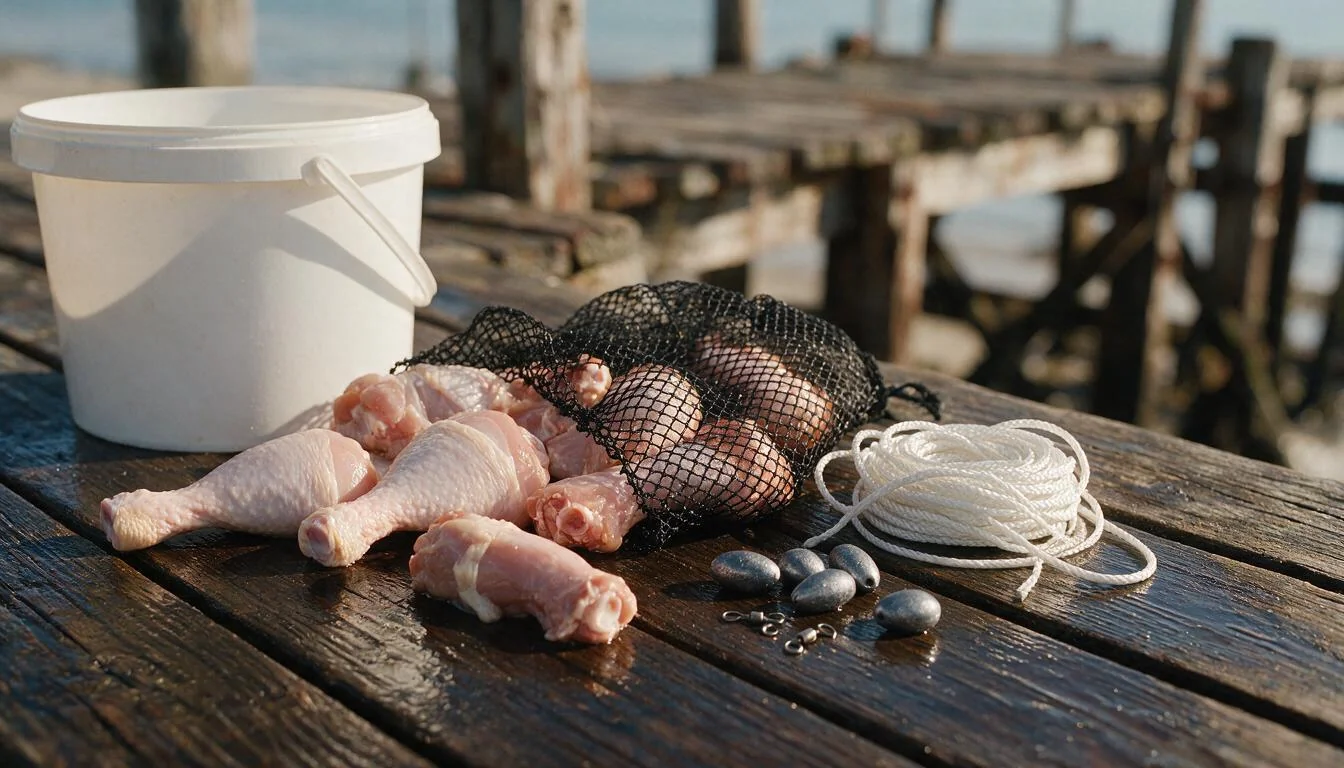
Crabs are scavengers that find food by smell, and the stinkier the bait, the faster they come. Freshness is not a virtue here.
Bait Ranked by Effectiveness
- Chicken necks and legs. The gold standard for blue crabbers. Cheap, tough enough to stay on the line, and they stink. Thread several onto a line or stuff them in a bait bag.
- Fish heads and frames. Ask a fishmonger for scraps, or use what you clean yourself. Menhaden, mackerel, herring, and bluefish all work. Chesapeake crabbers have used bunker and razor clams for generations.
- Squid. Durable and strong-smelling. Cut into strips and it outlasts almost anything else.
- Razor clams. The West Coast standby for Dungeness, because the scent carries in cold water.
- Turkey necks. Tougher and larger than chicken, so they last longer through a long soak.
Bait Handling Tips
- Score or crush the bait so the scent bleeds out faster.
- Use a bait bag or mesh sack. Loose bait just feeds the bottom.
- Refresh bait every 30 to 45 minutes if nothing is happening.
- Frozen bait works fine. Just don’t let it bake in the sun all afternoon.
Five Proven Crabbing Techniques
None of these is complicated, and the order matters: pots for volume, lines for learning how to catch crabs by feel, and nets for everything the gear misses.
1. Crab Pots: Best Odds, Least Effort
- Bait the pot. Three to five chicken necks or a couple of fish heads, secured in the bait compartment or bag.
- Rig the line. Attach a floating buoy to a line long enough to reach bottom with slack for the tide.
- Set it. Lower the pot to the bottom in 6 to 20 feet of water, over grass, mud, or a sandy channel edge.
- Soak it short. Twenty to thirty minutes in warm shallow water, up to a couple of hours deeper. A pot left all day fills with escaped shorts, keeps nothing extra, and can drown diamondback terrapins — the main reason frequent checking is now a rule in several states, not just good manners.
- Pull and empty. Retrieve the pot with a rope hook or gaff, sort your catch, and put keepers straight into the bucket.
2. Hand Lining from a Pier or Dock
This is where every beginner should start. No pot, no boat, no license headache — just bait on a line.
- Tie a chicken neck or fish head onto the weighted end.
- Lower it to the bottom right beside a piling, rock, or drop-off.
- Feel for the tug. A crab that has grabbed your bait will hold on as long as you don’t panic.
- Come up slow and steady. Yank it and the crab lets go halfway to the surface.
- Slide the dip net under the crab just below the water line and lift.
Pro tip: fish two or three hand lines at once, spaced 10 to 15 feet apart, and keep the line slightly tight so you can feel a grab.
3. Trotline Crabbing from a Boat
Trotline crabbing is the scaled-up version: a mainline of 100 to 300 feet with baits tied every few feet, anchored at both ends over a productive flat. One person idles the boat slowly along the line while the other nets the crabs riding the bait and drops them in the cooler.
The whole trick is pace. Move too slowly and crabs drop off before you reach them; move too fast and your net misses. Keep the mainline just off the bottom and never stall over a crab. Check your state’s rules first — trotlining is usually allowed recreationally but often has gear and license conditions attached.
4. Dip Netting in the Shallows
When you can see a crab, you can catch it. Dip netting is a sight-fishing game that works along seawalls, docks, and clear grass flats.
- Spot the crab on the bottom in a foot or two of water.
- Put the net down-current or downwind of it, so the drift carries it in.
- Prod it gently from behind. A startled crab swims backward or sideways — straight into the net.
- Lift fast. Hesitation costs you every time.
5. Catching Crabs by Hand
On a summer night in a shallow flat, a headlamp and a pair of gloves beat any trap. Crabs move into the shallows to feed after dark and a light pins them in place.
Work slowly. Pin the crab from behind, using your thumb and forefinger to clamp the rear of the shell while its claws fold toward your palm.
Keep your fingers out of the claw’s reach, hold the crab away from your body, and get it into the bucket before it works a claw free. Bare-handed night crabbing is how people end up in urgent care — wear gloves.
When to Go Crabbing
Tides Matter More Than You Think
- Rising tide is the money window. Crabs push into the shallows to feed on what the incoming water disturbs.
- Slack water, just after the high, is the easiest time to see them.
- Strong outgoing tide sends crabs back to deeper water, where your gear can’t reach them.
The last two hours of the rise plus the first hour of slack is the window serious crabbers plan their day around.
Season by Species
There is no national opening day, and last year’s dates aren’t reliable either — seasons are set state by state and often adjusted by emergency order mid-year. Our blue crab season guide breaks down the regional dates and limits; the short version for the main species:
- Blue crab: roughly May through October, peaking in July and August when the water is warmest.
- Dungeness: varies by state. Washington’s recreational season is mostly summer, opened each year by emergency rule; Oregon and California lean toward the fall, winter, and spring months.
- Stone crab: October 15 through May 1 in Florida, claws only.
- Red rock and Jonah crab: available almost year-round in most areas.
- Tanner and king crab: short, permit-based windows in Alaska, set annually.
Best Time of Day
Early morning and late afternoon are the dependable feeding windows, and night is best for hand-catching in shallow water. Crabs also feed through the day whenever the tide is moving, so a rising tide at noon beats a slack tide at dawn.
Size Limits, Licenses, and the Law
- License: most coastal states require a fishing or crabbing license, and some require a separate free registration just to set pots from your own shoreline.
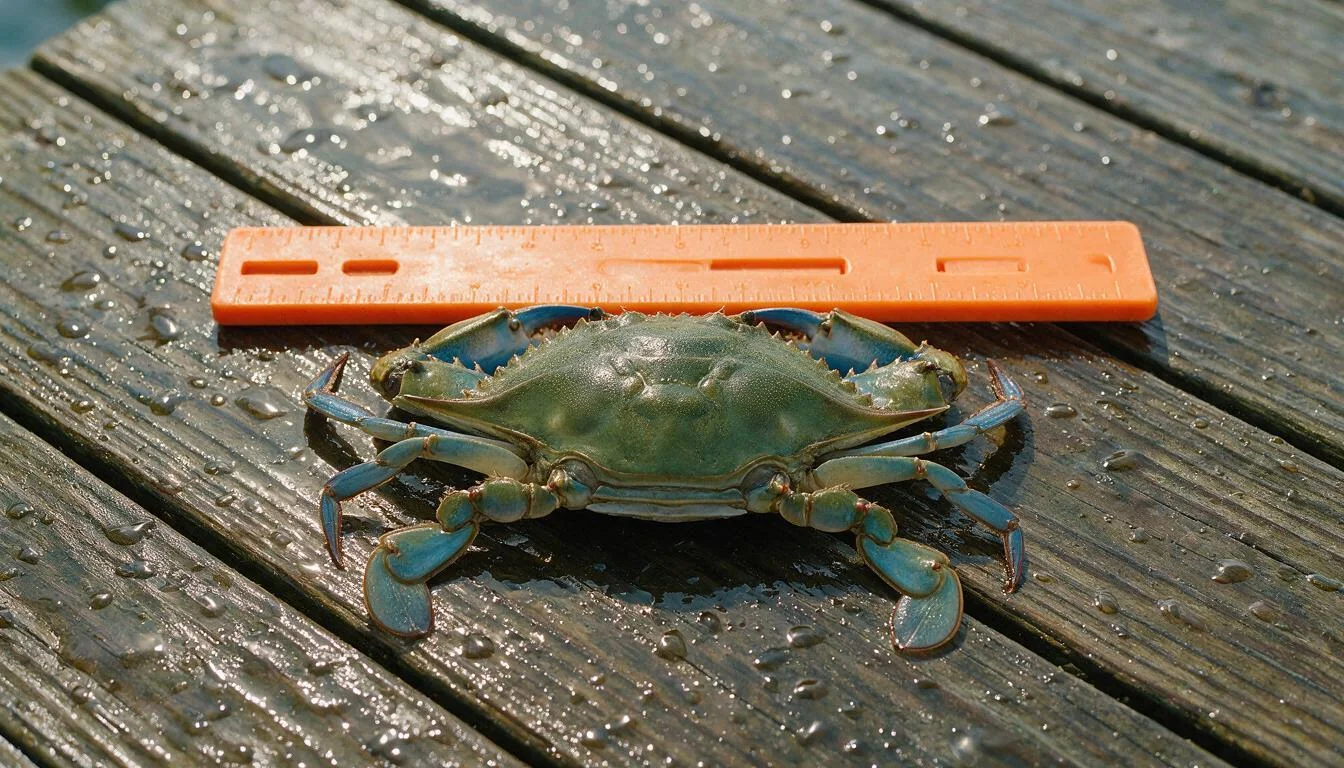
- Measure it right: blue crabs are measured tip to tip of the pointed spikes, from the top of the shell. Dungeness are measured across the widest part of the carapace. Buy the cheap plastic gauge for your species — guessing at the dock is how you get cited.
- Blue crab size limits: Maryland is 5 inches from April 1 through mid-July, then 5¼ inches, with mature females exempt; Virginia is 5 inches for males and immature females, with mature females having no minimum.
- Dungeness: 6¼ inches, hard shell, males only on the West Coast sport fishery.
- Stone crab: claws only, 2⅞ inches minimum, one gallon of claws per person per day.
- Egg-bearing females: a sponge crab goes back immediately everywhere. No exceptions, no argument — those eggs are next year’s fishery.
- Bag limits: they change. Maryland resets its recreational hard crab limits by public notice each year; other states cap by the dozen, the bushel, or the gallon. Check before you load up.
Handling Crabs Without Getting Pinched
Hold a crab from behind, gripping the rear of the shell so both claws fold forward, away from your fingers. Never pick one up by the claws. Move each crab into the bucket claws-down and keep the lid on — a blue crab’s pinch splits skin, and a stone crab can crack an oyster shell.
Keeping Your Catch Alive
- Keep them cool, damp, and out of direct sun. Wet burlap or seaweed over the top of a cooler works well.
- Never store live crabs in fresh water. Saltwater species die fast in it, and dead crabs spoil quickly.
- Don’t crowd them. Crabs need air and space, and a packed bucket kills the bottom layer.
- Cook within 24 hours. That’s when the meat is sweetest. A crab that died on its own goes in the trash, never in the pot.
Blue crabs steam in 20 to 30 minutes with a heavy shake of Old Bay. Dungeness boil in about 18 minutes for a two-pound crab. Then you’re at the best part of crabbing: cold drink, newspaper on the table, and the sound of shells cracking.
FAQ
Do you need a license to catch crabs?
In most coastal states, yes — a recreational fishing, crabbing, or saltwater license covers it, along with a registration for pots in some places. A few states allow hand-lining or dip netting without one. The license is cheap; the fine for skipping it is not.
Can you catch crabs without a boat?
Easily. Hand lines, folding traps, and ring nets are designed for piers, docks, jetties, and bulkheads, and dip netting and hand-catching both happen in water you can wade. Boat-less crabbing is the normal way beginners start.
How long should you leave a crab pot in the water?
Twenty to thirty minutes in warm shallow water is the sweet spot, and a couple of hours is reasonable in deeper water. Longer soaks don’t add many keepers, and abandoned or all-day pots kill terrapins, which is why several states require frequent checks.
How do you measure a crab to see if it’s legal?
Lay a plastic crab gauge across the top of the shell. Blue crabs measure from spike tip to spike tip; Dungeness measure across the widest part of the carapace. If it’s close, throw it back — undersized crabs are the one thing a warden checks without asking twice.
Are crabs more active at night or during the day?
Both, depending on the tide. Crabs feed hardest on a rising tide whenever it happens. Night wins for shallow-water hand-catching because a light freezes them in place, and mornings and evenings are the most productive daylight windows.
Related reading
- How to Catch Blue Crabs — the East and Gulf Coast playbook, method by method.
- Blue Crab: Complete Guide — identification, habitat, and how the fishery works.
- How to Dig Clams — the other shellfish trip that fills a bucket from shore.
- How to Catch Shrimp — cast nets, traps, and the light-scoop technique.
Crabbing rules change by state and sometimes by year — confirm seasons, size limits, and gear requirements with your state fish and wildlife agency before you keep anything.