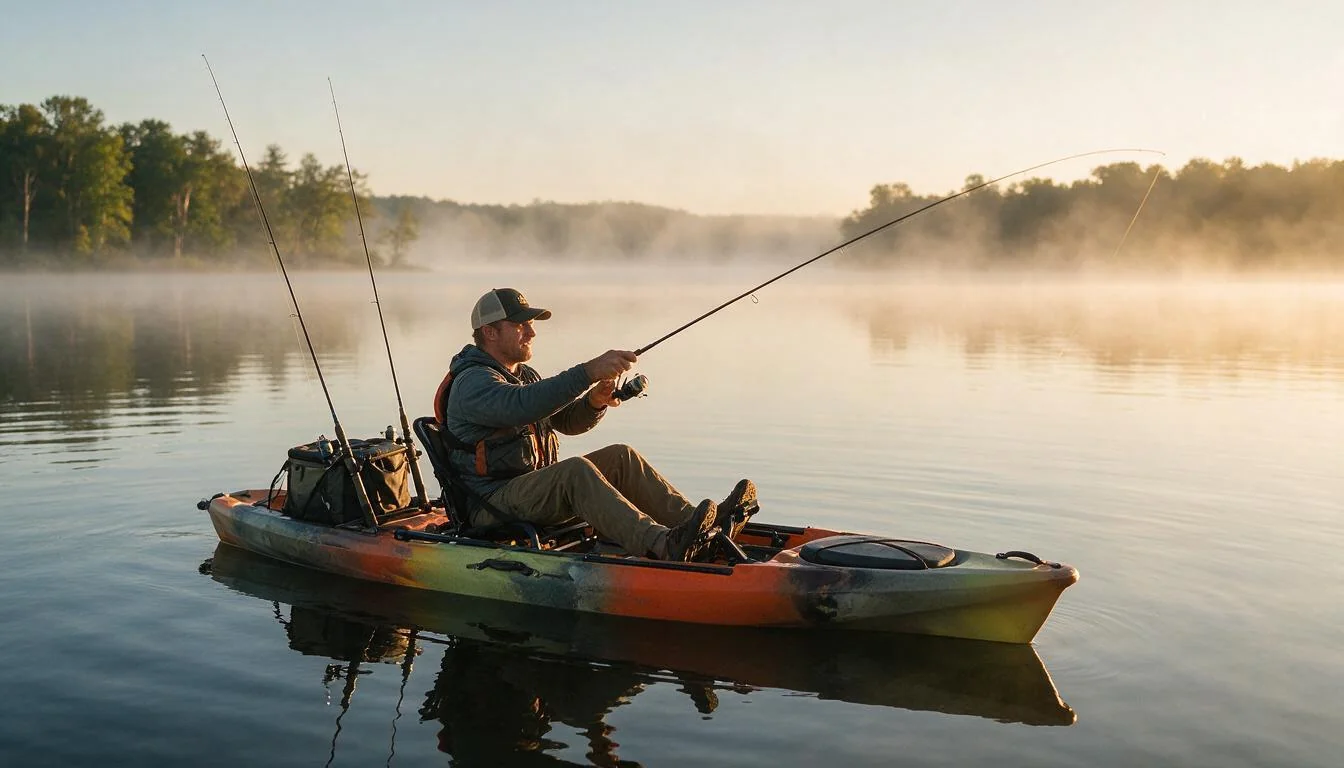
Kayak Fishing for Beginners: How to Rig, Launch, and Fish a Paddle Craft
Kayak fishing fixes a problem every shore angler knows. The fish you can see are usually the fish you cannot reach, and the best cover sits well past your longest cast. A paddle craft turns that last hundred yards into open water, quietly, for less money than a used aluminum boat.
The access comes with homework, though. A kayak behaves nothing like a bass boat or a pair of waders, and the margin for error is smaller. If you already read water from one bank, the basics of fishing from shore carry over. What changes is range, wind, and how much gear you can bring.
Rig the platform first, then the launch, then the fishing. That order keeps the first kayak fishing trips out of trouble.
Sit-On-Top or Sit-Inside: Why Anglers Almost Always Choose Open
A sit-on-top kayak puts you on a molded seat above the hull, with an open deck and scupper holes that drain water straight through. A sit-inside kayak wraps you in a cockpit instead. Both float, both paddle, and they suit different jobs.
Walk a kayak shop or a launch on any warm weekend and count hulls. Purpose-built fishing kayaks are overwhelmingly sit-on-top, and for three practical reasons.
- Self-rescue. If you flip, you climb back onto a flat deck. Re-entering a swamped cockpit in deep water is a skill most beginners never practice.
- Gear access. Rods lie flat, a crate sits behind the seat, and nothing disappears inside a hull.
- Freedom to move. You can swivel, kneel, or stand on a wide model without a coaming around your hips.
Sit-inside designs still earn their place. A cockpit with a spray skirt sheds spray and wind, keeps legs warmer in November, and paddles more efficiently in long open-water crossings. The trade is real: bailing and re-entry get harder, and getting trapped upside down is the failure mode the fishing market walked away from.
Open decks have one drawback worth naming. You sit higher, so crosswind pushes you around more than it does a paddler sitting at the waterline.
Length, Width, and Weight Capacity: The Trade-Offs That Matter
Three numbers decide how a kayak behaves: length, width, and rated capacity. Everything else is comfort and rigging.
- 10 feet. Light, cheap, turns on a dime, ideal for creeks and farm ponds. It tracks poorly and loses speed battles against wind.
- 12 feet. The usual beginner answer. Enough hull to track and cover water, short enough to turn and car-top alone.
- 14 feet and up. Fast, straight-tracking, comfortable on long paddles and open water. Heavier to load and harder to turn in tight cover.
Width drives kayak stability more than any marketing claim. A 28-to-30-inch hull feels quick and twitchy. A 32-to-36-inch hull feels planted, stands up to standing, and pushes water like a barge. Seat height and hull shape (pontoon versus V) shift the feel again, which is why a demo paddle beats a spec sheet.
Capacity is the number beginners ignore. Every hull carries a plate or label with a maximum load: paddler, tackle, cooler, battery, anchor, everything. Stay well under it. A kayak loaded to its limit sits low, drains sluggishly, and feels unstable in chop.
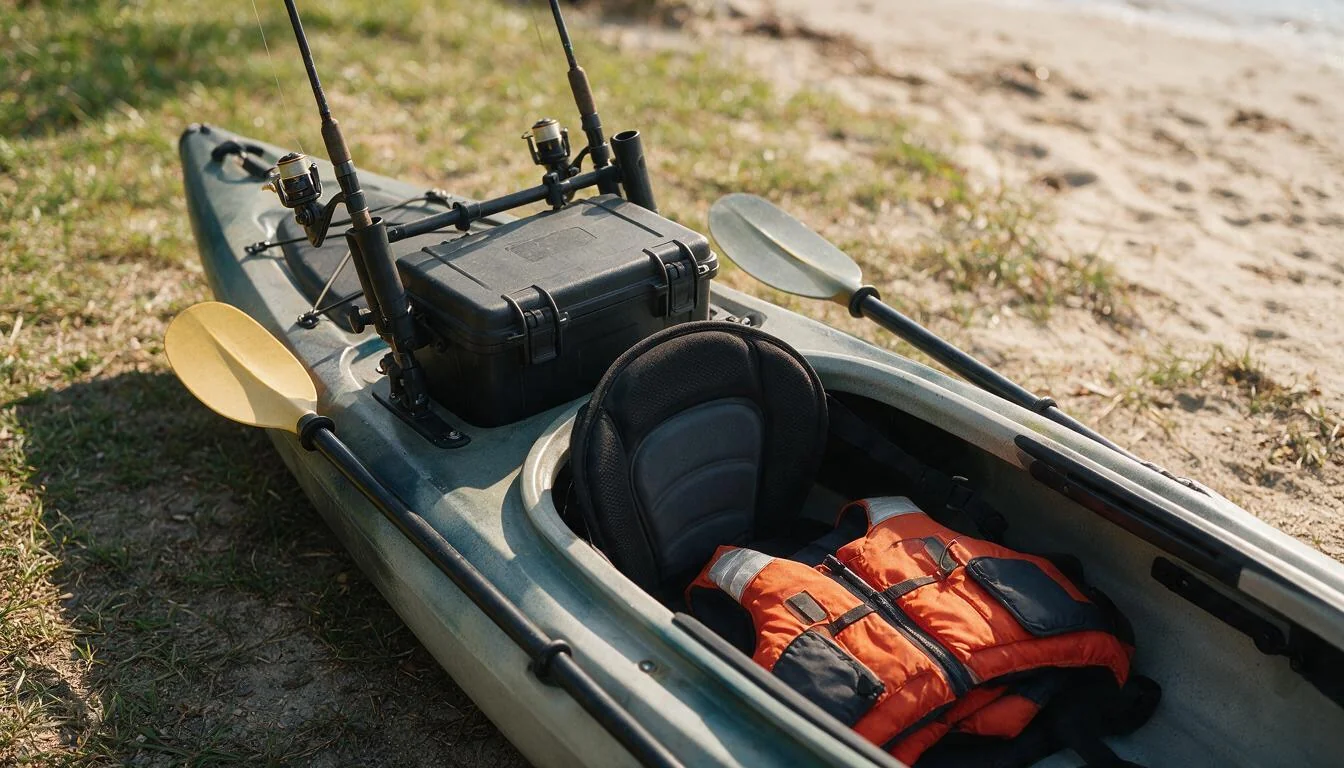
Paddle vs Pedal: How You Want to Move
The paddle vs pedal question is really about which water you fish most.
A paddle is cheap, light, nearly unbreakable, and works in six inches of water with weeds brushing the hull. It also occupies both hands, and holding position in wind or current means constant correction strokes.
A pedal drive hands your feet the job. You steer with a rudder, troll hands-free, fight wind and current while keeping your rod ready, and cover distance faster over a long day. The cost is money, weight, and draft. Prop and fin drives need water beneath them, and vegetation wraps them at exactly the wrong moment.
Here is the honest split:
- Small ponds, creeks, and weedy shallows: paddle.
- Big lakes, reservoirs, and anywhere you fight wind: pedal.
- Rivers with current: paddle plus an anchor or stake-out pole beats both.
Many anglers run a pedal hull with a paddle on deck as backup, which is the practical compromise.
Kayak Safety Gear: The Short List That Does Not Bend
Federal rules require a wearable, Coast Guard-approved life jacket for each person aboard a recreational vessel, sized to the wearer, in serviceable condition. Federal law sets carriage; many states go further and require paddlers to actually wear one. Check your state's rules before your first trip.
The rest of the kit is short and cheap:
- A whistle or horn. New York, for example, lists a sound-producing device as required paddlecraft equipment.
- A white light for low light and night, plus a headlamp so your hands stay free.
- Short leashes on the paddle and rods. Anything loose in a kayak ends up at the bottom of the lake.
- A spare paddle, and a hand pump if you paddle a sit-inside hull.
- A dry bag with a charged phone and a written float plan left with someone on land.
Water temperature decides what you wear. The National Weather Service notes cold shock can be just as severe at 50-60°F as at 35°F, and the involuntary gasp can be triggered by water as warm as 77°F. Dress for the water, not the air: shorts in April on a 50°F lake is how spring trips turn into rescues.
Launching a Kayak Without a Boat Ramp
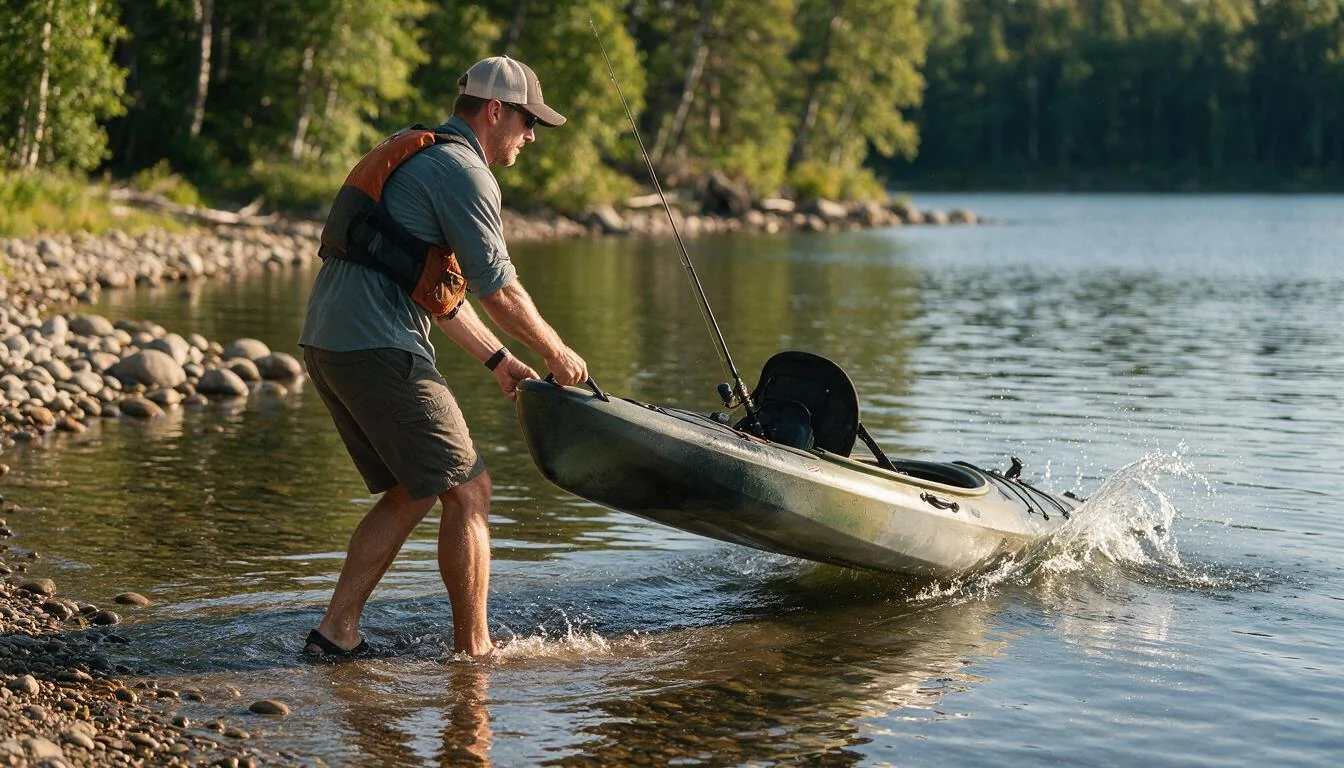
Ramps are for trailers. Launching a kayak is easier at a grass bank, a gravel bar, or a muddy cut, and those spots are everywhere once you look.
Put the bow in the water, hold the toggle or a deck line, and walk the hull out until it floats. Step in over the center of the boat while standing in ankle-deep water, then sit and push off with your hands. Load rods and the crate once you are afloat, or stage them within reach on shore.
Two habits keep it clean. Turn the bow into the wind or current before you sit down, so the hull does not swing broadside while you board. And skip the busy concrete ramp on a holiday weekend, where wakes and reversing trailers create more risk than any bank.
A wheel cart pays for itself on long carries, and a hull pad under the bow saves plastic on gravel. Wet rock, algae, and slick clay banks are the real hazards at a launch, not deep water.
Anchoring, Holding Position, and Standing to Sight-Fish
Wind moves a kayak faster than you expect, so holding position is the part of kayak fishing for beginners that nobody warns you about. A stake-out pole pins you in one to six feet of water and is the tool shallow-water anglers use most. An anchor with a trolley lets you adjust your angle without re-setting.
Anchor from the bow or stern in moving water, never broadside. Use a quick-release cleat so you can drop the line instantly, and never anchor in strong current where the hull could swamp.
Standing transforms sight-fishing. On a 32-inch-plus hull with a flat deck, stand close to the centerline, keep your feet quiet, and pick apart beds, tailing fish, and shadows with polarized glasses and sun at your back.
Practice standing in waist-deep water with your PFD on. A fall in three feet of water costs you nothing but dignity. A first attempt over deep water does not.
Wind, Current, and Where a Kayak Actually Wins
Plan the day around the wind, not around a pile of spots. Paddle upwind and upcurrent first, then drift or fish your way back. A drift sock slows a windblown drift to a fishable speed, and the windblown shoreline is usually the one with bait pushed against it.
On lakes, that instinct pairs with structure. Search for points, weed edges, and creek channels the same way a boat angler would, which is the whole logic behind how to fish a lake. Where those features stack up is covered in this guide to locating productive water.
Now the honest part. A kayak reaches coves, backwater, and mid-lake structure that shore anglers can only stare at. It also asks for weather judgment. You are the engine, there is no cabin, and a building thunderstorm or a 20 mph afternoon gust leaves you exposed. When the forecast turns, go in early.
FAQ
Do you have to wear a life jacket in a kayak?
Federal law requires a wearable, Coast Guard-approved PFD carried for each person aboard, sized and in good condition. Many states specifically require paddlecraft users to wear one rather than stow it. Assume you must wear it, and check your state's boating regulations for the exact wording.
Do you have to register a kayak?
It depends entirely on the state. Ohio registers kayaks as boats; Minnesota does not require a license for non-motorized craft 10 feet or less; Oregon sells a waterway access permit for paddlecraft. Add a motor or a trolling motor and most states treat the hull as a motorboat. Verify with your state agency.
What length kayak should a beginner buy?
Twelve feet still fits most beginners on mixed water. Push past roughly 220 pounds of paddler plus gear, or fish open water that builds an afternoon chop, and move up to 13-14 feet with a 350-pound capacity. Heavier anglers should buy width before length, because a narrow 14-footer loaded down feels twitchier than a wide 12.
How cold is too cold for kayak fishing?
Treat the first sixty seconds after a capsize as breathing practice, not a rescue. Cold shock flips your breathing into short, uncontrollable gasps, so keep your head clear of spray, stay with the hull, and count until your breath evens out. Fighting for shore in that first minute burns energy you will need to reboard.
Can you stand up in a fishing kayak?
Yes, on a sit-on-top hull roughly 32 inches wide or more, and only after you test the boat. Load a rod in the holder and the crate the way you will fish, then shift your weight side to side from a kneeling position and watch how far the hull rocks. A grab bar helps until the wobble stops surprising you.
How do you get back in a kayak after falling out?
On a sit-on-top, roll the hull upright, grab the far-side handle, kick, and slide your belly onto the deck, then swing your legs up. Practice in waist-deep water with a PFD on until it feels routine, because cold water and surprise make simple tasks hard.
The Bottom Line
A kayak is a range extender, not a shortcut. Choose a sit-on-top hull around 12 feet, keep it well under its rated capacity, and wear the life jacket instead of stowing it. Match your clothing to water temperature, not air temperature.
Launch away from trailer ramps, plan the day around wind, and treat the forecast as part of your tackle. Sort out the license and registration rules first, then go fish water you could never reach on foot.