Aquarium Filter Maintenance: How to Clean a Filter Without Killing Your Cycle
Almost every tank crash traced back to "cleaning day" starts the same way. Someone pulls the media out, rinses it under the kitchen tap, and scours the biofilm off, along with the debris it holds, leaving a colony that took six weeks to grow on bare plastic.
Aquarium filter maintenance is really a study in restraint. The sludge you want gone is partly alive, and the nitrifying bacteria doing your water quality work are clinging to the media surface rather than floating in the water.
If your tank is still new, the cycling process that built that colony happens before any of this matters. This guide covers what to rinse, what to leave alone, and how to tell when cleaning is genuinely due.
Why the Filter Holds the Biofilter, Not the Water
Nitrifying bacteria grow as a biofilm on surfaces. In a mature tank, the media inside your filter carries most of that surface area, so the colony concentrates exactly where water moves fastest and oxygen stays highest.
Two groups do the work. Ammonia-oxidizing bacteria such as Nitrosomonas turn ammonia into nitrite, and nitrite-oxidizing bacteria such as Nitrospira and Nitrobacter convert that nitrite into nitrate. All of them need oxygen, a stable pH, and something to cling to.
The open water holds almost none of them. That is why draining half the tank is safe while swapping out all the media can crash it. You are removing water, not habitat — until the day you scour the habitat under a faucet.
Aquaculture extension material describes the biofilter as the primary site of nitrification, and treats the media bed as the equipment that keeps ammonia and nitrite near zero. A home filter is the same idea at smaller scale, running on the same two-step conversion.
The Cardinal Rule: Rinse Media in Tank Water, Not Tap
Municipal water is disinfected on purpose. Chlorine and chloramine exist to kill microorganisms, and the bacteria in your filter are precisely the kind of life they are designed to destroy. A filter media rinse in untreated tap water lays disinfectant directly against your biofilter.
Plenty of keepers have rinsed a sponge under the tap and seen no ammonia spike, and the chemistry explains why. Chlorine at the 0.5 to 1 ppm typical of treated supplies takes far longer than a 30-second rinse to kill nitrifiers. One study on chloraminated water found it took around 90 minutes of contact to knock out even small colonies.
The larger risk is mechanical. Running water strips biofilm and brown sludge off a sponge far more aggressively than a light swish in a bucket. That brown material is a living community of bacteria, worms, and ciliates, and losing it is what actually produces the spike people blame on chlorine.
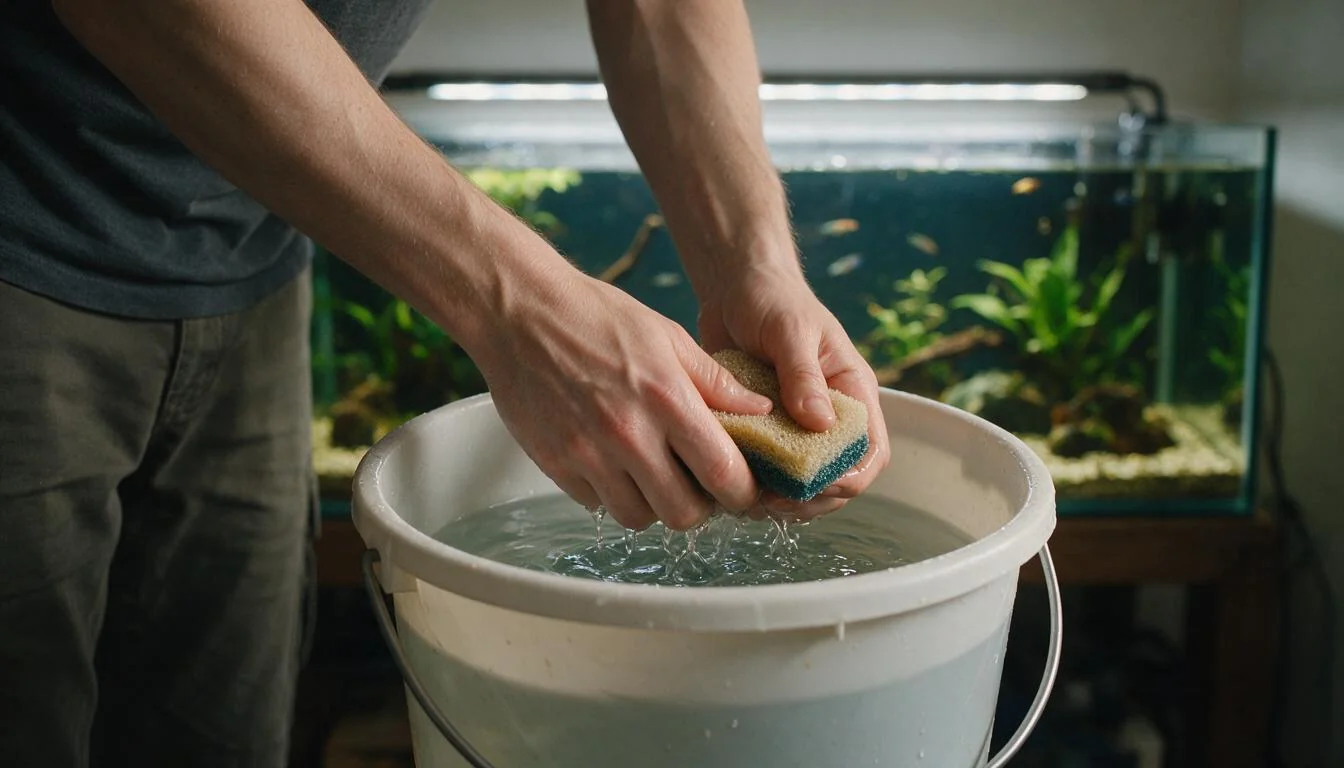
So the rule holds for practical reasons. Save a bucket of water during your next change, squeeze the media in it, and dump the dirty water. Cost: nothing. It removes the entire category of risk.
When to Clean and When to Leave It Alone
Beginners over-clean; veterans under-clean. An honest answer is that there is no single correct interval for aquarium filter maintenance. A filter running with clear water and steady flow does not need attention simply because a month has passed.
Signs that service is due: flow visibly weaker than when the filter was fresh, water turning hazy, debris piling up on the intake, or a rattling impeller. Nitrate climbing faster than usual on the same feeding routine is another clue worth logging.
Typical intervals give you a starting point. Coarse sponges usually want a rinse every 2 to 4 weeks, fine floss or polishing pads every 1 to 2 weeks, and bio-media only when the pores are visibly choked – many filters go years without it. Canisters often run 3 to 6 months between full service.
A heavily stocked or heavily fed tank will need attention sooner. A lightly stocked planted tank can stretch much further, and a decades-old filter tolerates handling that a three-month-old one cannot. Let the tank set the pace instead of a calendar reminder alone. If the whole setup still feels unfamiliar, our step-by-step beginner setup guide walks through the surrounding routine.
A Cleaning Sequence for Each Filter Type
Sponge filters are the simplest case. Lift the sponge out, squeeze it gently four to six times in a bucket of tank water until the rinse water looks cloudy, then put it straight back. Never scrub it pale. A spongy brown appearance is normal and good.
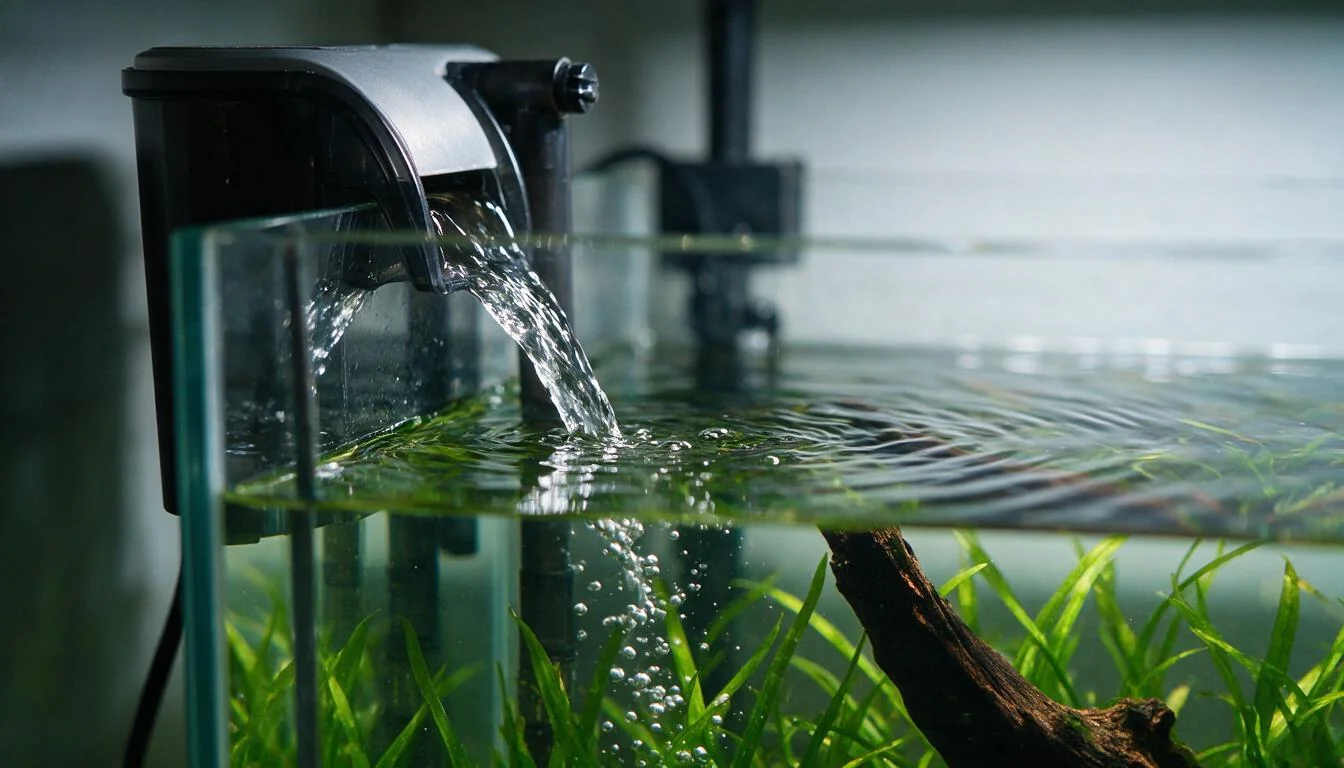
Cartridge and hang-on-back filters usually hold a replaceable pad plus some biological media. Rinse the pad in tank water and reuse it until it starts falling apart; replace it only when rinsing no longer restores flow. Leave the bio-media alone.
A canister filter cleaning session deserves patience. Unplug the unit, close the valves, and carry it somewhere with a towel underneath. Rinse the mechanical trays in tank water, swirl the biological media without scrubbing, and clean the impeller and its well with an old toothbrush.
Reassemble, refill with tank water, and restart. Expect a brief puff of cloudiness when flow resumes; that is dislodged debris, not a crash. Watch the outflow for a minute to confirm the impeller seated properly.
Replace Media in Stages, Never All at Once
Swapping every cartridge or sponge in one session is the fastest route to losing a cycle. You have just removed the whole bacterial population and left bare surfaces behind. The tank now behaves like a brand-new setup with fish already in it.
A thoroughly cleaned or fully replaced filter has to recolonize, which extension guidance on biofilter start-up measures in weeks rather than days. Ammonia can climb within a day or two, the water goes milky, and fish show stress before you think to test.
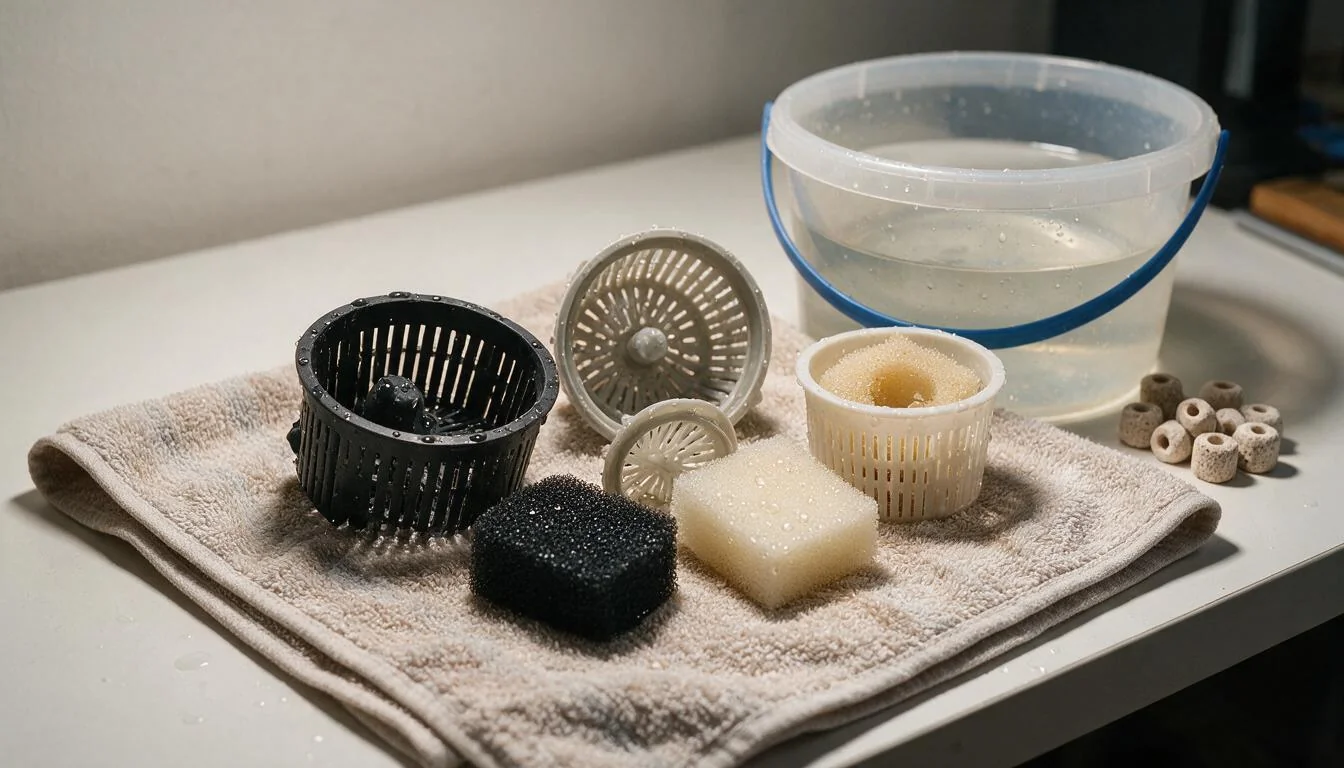
Stage it instead. Swap or deep-clean one media component per session and leave the rest untouched. If your filter holds three trays, rotate through one per visit. Squeezing a dirty old sponge over the fresh piece seeds it with bacteria immediately.
Chemical media is the exception to all of this. Carbon and similar adsorbents are consumed rather than colonized, so replace them on their own schedule without worrying about the colony.
Flow Rate Is Your Best Clogging Signal
Flow falls gradually, which makes it easy to miss. Mark the normal water level in the return chamber, or note how far the outflow disturbs the surface, then compare every week or two. A consistent reference beats your memory.
A drop of roughly 30 percent from the freshly cleaned baseline is a reasonable trigger for service. Past that point, media is packed with debris and the bacteria inside receive less oxygenated water than they need to keep up with waste.
Targets give useful context for judging that drop. Most freshwater tanks want four to ten times their volume per hour. Manufacturers rate pumps with an empty housing, so real filter flow rate commonly lands 25 to 50 percent below the box number once media, hoses, and vertical lift are accounted for.
A 40-gallon community tank aiming for six turns per hour needs about 240 gph of true movement. That usually means a pump rated well above 240 gph, plus a clean intake. A partially clogged strainer can quietly starve the whole target.
A Maintenance Rhythm That Actually Works
A monthly pass takes ten minutes. Check flow, rinse the coarse sponge in tank water, top off with dechlorinated water, and listen to the impeller. If the outflow is still strong, stop there and close the lid.
Quarterly, open a canister or hang-on-back and rinse the mechanical media in tank water. Inspect hoses for kinks, cracks, or loose fittings while everything is unplugged, and wipe the impeller well if it feels gritty.
Rotate one biological component if you clean bio-media at all. Many long-established filters never need it, and the brown film coating the rings is doing real work. Disturbing it on a schedule buys you nothing.
After any filter service, test ammonia and nitrite for the next few days. A small blip is possible even when you do everything right. Catching it early costs a water change instead of a fish.
FAQ
How often should I clean my aquarium filter?
Let flow decide more than the calendar. A reasonably sized filter on a moderately stocked tank usually needs service somewhere between once a month and once a quarter, with canisters often stretching to six months. A heavily stocked tank may want attention every two to four weeks.
Can I rinse filter media in tap water if I add dechlorinator first?
You can, and the habit worth building is storage rather than rinsing. If the filter has to stay off for a while during a rebuild or a move, keep the media submerged in dechlorinated water so it does not dry out. Drying is the thing the colony cannot tolerate, and dechlorinator is cheap insurance for the soak.
What happens if I replace all my filter media at once?
Treat a fully swapped filter like a fresh cycle. Test ammonia and nitrite daily for the first week or two, feed lightly, and change water whenever either reading climbs. Leaving a piece of the old media in a mesh bag near the outflow gives the new surfaces a head start.
Do I need to clean bio-balls or ceramic rings?
Rarely – and when you do, the mechanic matters more than the tool. Swirl them gently in a bucket of tank water so the debris lifts away on its own, then set them straight back in the filter. Never scrub, because that takes the colony off with the dirt.
Why did my filter flow drop right after cleaning?
Air trapped in the impeller housing is the usual culprit. Tilt the filter or canister to let bubbles escape, then restart it and let it run a minute. Check the intake tube for a kink or a clogged prefilter before assuming the pump is failing.
Should I clean the filter and vacuum the gravel on the same day?
Spread them out if you can. Both tasks disturb bacteria and both change water chemistry, so stacking them leaves the tank with very little margin. If you must combine them, clean one filter component only, keep the gravel vacuuming shallow, and test for a few days afterward.
The Bottom Line
Good aquarium filter maintenance is deliberately boring. Rinse mechanical media in tank water, leave the biological media alone most of the time, and replace one piece at a time only when flow tells you it is time. Squeeze the media in a bucket of tank water instead of under a running tap, and your colony survives the chore.
Once the filter side is stable, choosing easy, forgiving fish is the next decision that keeps a new tank calm and gives that bacteria a manageable waste load.