
Pond Water Testing: How to Sample, Read, and Act on the Numbers
Pond water testing is the cheapest insurance a pond owner can buy. A liquid kit costs less than a tank of gas, and twenty minutes with it tells you more about your fish's future than a whole season of staring at the surface. Clear water hides trouble as easily as muddy water does.
Nothing else on a pond moves as many outcomes as water chemistry. Growth rates, spawning success, how fish come through a July heat wave — all of it traces back to a handful of readings.
That is why chemistry sits at the center of pond management basics. Measure on a schedule, write the numbers down, and most fish kills stop being a mystery.
What a Pond Owner Actually Needs to Test
Six or seven readings cover nearly every problem a private pond runs into. Three of them — pH, alkalinity, and ammonia — interact so tightly that testing one without the others tells you very little.
- pH. Penn State Extension puts healthy pond water between 6.0 and 9.0, with most fish doing best near 7.0. Southern extension guides stretch the workable window to 6.5–9.5, but reproduction suffers when pH sits under 6.5 for long stretches.
- Total alkalinity. Pond alkalinity is the measure of buffering capacity, reported as mg/L of calcium carbonate. A desirable range is 50–150 mg/L; ponds under 20 mg/L swing wildly and often grow stunted fish populations.
- Ammonia. The target is zero. Ammonia in ponds comes from fish waste and decaying plants and feed, and the toxic fraction — un-ionized ammonia — is what burns gills. It climbs sharply as pH and temperature rise.
- Nitrite. Also a zero target. Nitrite blocks a fish's blood from carrying oxygen ("brown blood disease"); toxicity can begin as low as 0.1 mg/L, and 0.5 mg/L is a clear action point.
- Dissolved oxygen. Warmwater fish such as bass, bluegill, and catfish need roughly 5 ppm to stay comfortable, and coldwater species like trout need closer to 6.5 ppm at the warmest part of the year.
- Clarity. A Secchi disk reading tells you how much plankton is in the water. Under one foot, extension guidance warns, a pond is a candidate for a lethal oxygen crash.
- Temperature. Take it at the surface and at depth. It governs how much oxygen the water can physically hold and how fast waste breaks down.
Nitrate and phosphorus are worth a lab test once a year if algae keeps winning. Nitrate-nitrogen above 3 mg/L usually points to fertilizer, manure, or failing septics feeding the pond.
When to Test: Pond pH, Oxygen, and the Daily Cycle
A pond is not a steady-state aquarium. Photosynthesis and respiration shove the numbers around on a daily cycle, so a reading taken at noon and one taken at dawn can look like two different ponds.
Sunlight drives it. Algae and plants strip carbon dioxide out of the water all afternoon, which pushes pH up — a full point of swing between dawn and late afternoon is normal in a fertile pond, which is why state labs note the sampling hour on your report.
After dark the process reverses. Plants consume oxygen and release carbon dioxide, and oxygen bottoms out just before sunrise.
That dawn low is the number that kills fish. If you only ever test at 2 p.m., you will never see the 2 ppm oxygen event that suffocated your biggest bass in July. Sample in the morning when you are troubleshooting, and always at the same hour when you are tracking a trend.
Season matters too. Warm water holds less oxygen and holds it worse after a string of 90°F days. Fall leaf loads feed bacteria that eat oxygen. Ice cover seals the pond off for months, and late-winter die-offs usually trace back to oxygen and low pH under the ice, not cold.
Why a Pond Test Kit Beats Strips
Test strips are convenient, which is the only argument for them.
- Color blocks on a strip sit several shades apart, so "0.25" and "0.5" ammonia can look identical. That is the difference between watching a pond and treating one.
- Strips typically read in wide steps and expire quietly after a few months of humid storage in a shed.
- Bouncing light and wet fingers change the color you compare, and your interpretation is a judgment call rather than a number.
- Nobody reads dissolved oxygen reliably from a strip. It has to be measured at the pond with a meter or a drop-count kit.
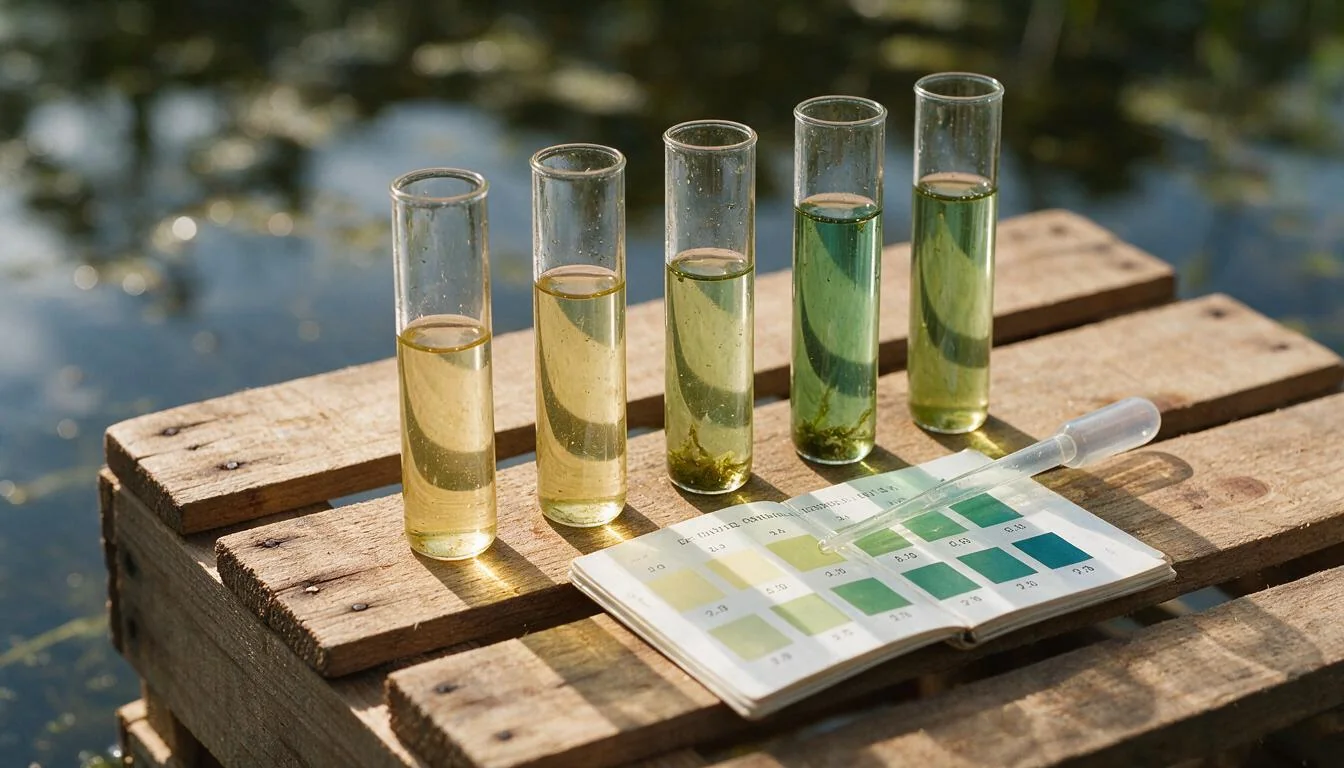
A basic liquid drop kit handles pH, ammonia, nitrite, and often hardness with decent precision. Alkalinity is usually a titration — count drops until the color flips — and that method is genuinely accurate. Buy a freshwater pond test kit with liquid reagents or a digital meter, keep it indoors, and check the expiration date each spring.
If you want real numbers on oxygen, plan on a dissolved oxygen test performed on site. Oxygen changes the moment the sample sits in a bucket, so a reading taken two hours later at the kitchen table is fiction.
Sampling Without Ruining the Sample
Most bad test results are bad samples, not bad chemistry. Careless pond water testing shows up as mystery spikes that vanish on the next round.
- Take water from mid-pond if you can reach it — an extended pole, a dock, or a boat beats an arm's-length grab at the bank, where runoff and shoreline mud skew everything.
- Sample 12 to 18 inches below the surface. Surface film concentrates oils, pollen, and algae; bottom water near the muck layer is a different world entirely.
- Rinse the bucket or bottle two or three times with the water you are about to sample. Detergent residue and leftover tap water both register.
- Sample before you feed, or at least an hour after. Ammonia peaks as digestion runs its course.
- Test oxygen and temperature at the pond, within a minute or two of pulling the water.
- For a lab test, keep the sample cool and dark and get it to the lab within about 24 hours. Warm samples grow their own chemistry on the drive.
Write the results down with the date, time, and weather. A single sheet of numbers is a snapshot; twelve months of them is a management tool.
Reading Your Pond Test Kit Results
| Reading | Comfortable | Watch it | Act now |
|---|---|---|---|
| pH | 6.5–9.0 | 6.0–6.5 or 9.0–9.5 | under 6.0 or over 9.5 |
| Alkalinity | 50–150 mg/L | 20–50 mg/L | under 20 mg/L |
| Ammonia (toxic fraction) | 0 | 0.02–0.05 mg/L | above 0.05 mg/L |
| Nitrite | 0 | 0.25–0.5 mg/L | above 0.5 mg/L |
| Dissolved oxygen | 5+ ppm (6 ppm as a working target) | 4–6 ppm | under 4 ppm at dawn |
| Secchi depth | 18–36 in | 12–18 in | under 12 in |
Fish rarely die from a number. They die from how long the number lasts and what else is stacked on top of it.
Low oxygen plus high ammonia is a far worse combination than either alone, because damaged gills cannot extract oxygen from water that is already short of it. Nitrite hits hardest in soft, low-chloride water.
Low pH is most dangerous in late winter, when fish are already running on reserves. Hot afternoons with heavy algae and no wind are the classic setup for a summer kill.
Watch the fish as well as the kit. Fish hanging at the surface at sunrise, gulping, or refusing feed for two days in a row is data. Test again, earlier in the day, before you assume the problem is disease.
Fixes That Are Safe and Legal
The instinct to dump something in the pond is usually the wrong one. Most pond emergencies loosen up with oxygen, feeding discipline, and time.
- Add aeration. Running a diffuser or fountain overnight — not just during the day — prevents the dawn crash. See pond aeration explained for sizing and placement.
- Stop feeding until ammonia and nitrite read zero. Every pound of uneaten feed becomes ammonia within a day or two.
- Change part of the water only if your source water is clean and similar in temperature. A 25% swap helps; a 90% swap can shock fish worse than the ammonia did.
- Spread limestone if alkalinity and pH are both low. Agricultural lime applied at one to two tons per surface acre is the standard extension recommendation, and it works slowly.
- Cut the nutrient supply. A 30-foot unmowed buffer, keeping geese and livestock out, and fixing septic systems do more than any additive.
- Treat plants carefully. Aquatic herbicides are regulated, some require a state permit, and killing a pond full of vegetation at once strips the oxygen out overnight. Read the label and check your state rules first.
- Never use aquarium medications, bleach, or dyes blindly. Off-label chemical use in a pond is illegal in some states and lethal in all of them when mis-dosed.
Ponds also carry a natural ceiling on how many fish they can support, and a pond that tests clean with fish dying can simply be overstocked. That is a stocking question, not a chemistry question.
The Honest Caveat
A pond is a moving target. Dissolved oxygen, pH, and temperature drift every single day, and alkalinity, nutrient load, and fish biomass shift across the seasons. Testing once, getting a good number, and declaring victory is the most common mistake in pond keeping.
What you are really building is a baseline. Ten months of morning readings tell you what your pond does after a rain, after a hot spell, and under ice. Then one odd number means something, because you know what normal looks like for your water and nobody else's.
FAQ
How often should I test my pond water?
Weekly when the pond is warm, newly stocked, or being fed heavy, and monthly through the cold months if the pond stays open. Test more often — daily — whenever fish are acting strange or you have just treated for weeds.
What is a safe ammonia level in a backyard pond?
Zero is the target. Total ammonia nitrogen above about 0.05 mg/L of the un-ionized form is where chronic damage starts, and pH and temperature control how much of your reading is that toxic form. At pH 6.5 a substantial total ammonia reading may be harmless; at 8.5 a much smaller one is not.
Does pond pH change during the day?
Enough to matter. Write the dawn reading and the late-afternoon reading on the same line of your log, each with its own timestamp, so the day's spread lands in one entry instead of two unrelated numbers.
A rise of a point or less is ordinary in a fertile pond; a wider swing usually points to heavy algae and thin buffering, which leaves fish on an oxygen knife edge every night. Pond water testing only reveals that pattern when the hours stay fixed.
Are test strips accurate enough for a pond?
Not for anything you plan to dose against. Most ammonia strips resolve no finer than 0.25 mg/L steps, so a pond moving from safe to dangerous can still show the same colour block.
Keep the tube sealed with its desiccant, store it indoors rather than in a shed, and write the expiry date on the lid so tired strips get replaced. A strip is fine as a weekly screen; reach for liquid reagents or a meter when you need a number you can act on.
What dissolved oxygen level do bass and bluegill need?
Roughly 5 ppm or better for warmwater species, with 6 ppm as a comfortable working target. Trout stocked in a pond need about 6.5 ppm even in summer. Below 4 ppm is chronic stress, and below 3 ppm fish start dying — most often in the hour before dawn.
Can I fix low alkalinity without adding chemicals?
Agricultural limestone is the standard fix, applied in late fall or winter at one to two tons per surface acre for a typical farm pond. It raises alkalinity slowly, which is what you want, and it is safe for fish. Avoid quick lime and any product sold without a guaranteed calcium carbonate equivalent.
The Bottom Line
Testing pond water is a habit, not an event. Buy a liquid kit, sample mid-pond at 12 to 18 inches, write down the time of day with every number, and test oxygen before sunrise when something looks wrong.
Judge each reading against the ranges above, then act with oxygen, feeding, and limestone before you reach for a bottle of anything. If your fish keep dying on clean numbers, brush up on keeping fish alive after the catch.