King Salmon Guide: Identifying and Catching Chinook Salmon in US Waters
A big king grabs your lure in a Columbia River tidewater eddy and the next few minutes turn into a blur of drag and backing.
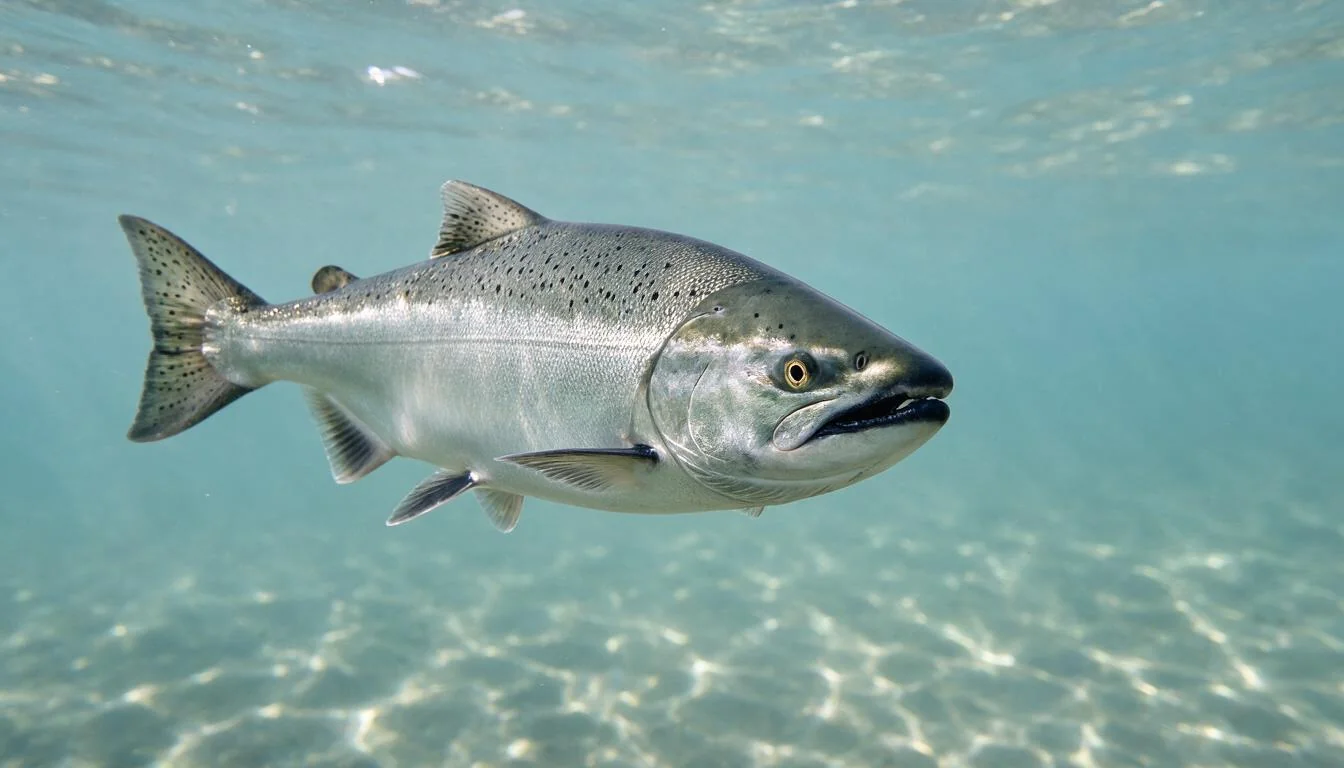
Chinook salmon (Oncorhynchus tshawytscha) — the king salmon — is the largest of the Pacific salmon: black gums, spots on both tail lobes, and a native range from California rivers to Alaska that now includes stocked Great Lakes harbors.
Nothing else in the Pacific salmon family comes close on weight, and few fish in North American fresh water fight longer. Unlike their ocean-run cousin the steelhead, kings get exactly one spawning run and then they're done. Here's how to recognize one, read its timing, and fish for it.
Chinook Salmon Identification: The Marks That Actually Work
Three features separate a king from everything else in the water. The gums where the teeth meet the lower jaw are black, and the inside of the mouth is dark, which is why coastal anglers call immature fish blackmouths.
Chinook salmon also carry large black spots across the back, the dorsal fin, and both lobes of the tail. That tail spotting matters in a minute. The tail itself shows silver.
Count fin rays if you want hard confirmation. Kings run 13 to 19 anal fin rays, 10 to 14 dorsal soft rays, and 67 to 75 vertebrae. Big adults look fusiform and noticeably compressed side to side.
Flesh color is a separate question entirely. Kings come red or white, and the difference is genetic rather than dietary, so a few river systems produce mostly white-fleshed fish while others produce almost none.
Once they reach the spawning grounds, adults shift to olive-brown and maroon tones and males grow a hooked jaw. The spots stay put.
Chinook vs Coho: The 60-Second Check
Autumn rivers carry both species, and misreading one is expensive when only coho are legal to keep. Start with the gumline. Kings have a dark mouth with black gums; coho have a black mouth with a white gumline, the pattern Oregon's fish and wildlife agency describes as Oreo.
Tail spotting settles most remaining arguments. Coho wear spots on the upper lobe of the tail only. Kings spot both lobes. Kings also show prominent, well-developed teeth and average-sized scales.
Size is a hint, never proof. Coho top out far below king weights, but a small jack male can fool you in flat light, so open the mouth before you net anything.
The Chinook Life Cycle: One Trip, Then the End
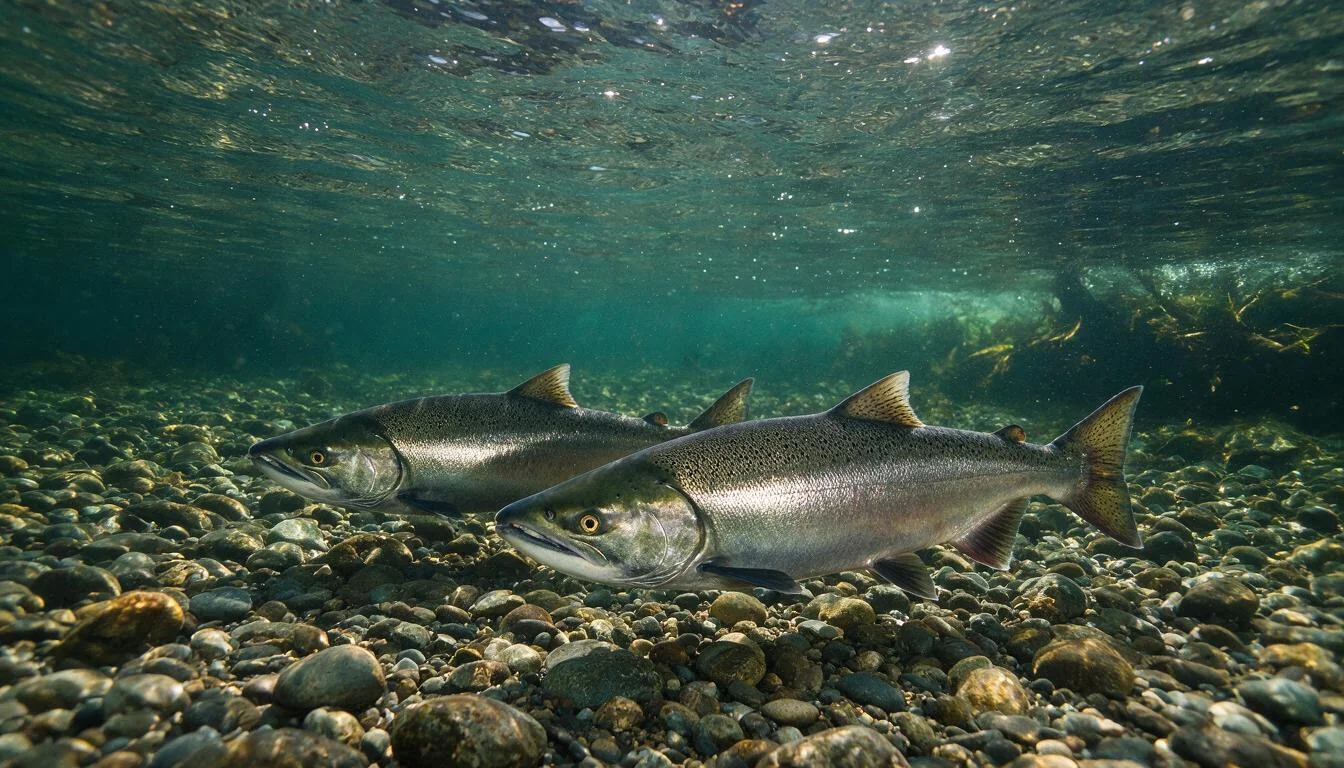
A female digs a redd in clean gravel, drops her eggs, and a male fertilizes them. Adults die within days to weeks of spawning. Kings don't get a second season the way a brown trout might, and their carcasses feed the river that raised them.
Eggs incubate through winter. Alevins live in the gravel on a yolk sac, then emerge as fry in spring. From that point the species splits into two distinct life-history forms.
Stream-type juveniles spend a full year in fresh water before migrating to sea. They typically enter rivers as immature adults in spring or summer and then hold in deep, cold pools for weeks or months before spawning in fall.
Ocean-type juveniles drop downstream within months, sometimes days, and return in summer or fall to spawn soon after arriving. Most populations south of roughly 56 degrees north latitude follow the ocean-type pattern.
At sea, kings feed for one to six years on forage fish, squid, and crustaceans. They mature anywhere between age two and age seven, most often at three or four.
Salmon Run Timing: Why No Single Month Works
A run is named for the season when most adults leave salt water, and a single river can carry more than one run. Biologists sort them as spring, summer, fall, and in a few places winter. The calendar shifts with the stock, the drainage, and the year.
Spring kings in some Washington rivers enter fresh water as early as March and hold in cold pools until they spawn in late summer. Fall fish often spawn within days or weeks of arrival, yet fall entry itself can stretch from July into December depending on the river.
California's Sacramento system shows the spread. State biologists list fall-run adults moving upstream from July through December, plus a winter-run that spawns from mid-April into August on cold reservoir releases.
Alaska tends to be simpler. Most streams there see a single run moving between May and July. Water temperature matters as much as the date, since holding adults do best below 60°F and egg incubation above 56°F costs survival.
So there is no universal king month, only your drainage's own schedule. Treat any national "salmon season" claim with suspicion.
Where Kings Live: California to Alaska, Plus the Great Lakes
The native range on this continent stretches from Monterey Bay, California north to the Chukchi Sea, with a mirror population along Asia's coast from Japan to Siberia. Alaska remains the stronghold, and the species has been that state's official fish since 1963.
California holds the southernmost runs. The Columbia, Snake, and Sacramento systems anchor the Lower 48 fisheries, and big coastal rivers in Oregon and Washington support both spring and fall returns.
The Great Lakes are a different story. Agencies stocked Chinook salmon there as early as the 1870s, but Michigan's 1967 plants finally took hold once alewife forage was available. Kings now dominate that basin's salmon fishery, and wild reproduction supplies a large share of the catch in some areas.
Michigan's state record weighed 47.86 pounds and measured 47.5 inches, taken from Lake Michigan in 2021. The lake's other big predator, the lake trout, grows slower and lives far longer. Kings burn hot and short by comparison.
Size, Records, and the Word "Tyee"
Mature kings typically run about 3 feet and 30 pounds. The ceiling is absurd: NOAA lists a maximum around 4.9 feet and 129 pounds, and Alaska's wildlife agency cites a 126-pound fish from a Petersburg commercial trap in 1949 as the heaviest ever recorded.
The rod-and-reel mark is cleaner. Les Anderson landed a 97-pound 4-ounce king from Alaska's Kenai River on May 17, 1985, and it still stands as the IGFA all-tackle world record. Nothing close has come since.
Tyee is a coastal British Columbia word for any king of 30 pounds or better. The Tyee Club of British Columbia has weighed qualifying fish at that threshold for generations, and the label attaches most often to big spring and summer fish in BC waters.
In the United States, king is simply the everyday name, alongside spring salmon and blackmouth. Alaskan anglers say kings. Fall-run and spring-run labels describe timing rather than different animals, so a fall king and a spring tyee are the same species on different schedules.
Small males that mature after a single winter at sea are called jacks. They can weigh under 4 pounds and are usually released.
How Anglers Target Kings: Trolling, Plugs, and Flies
King salmon fishing rewards depth control more than any particular lure. In the ocean and on the big lakes, that means downriggers, divers, and weighted lines carrying a flasher-and-bait or flasher-and-fly combo down where the kings sit, which is usually well beneath the coho.
Tidewater anglers troll cut-plug herring or spoons on a slow boat, working the current seams near a river mouth. Washington's Buoy 10 fishery at the Columbia mouth is built on exactly that approach.
In rivers, the classic move is back-trolling: point the boat downstream and let a large diving plug wobble through a holding pool, often with a fillet wrapped on the belly for scent. Anchored anglers back-bounce cured eggs or sand shrimp along the bottom instead, and bank anglers plunk the same baits in a migration lane.
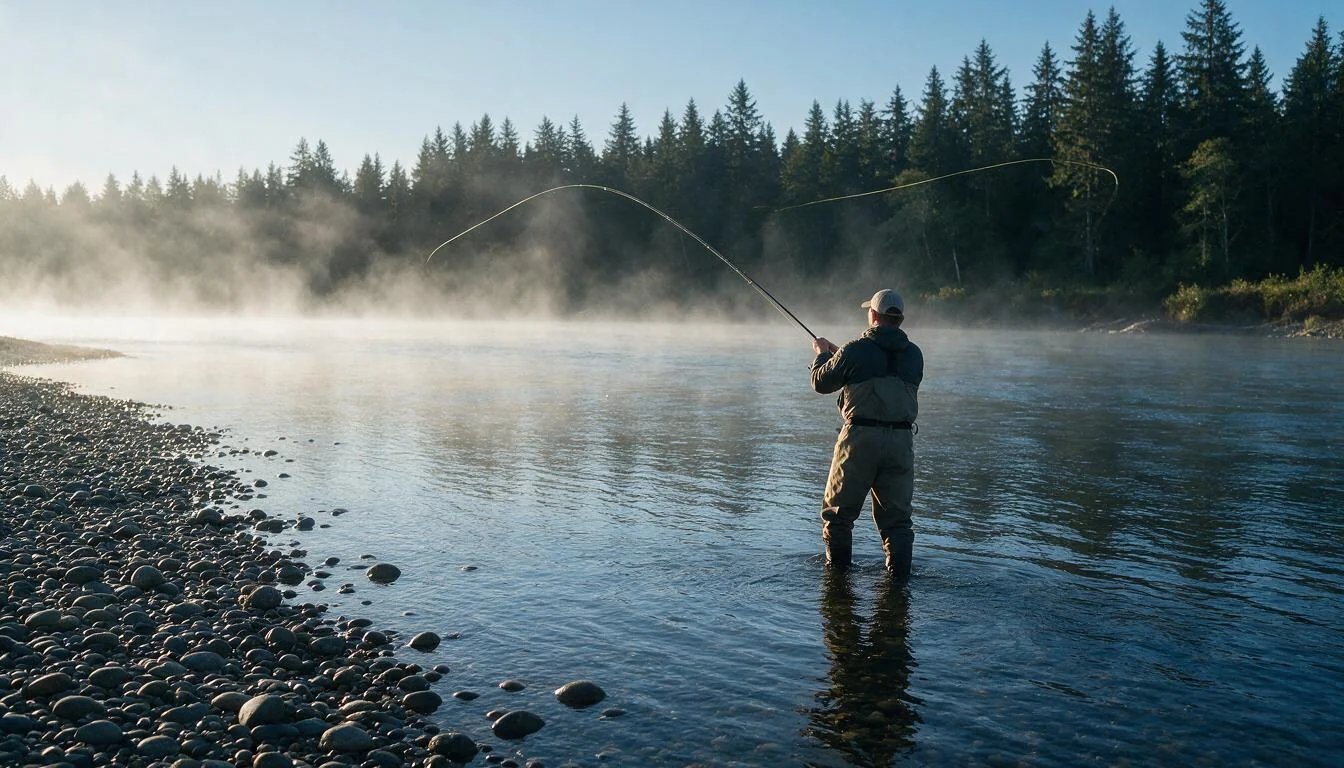
Summer and fall kings in clear water will take a swung fly, and a sink-tip line is what carries a big streamer or egg pattern into the lower third of the water column, usually where the fish are sitting.
Regulations vary widely by state and river. Many West Coast fisheries are hatchery-only for kings, so check whether the adipose fin has been clipped, and confirm minimum size limits before you keep a fish.
FAQ
Is a chinook the same fish as a king salmon?
Yes. King, blackmouth, spring salmon, quinnat, and tyee all point at Oncorhynchus tshawytscha. Alaska made the species its official state fish in 1963, and Alaskans almost always call it a king. The names describe one animal, not regional subspecies.
How do you tell a king from a coho?
Gumline first, both tail lobes second — then check the adipose fin. Many West Coast rivers are hatchery-only for kings, so a clipped adipose means you can keep the fish and an intact one means release it. Coho rarely pass 15 pounds while kings routinely do, so a fish over 20 pounds is almost certainly a king.
What is the largest king salmon ever caught?
The IGFA all-tackle record is Les Anderson's 97-pound 4-ounce Kenai River king from May 17, 1985, and the heaviest ever recorded is a 126-pound commercial fish from a Petersburg trap in 1949. The Great Lakes mark is far smaller — Michigan's 47.86-pound king from Lake Michigan in 2021.
When do kings run?
It depends entirely on the stock. Some Washington and California spring runs enter rivers in March and hold all summer, while fall runs may enter anywhere from July to December. Alaska's streams mostly see one run from May through July. Fish your own drainage, and read the water rather than the calendar: adults hold best below 60°F, so a warm September pushes fall kings upstream at night while a cold spring stalls them in the lower river for weeks.
Do kings die after spawning?
Yes. Every Pacific salmon is semelparous, meaning it spawns once and dies, usually within days to a few weeks. The carcasses release marine nutrients into the river, which supports the juveniles that hatch from the same gravel.
Can you catch kings in the Great Lakes?
Yes. Kings have been stocked in the Great Lakes since the 1870s and spread widely after Michigan's 1967 plants. They now carry trolling fisheries on lakes Michigan, Huron, and Ontario, with natural reproduction supplying much of the catch in some areas.
The Bottom Line
Kings are the heavyweight of the Pacific salmon family, and they punish sloppy presentations. Learn the black gums, learn your home river's run timing, and get your bait or plug down near the bottom where fish hold.
That alone puts you ahead of most anglers on the water. To compare them against their trout relatives, start with the rainbow trout, which shares their genus and much of their speed.