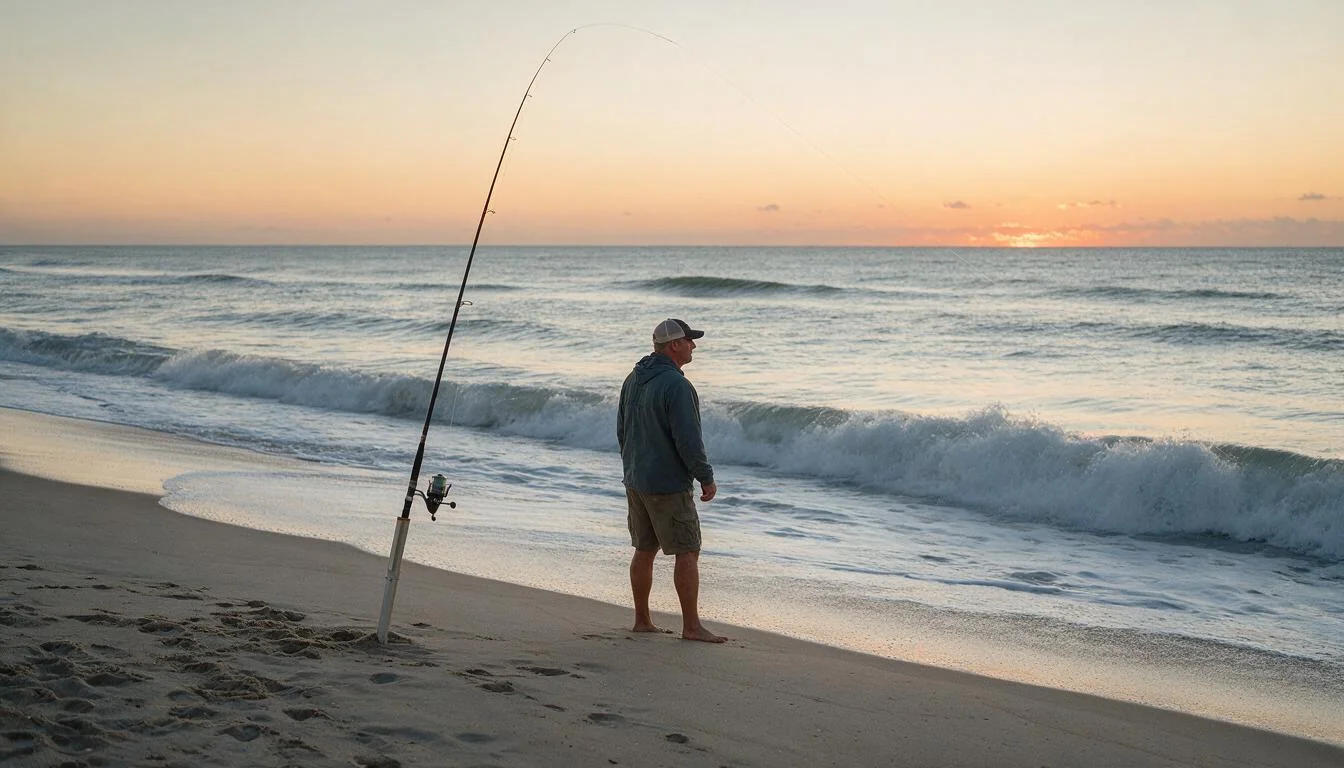
Surf Fishing Basics: How to Read a Beach and Catch More From Shore
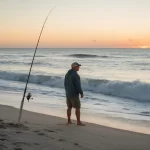
Standing on the sand with a rod in your hand is the easy part. Catching something is what takes a plan, and most surf fishing for beginners starts the same way: a sinker hurled as far as possible, in a straight line, into water nobody actually looked at.
The anglers who go home with fish do two things differently. They read the beach before they rig up, and they fish when the water is moving. Rod length, sinker style, bait versus lure — all of that is secondary tuning.
This guide covers the structure under the waves, a sensible beginner outfit, bait choices, the saltwater realities nobody warns you about, and the paperwork. If you are still deciding whether the ocean suits you, our freshwater vs saltwater fishing comparison is the honest place to start.
Read the Beach Before You Rig Up
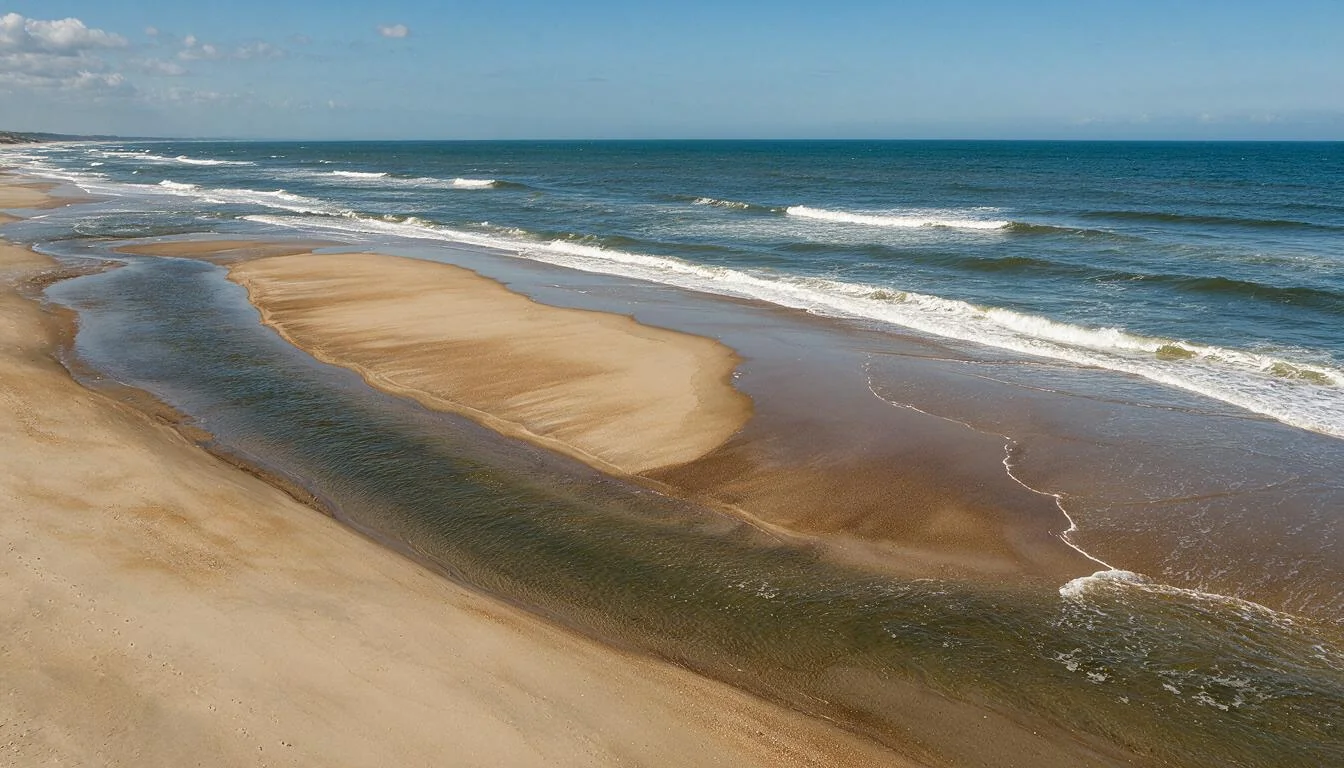
Stop at the top of the dune and spend five minutes looking instead of casting. From up there the whole pattern is visible: where waves roll in unbroken, where they stack up and crash, where the water runs off-color or churns in two directions at once.
Waves break over shallow water and slide over deep water. That single fact is most of reading the beach. White water in a straight line means sand below it.
A gap in that white water — a spot where wave after wave refuses to break — is deeper water. That is a hole, a cut, or the mouth of a trough. Before you move on, put one cast into it.
Color helps on calm days. Shallow sand reads light green or tan. Deeper water goes dark blue-green or gray.
Edges matter more than raw depth. A slough is a deeper gutter running parallel to the beach, and it has edges. A point of sand has edges. Bait collects along them, and predators patrol them because current delivers food without costing much energy.
Low tide is the best time to learn all of this. The bars expose, the troughs drain, and the layout of the bottom is right there in front of you. Pick a landmark, mark the spot, and come back to fish it on the high.
Sandbars and Cuts: The Highways Fish Use
On any ocean beach with decent wave action you will find a repeating pattern of sandbars and cuts. The outer bar can sit anywhere from about 30 yards to well over 100 yards out, depending on the beach. Between the bar and the dry sand runs a trough, where most fish spend most of their time.
A cut is a low spot in the bar, worn open by water draining off the beach. It works like a doorway. Fish use cuts to move from open water into the trough, then ride that trough up and down the beach in both directions.
This is where the old line about rip currents comes from. A rip current is more than a hazard — it is a conveyor moving food seaward, with the strongest flow down the middle and current seams along both sides. Predators sit on those seams, where bait arrives with almost no effort on their part.
You do not need to reach the horizon. The first trough often sits 20 to 50 feet off the sand, and fish feed in it in just a few feet of water. A short, accurate cast into the deep edge beats a long cast into flat sand every trip.
When you find a cut, fish it from both sides. The upcurrent side usually outproduces the downcurrent side, because bait drifts down into it first.
Tides for Surf Fishing: Moving Water Beats the Clock
Anglers argue about the best hour of the day, but tides for surf fishing matter more than the bite clock. Fish feed when water moves, because moving water moves food. Slack water is a lull for them and for you.
The classic window runs from about two hours before high tide through the first hour or two after. Rising water reaches sand, shell, and mud that sat dry for hours, exposing sand fleas, crabs, and worms that fish rarely get at low water.
A falling tide is not a write-off. As water drops, the beach reveals its structure again, and the deeper water on the far side of the outer bar gets easier to reach. On plenty of beaches the last two hours of the drop are the best bite of the day.
What kills a trip is a big tide range with no flow, or water so high that your trough flattens out under a sheet of calm. Watch stage and current, not just the numbers.
Tidal timing also shifts from place to place, so use predictions for the exact beach rather than the nearest city. An inlet or a long stretch of sand can behave differently from the harbor a few miles away.
Water temperature matters too. Cold water in the 40s and 50s slows everything down; the same beach in the 70s fishes like a different world.
Surf Rod Setup, Explained by Job
Every piece on a beginner surf rod setup has one job. Get them roughly right and you can fish most beach conditions without upgrading anything.
Rod. An all-around rod runs 9 to 11 feet, and 10 feet is the common sweet spot: long enough for distance, short enough to cast all day. If you plan to soak heavy bait in rough water, step up to a 10- to 12-foot medium-heavy rod that handles 5- to 8-ounce sinkers.
Reel. A 4,500 to 6,500 size spinning reel with a smooth drag suits that rod. You want enough spool capacity that a long run does not spool you.
Line. Thirty-pound braid on a 10-foot spinning outfit gives you casting distance and capacity without the stretch that buries a hook. Matching line to conditions gets its own treatment in our fishing line selection guide.
Shock leader. A cast with a heavy sinker stores real energy, and it has to go somewhere. A shock leader is a longer length of heavier mono, sized at roughly 10 pounds of leader per ounce of sinker – 50 to 80 pounds for 5- to 8-ounce weights. It absorbs that load and adds abrasion protection on shell and rock.
Sinkers. Pyramid sinkers dig into sand and hold in moderate surf. Sputnik-style weights with wire arms grip harder and are the answer when current rolls pyramids down the beach.
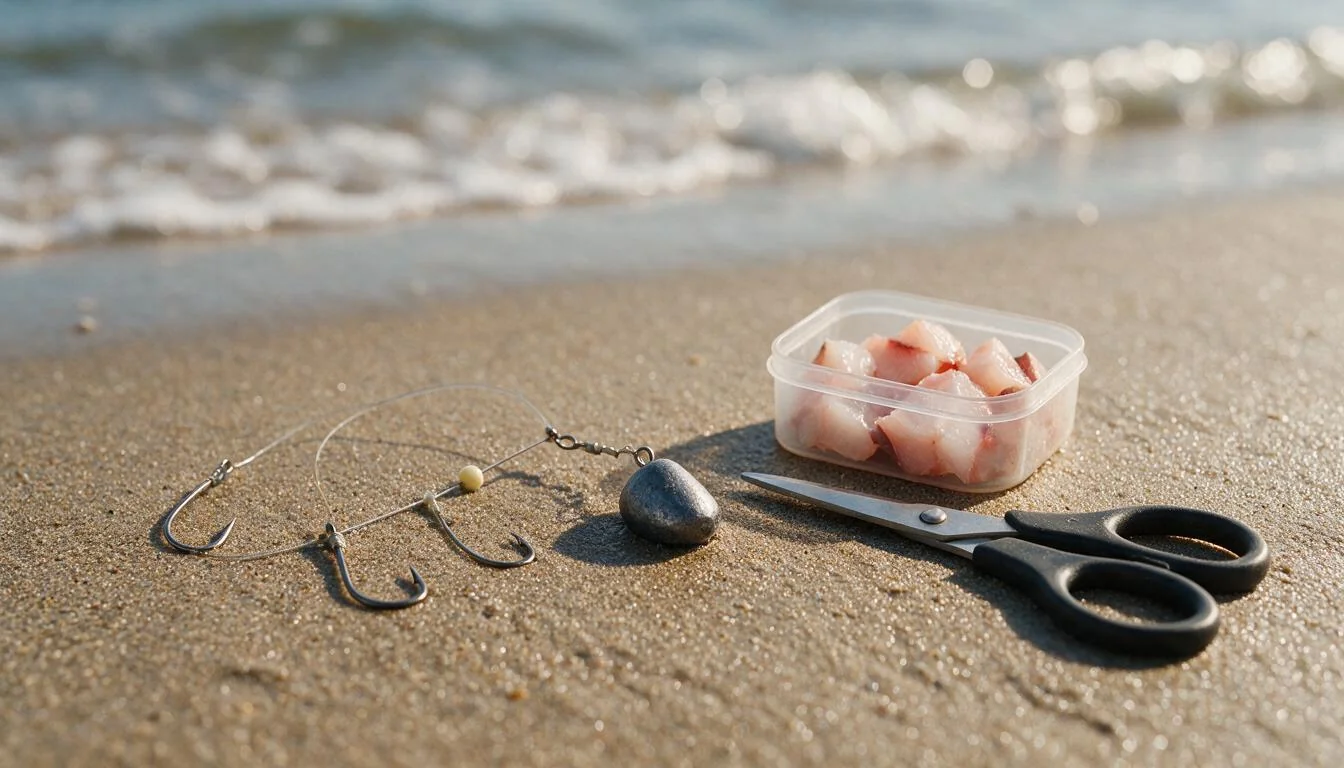
Rigs. A hi-lo (double dropper) rig fishes two small hooks for whiting, pompano, croaker, and spot. A fish-finder rig slides the sinker on the main line, so a fish can pick up bait without feeling the weight. That version suits drum, striped bass, and other larger fish.
Cut Bait vs Lures: Let the Conditions Choose
Cut bait vs lures is the decision that shapes the whole trip. Neither wins on every beach, and the water usually tells you which one to tie on.
Cut bait — mullet, menhaden, shrimp, squid, or strips of bluefish — works by scent. It soaks in place and lays a trail through the current. Muddy water after a blow, heavy surf, and fish spread thin across a flat all favor bait. A fish that follows its nose finds you.
Lures work by search. A metal spoon, a bucktail, a swimming plug, or a soft plastic covers water and trips reaction strikes. Clear water, visible bait, diving birds, and fish pushing bait against the beach are lure conditions.
Distance decides a lot of this. Bait anglers can soak a rig in a cut and wait for the tide to deliver customers. Lure casters usually have to walk the beach to find fish, and on the first trough that walk pays off more than any max-distance cast.
Carry both. Start with bait to learn whether fish are around, then switch to a lure once you know where they are feeding.
Salt, Sand, Safety, and Paperwork
Saltwater ruins tackle that never gets rinsed. After every trip, spray the reel and wipe the rod guides with fresh water, back the drag off, and let everything dry before it goes back in the bag. Sand is worse than salt: one grain grinding between gears turns a smooth reel into a crunchy one.
Most states require a saltwater fishing license, registry, or endorsement for anglers 16 and older, and the specifics differ by state. New Jersey runs a free annual registry rather than a license. Massachusetts requires a recreational saltwater permit. Check your state's marine fisheries agency before you fish, and do not assume a freshwater license covers the coast.
Access carries rules too. Many town beaches allow shore fishing but restrict it during swimming season. Some federal seashores require a permit for driving on the sand — Cape Hatteras, Cape Lookout, and Cape Cod all issue off-road vehicle permits.
Then there is the ocean itself. Rip currents are the real danger. If one pulls you out, stay calm, swim parallel to the beach until you are clear, then angle back in. Check the surf zone forecast, never wade deeper than you can stand in rough surf, and tell someone where you are fishing.
The Fish You Will Actually Meet
Which species show up depends on the coast, so plan around your region instead of a wish list.
Atlantic beaches offer striped bass, bluefish, weakfish, summer flounder, red and black drum, and small bottom feeders such as kingfish, croaker, and spot. The striped bass species guide covers that fishery in depth. Gulf beaches deliver pompano, red drum, whiting, speckled trout, and black drum.
Pacific surf anglers chase barred surfperch, corbina, and halibut on sandy beaches, with leopard sharks and bat rays in the mix. Florida and Texas sand adds jacks, ladyfish, and sharks after dark.
Match tackle to what actually swims there. A 6- to 8-ounce heaver rig is normal for bull drum. That same rig will bury a surfperch, and a pompano rig will not hold in an inlet on a big tide.
FAQ
What is the best tide to fish the surf?
Pull the tide table for the exact beach, not the nearest city, and note the time and height of each high and low. A swing of three feet or more pushes real current through the trough, so the bite runs with the fastest water. A small exchange barely moves anything, and slack water near the turn is dead time.
How far do I need to cast?
A 9- to 10-foot plug rod will launch a metal or bucktail 60 to 80 yards, and that is already past the first break on most beaches. A bait rod built for 5- to 8-ounce sinkers holds bottom around 40 to 60 yards in moderate surf, and pushing beyond that trade accuracy for yards you rarely need.
Is a 9-foot rod too short for the beach?
No. A typical 9-foot medium-heavy surf rod tops out around 4 ounces, with 3 ounces as the comfortable working weight. Hang 6 ounces on it and the rod lobs instead of loading, costing distance and risking the tip. Plan on 8-ounce sinkers in a running tide and you need a 10- or 11-foot heavy blank under your reel.
Can I catch fish in the surf with lures only?
Yes, and plenty of anglers do it. Metals and bucktails work best when the water is clear and bait is visible. Bait still has the edge in muddy water, heavy surf, or when fish are scattered and scent is the only way to call them in.
Do I need a license to fish from the beach?
Most states say yes. Some issue a full saltwater license; others use a free registry, as New Jersey does. Reciprocity between neighboring states varies, so check the agency website for the state whose water you are standing in.
Do I need waders to fish the surf?
Not in summer, when plenty of anglers simply wet-wade in shorts and old sneakers. Waders help in cold water and early spring, but they hold water if you go down. A wading belt matters more than the brand name on the chest.
The Bottom Line
Surf fishing rewards attention more than equipment. Read the structure, fish the moving water, and put your bait or lure where the current already concentrates food.
A 10-foot rod, 30-pound braid, a pyramid sinker, and one simple rig will catch fish on any US beach. Learn your tide table and your local layout, and pick a rod you can cast all day using our how to choose a fishing rod guide.