Pond Weed Control Begins With Knowing What Is Actually Growing
Most pond problems start as plant problems, and most plant problems start as nutrient problems. That order explains why pond weed control fails so often: owners reach for a jug before they know what is in the water. Stronger chemicals do not fix a nutrient-loaded pond, and they can backfire badly when you treat too much at once.
This guide covers the four plant groups found in American ponds, the nutrient loop feeding them, the oxygen crash that follows a careless spray, and the tools that hold up through a season. If you are new to the whole picture, start with our pond management basics guide — water quality and habitat come before weed work.
Identify the Four Plant Groups Before You Act
Aquatic plant identification is the step most owners skip, and it decides everything else. Nearly every plant in a farm pond falls into one of four groups, and a method that destroys one group may do nothing to another.
- Algae. Primitive plants with no true stems, leaves, or roots. Planktonic algae turn water pea-soup green, filamentous algae form stringy mats with trapped gas bubbles, and Chara or Nitella look like rooted weeds but feel gritty between your fingers.
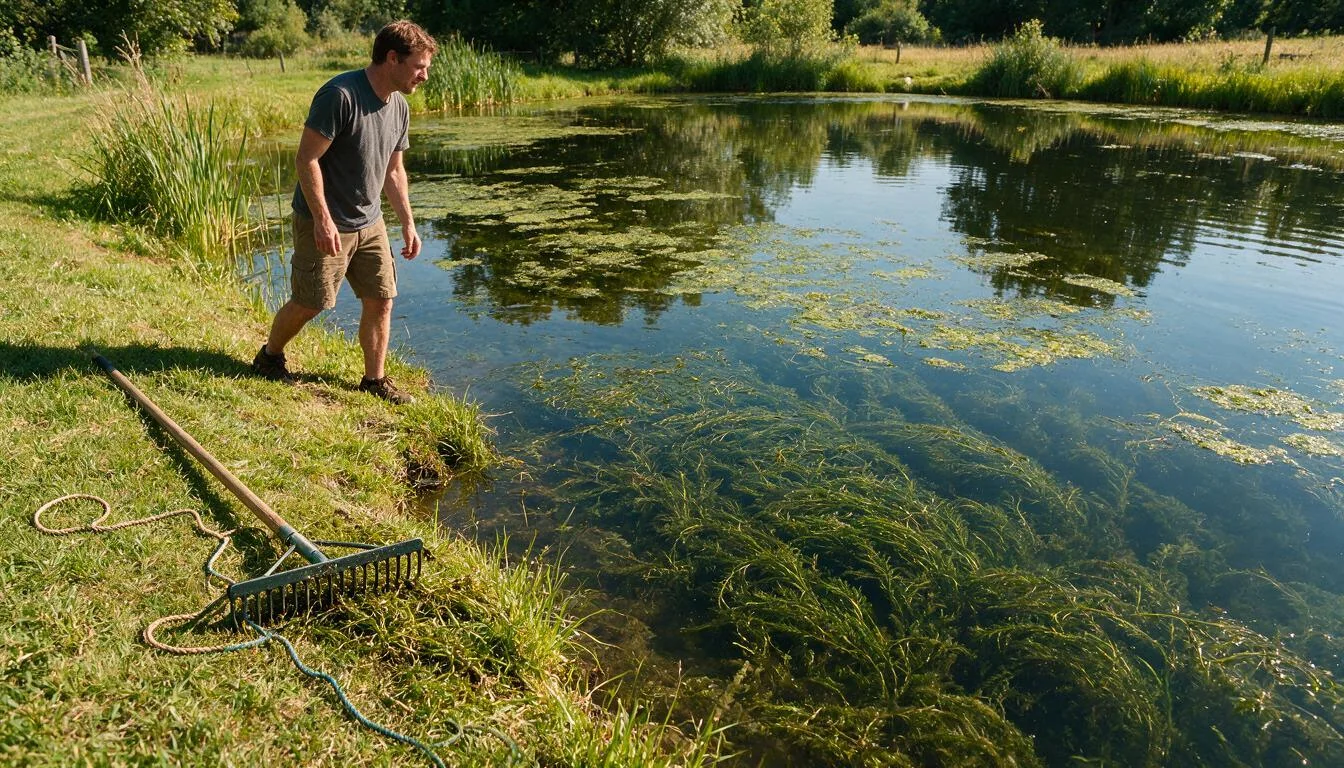
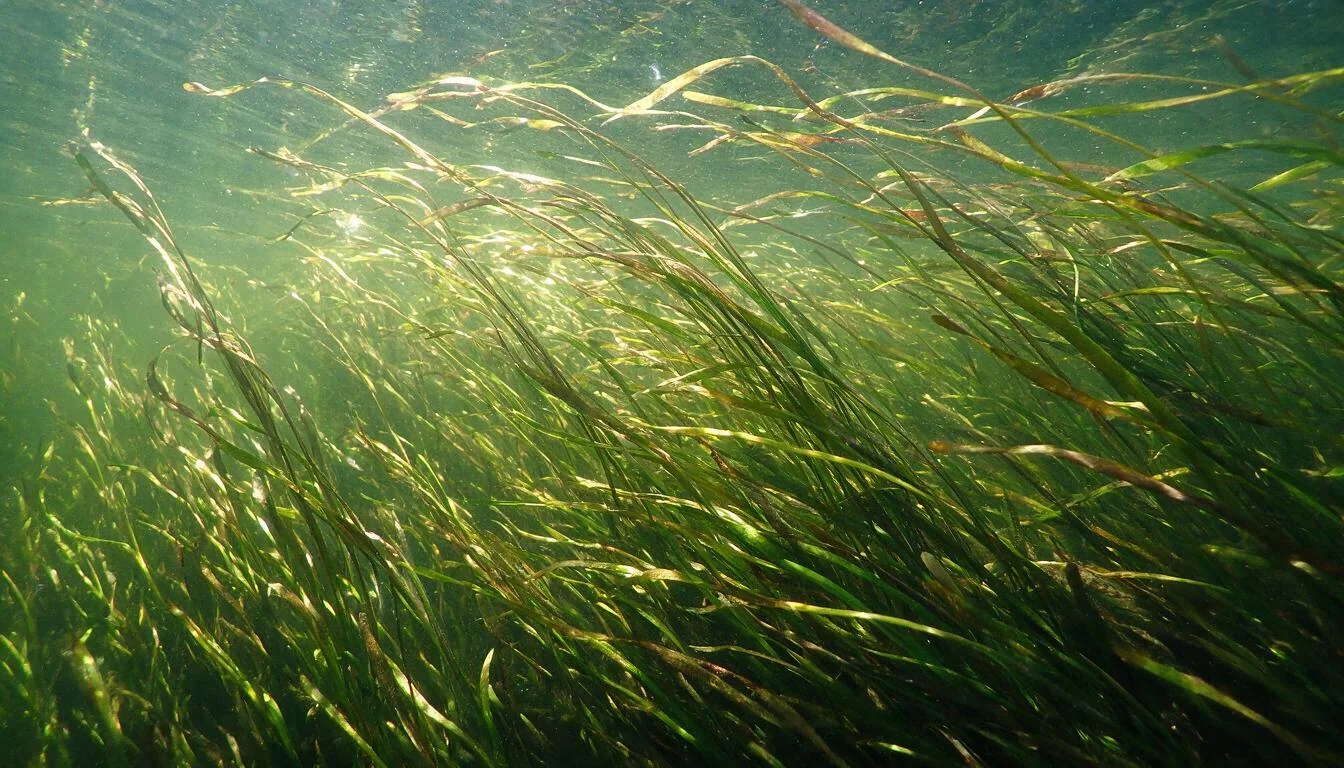
- Submerged weeds. Coontail, milfoil, naiad, pondweed, elodea. They root in the bottom and keep most of the plant underwater, usually in shallows where sunlight reaches the sediment, often less than 4 ft deep.
- Floating plants. Duckweed and watermeal drift free on the surface. Water lilies and spatterdock root in the bottom but hold leaves flat on the water.
- Emergent plants. Cattails, arrowhead, bulrush, water primrose. Roots in wet sediment, stems and leaves above the waterline, mostly along the bank.
The identification work pays off because each group answers to different tools. Grass carp graze submerged vegetation and ignore cattails. A shading dye does nothing for a plant holding its leaves in the air.
Algaecides will not touch rooted weeds, and a product meant for emergent foliage does nothing for a plankton bloom. Twenty minutes with a field guide beats a season of guessing.
The Nutrient Story Behind Every Weed Problem
Weeds are a symptom. The disease is nutrients, and in most ponds the two sources are runoff and the pond's own sediment. Understanding that loop is what separates real pond weed control from an annual fight.
Fertilizer from lawns, pastures, and crop fields is the big one. So are grass clippings, failing septic systems, livestock standing in the shallows, and waterfowl. Every fall, leaf litter drops in and breaks down into more of the same. If you feed fish heavily, uneaten feed and waste add to the load.
Phosphorus usually limits plant growth in freshwater, and it accumulates in the sediment over years. Rooted plants pull most of their nutrients from that muck rather than the water.
Cutting a bed of coontail therefore does not remove the fertilizer that built it. Cut plants also release nutrients back into the water as they decompose, so the pond keeps the bill either way.
Why Killing Too Much at Once Can Kill Fish Overnight
This is the mistake that turns a weed problem into a fish kill. Killed plants decompose, bacteria bloom, and that bacterial work consumes oxygen — a lot of it, especially at night when plants stop producing any.
Southern Regional Aquaculture Center guidance is blunt: treat only one-fourth to one-third of the total surface acreage at one time, watch the fish for a week afterward, and keep emergency aeration on hand.
Virginia's wildlife agency recommends never more than one-third of a pond, with at least two weeks between treatments. Texas A&M Extension puts the ceiling lower, at 20 to 25 percent per treatment.
Hot weather raises the stakes. Warm water holds less oxygen, plant biomass peaks, and a heavily infested pond can hold up to about 10 tons of vegetation per surface acre in 4 to 6 ft of water. Texas A&M says do not treat submerged vegetation above 85F (90F for shoreline plants left in the water).
The warning sign is fish gulping at the surface at sunrise. By then you have hours, not days. An aeration system is the difference between a partial loss and a pond-wide kill, so read our pond aeration guide before you plan a treatment.
One more thing to verify first: many aquatic herbicides require a state permit or a licensed applicator, and the rules differ by state.
What the Active Ingredients Actually Do
Herbicides group by chemistry, not by label color. The synthetic auxin 2,4-D and the systemic fluridone both work on many submerged and floating species, though fluridone acts slowly and needs long contact time.
Glyphosate suits emergent shoreline plants — cattails, arrowhead, primrose — where it goes on foliage above the waterline instead of into the pond. Copper complexes target algae rather than rooted plants, and they are the usual tool for filamentous mats and plankton blooms.
Contact and systemic behavior differ in ways that change your plan. A contact product burns only the tissue it touches and can leave roots alive, so regrowth from the same bed is common. A systemic product moves through the plant and may take weeks to show injury, so do not judge it early and dose again.
None of that changes the arithmetic. One treatment covers a quarter to a third of the surface at most, and many states require a permit or a licensed applicator for the products that work.
Mechanical Removal: Honest Work, Temporary Results
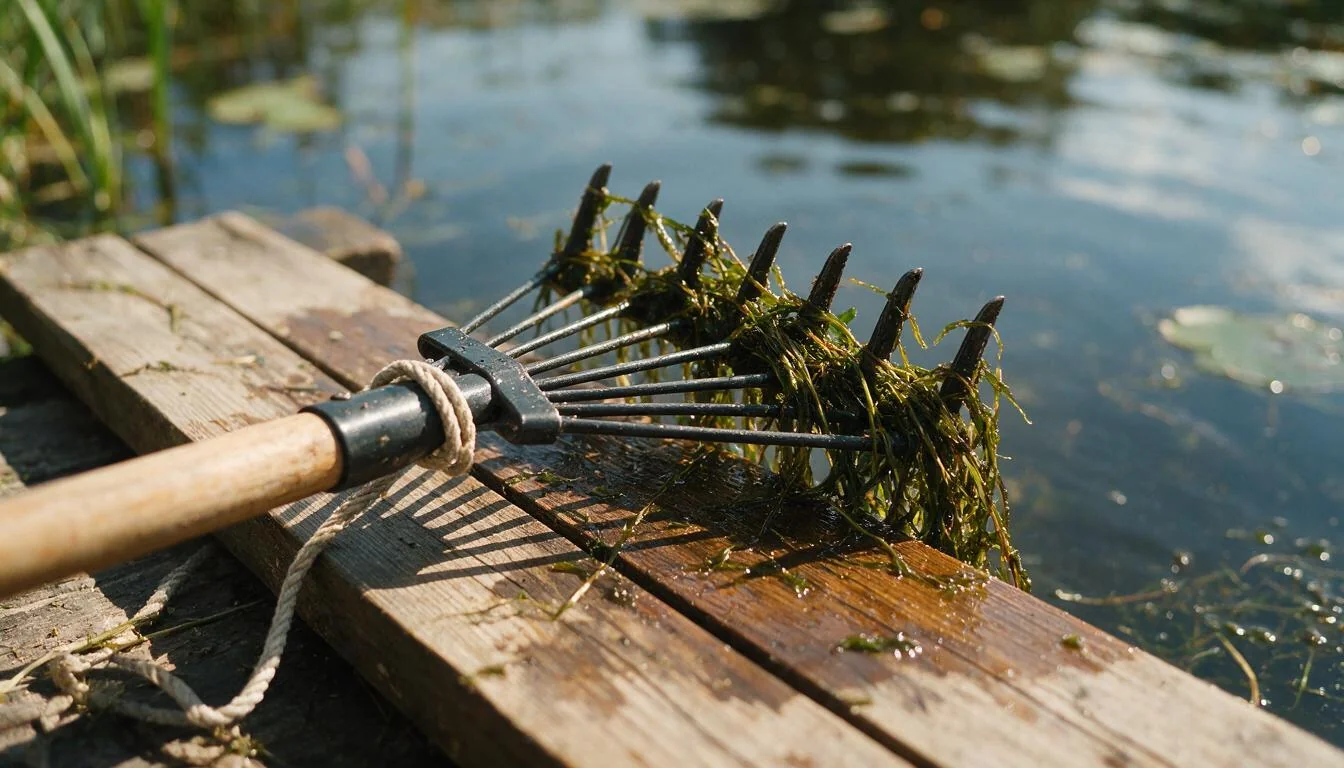
Rakes, weed cutters, hand pulling, bottom barriers, and winter drawdowns are the oldest forms of pond weed control, and most of them need no permit. They all have limits too.
Cutting and raking open water fast. Get the material out of the pond when you are done, because a pile of rotting weeds at the waterline puts the nutrients right back. Heavy fragment spreaders such as milfoil and hydrilla regrow from pieces, so cut those deliberately rather than casually.
Overwinter drawdown is the sleeper tool. Dropping the water level for weeks exposes sediment to freezing and drying, which knocks back many submerged species without chemicals, and it lets you repair banks while the pond is low.
What mechanical work cannot do is change the nutrient supply. In a shallow, sunlit bay, regrowth is a matter of weeks, and you will be back out there with a rake in July. Treat it as maintenance, not a cure.
Grass Carp: The Biological Option Comes With Paperwork
Grass carp eat plants for a living, and that is the appeal. The catch is legal: fertile diploid grass carp are banned in most states, and the fish you would stock are triploid — sterile, certified, and usually permit-controlled.
Texas requires a permit to possess, transport, or stock triploid grass carp. New York permits up to 15 fish per surface acre, and only in ponds of 5 acres or less that meet site conditions.
Ohio issues an annual permit and allows stocking in private waters only. North Carolina lets a receipt from a licensed distributor serve as the permit for private, self-contained ponds under 10 acres with 150 fish or fewer, provided there is no connection to public water and no way for the fish to escape.
Stocking guidance is conservative for a reason. Texas recommends about 5 fish per acre where plants cover half the surface or less, and up to 10 per acre above that.
Stock fish 10 to 12 inches long so bass and catfish cannot eat them, and stock in early spring. Control usually takes several years, sometimes longer in heavily vegetated ponds, with restocking typically needed every 5 to 7 years.
Stock too few and the tougher plants win. Stock too many and carp strip every submerged plant, which usually means green water and slower fish growth. Start light and add later. Our pond stocking guide covers rates and timing for the rest of the community.
Pond Dye and Shading: Cheap Prevention, Real Trade-Offs
Pond dye works by coloring the water so less light reaches the bottom. Fewer photons at the sediment means less submerged growth. That is the whole mechanism, and it only performs under specific conditions.
Timing matters more than dose. Ohio State Extension says dye has to go in during March or early April, before submerged plants germinate, then hold its strength through August.
Color fades from rain dilution, sunlight, and microbes, so plan on reapplying. Measure how deep a white object on a string disappears, and add dye when that depth grows by roughly 25 percent.
Dye fails in water shallower than about 2 ft, where light gets through anyway. It will not stop cattails or floating leaves. Ponds with a big watershed flush dye out the overflow.
Then the trade-off. Dark water suppresses plankton and aquatic insects, the base of the food chain, so fish growth can suffer. Ohio State Extension says not to dye a pond that already holds fish and a heavy weed or algae load.
Dye is also not an herbicide; it prevents new growth and does nothing to an established bed. Pouring it into a weedy pond blocks light to deep plants, kills them, and can set off the same oxygen crash.
The Design Fix That Ends Most Weed Problems
Most weed trouble traces back to how the pond was built. Wide shallow shelves along the bank are the classic culprit, because sunlight reaches the bottom and plants grow there all season.
New construction can fix it. Steepen the banks, cut back the shallow flats, and make sure part of the pond is deep enough — 8 to 10 ft or more — to stay cool and plant-free. A bowl-shaped pond with a narrow plant zone will outgrow one with a broad shelf every time.
You can retrofit the watershed too. Leave a buffer strip of tall, unmowed vegetation along the bank to filter runoff, divert roof and driveway drainage away from the pond, and fence livestock out of the shallows. None of it costs much, and all of it lowers the nutrient load every year.
Plant coverage of 20 to 30 percent is the target most extension programs use. That band feeds insects, shades shallow water, and buffers wave action, and the pond still fishes well. Zero plants sounds tidy and fishes badly, which is why clear water is never the real goal. Balance is.
FAQ
Algae vs weeds: how do I tell them apart?
Run a rake through the water and look at what comes up. Filamentous algae arrives as a slimy, shapeless clump with no stems, leaves, or roots, often holding trapped bubbles. A submerged weed brings up stems and leaves — and if it feels gritty instead of slick, you are probably holding Chara.
Why do the weeds come back in the same spot every year?
Because the roots and the nutrients stayed. Most submerged species spread from rhizomes and tubers that survive cutting and even drawdown, and each season's die-off returns nutrients to the sediment. Once a shallow shelf has a nutrient bank behind it, expect regrowth until you change the depth or the inflow.
Do I need a permit to use aquatic herbicide in my own pond?
Often, yes. Pennsylvania requires a state permit before herbicide goes into a private pond, and Wisconsin, Rhode Island, and Maine require permits too. Washington requires coverage under an aquatic pesticide general permit, applied by a licensed applicator. Check your state environmental or agriculture agency first.
How many grass carp should I put in a one-acre pond?
Your state permit sets the ceiling, so start there: turnaround runs from a few weeks to a full season, and some states issue carp permits on a spring-only calendar.
Certified triploid fish come from licensed distributors, often with a minimum order, a delivery window, and paperwork you keep on file. Once both are in hand, stock about 5 fish per acre where plants cover half the surface or less, and up to 10 per acre with heavier growth.
What is the safest time of year to treat?
Early in the growing season, while plants are growing fast and the water is cool. Warm water holds less oxygen, so a hot spell is the riskiest window — never treat above the temperature limit on the product label. Texas A&M says do not treat submerged vegetation above 85F (90F for shoreline plants left in the water).
Work in sections rather than all at once. A quarter to one-third of the surface per pass, with 10 days to two weeks between passes, and Texas A&M caps a single treatment at 20 to 25 percent.
On a 3-acre pond that is 0.75 to 1 acre per pass by the quarter-to-a-third guide, or 0.6 to 0.75 acre under the tighter A&M cap.
How much of my pond should be covered in plants?
Most extension programs aim for 20 to 30 percent coverage, which sets the open-water share at 70 to 80 percent. On a half-acre pond that leaves roughly 0.35 to 0.4 acre of fishable water.
At the low end of the range the pond casts wide open; at 30 percent the beds begin to draw the boundaries. Push past half and open water narrows to a lane, with bigger overnight oxygen swings from the plant mass.
The Bottom Line
Weeds are information, not an emergency. Identify the plant, treat a quarter to a third at a time, and keep aeration ready before anything goes in. Dyes and grass carp have trade-offs, and permits apply more often than owners expect. Aim for balance: our how to fish a lake guide covers the fishing side.